Phase Inverter Calculator
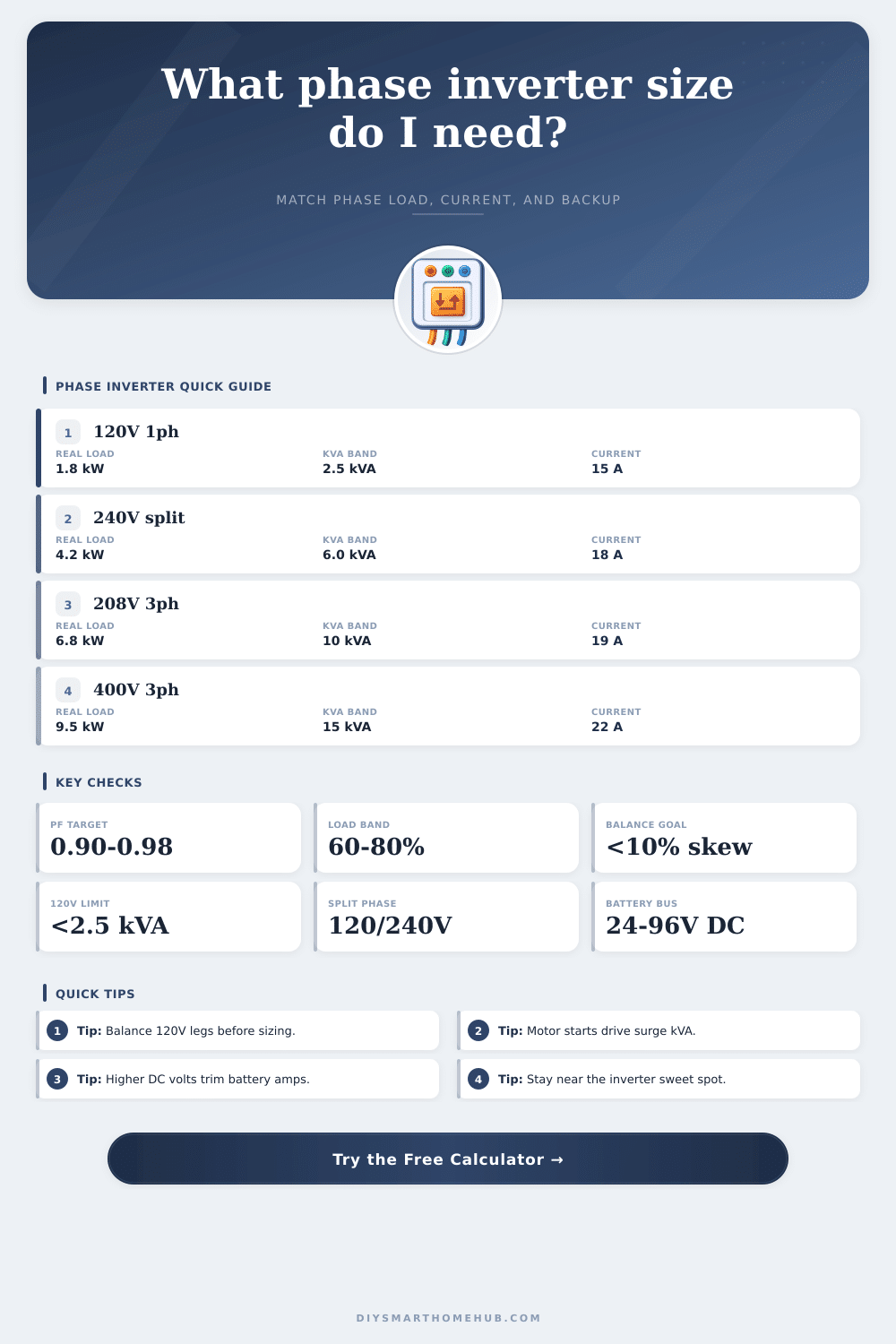
Translate home footprint, diversified smart-load density, power factor, phase balance, surge demand, and battery bus voltage into a realistic inverter class for small 120V shelves, 120/240V split-phase panels, or three-phase microgrid zones.
📌Phase Planning Presets
⚙Phase Inverter Inputs
Phase Inverter Recommendation
Run the calculator to translate diversified load, phase service, and backup runtime into a practical inverter size and battery-side current estimate.
📈Selected Inverter Snapshot
Estimated AC-to-DC conversion performance near the family sweet spot.
Short-term overload headroom available for startup events and brief current spikes.
Sizing target used so the chosen inverter does not operate too close to continuous maximum.
The phase architecture this inverter family is best aligned with before any compatibility warnings.
📑Phase Service Reference
| Service Type | Voltage | Current Equation | Best Home Use |
|---|---|---|---|
| 120V single-phase | 120V line-neutral | I = VA / 120 | Networking shelves, gate controls, compact backup loads |
| 230V single-phase | 230V line-neutral | I = VA / 230 | International smart homes, lighting panels, compact mini-split support |
| 240V single-phase | 240V line-line | I = VA / 240 | Pumps, workshops, and dedicated motor-backed branch circuits |
| 120/240V split-phase | 240V center-tapped | I = VA / 240 plus leg skew | North American homes with 120V circuits and selected 240V essentials |
| 208V three-phase | 208V line-line | I = VA / (1.732 x 208) | Detached shops, ADUs, and mixed automation loads with better phase sharing |
| 400V three-phase | 400V line-line | I = VA / (1.732 x 400) | Larger villas, outbuildings, and premium microgrid projects |
📊Smart Load Density Reference
| Protected Zone | Watts per sq ft | Typical PF | What It Includes |
|---|---|---|---|
| Router and hub closet | 1.5-2.2 | 0.96-0.99 | Modem, router, PoE switch, automation hub, battery charger overhead |
| Living essentials zone | 2.8-4.0 | 0.92-0.96 | TV, streaming box, lights, smart shades, low-start fans, device charging |
| Apartment core backup | 3.6-5.0 | 0.90-0.95 | Kitchen cold storage, internet, lighting, workstation, selected outlets |
| Workshop or utility bay | 5.5-7.2 | 0.84-0.92 | Task lighting, chargers, tools, dust extraction, pumps, smart relays |
| Motor-assisted comfort zone | 6.8-8.5 | 0.82-0.90 | Mini-splits, pumps, gate motors, ventilation, mixed automation gear |
📋Inverter Family Comparison
| Family | Eff. | Surge | Best Fit |
|---|---|---|---|
| Compact pure sine shelf | 91-93% | 1.8x | Light single-phase networking, lighting, and entertainment circuits |
| Low-frequency transformer | 89-91% | 2.7x | Resilient motor starts, pumps, compressors, and stubborn inductive loads |
| Hybrid split-phase | 94-96% | 2.0x | Essential panels needing 120V circuits plus a few strategic 240V loads |
| Rack UPS phase inverter | 92-94% | 1.6x | Server closets, camera racks, switches, NVRs, and low-inrush electronics |
| Motor-start inverter charger | 90-92% | 3.0x | Pool pumps, shop equipment, gate motors, and surge-dominant backup zones |
| Modular three-phase inverter | 95-97% | 2.1x | Balanced multi-structure loads and premium three-phase microgrids |
📅Common Smart Home Scenario Guide
| Scenario | Served Area | Typical Result | Phase Choice |
|---|---|---|---|
| Single room essentials | 168 sq ft | 1.0-1.5 kVA | 120V single-phase |
| Open plan living + office | 600 sq ft | 3-5 kVA | 120/240V split-phase |
| Apartment cold storage core | 800 sq ft | 4-6 kVA | 120/240V split-phase |
| Workshop with motors | 1200 sq ft | 7-10 kVA | 240V single or 208V three-phase |
| Whole-house essentials | 2000 sq ft | 8-12 kVA | 120/240V split-phase |
| Estate outbuilding cluster | 3000 sq ft | 12-18 kVA | 400V three-phase |
💡Phase Planning Tips
Split-phase systems often look undersized when one leg carries too many 120V devices. Rebalancing branch circuits can reduce the worst-leg current enough to stay within the same inverter class.
Pumps, mini-splits, and motorized shades can be quiet most of the day yet still define the inverter you need. The startup multiplier usually drives the jump from a compact unit to a transformer-based or motor-start model.
Selecting an inverter require a person to understand the specific loads that the inverter will have to carry. In many case, people will select an inverter that is more large for there needs. An inverter that is too large will be inefficient and will drain the battery faster.
A person has to select the inverter according to the need of the electrical loads and the electrical configuration of the power distribution system in a home. The electrical configuration of a home can differ based on the type of power that a person needs. In North American homes, the 120-volt branch typically use a split-phase system that includes an 240-volt outlet for large appliance.
How to Choose a Home Inverter
Single-phase power can be used to supply power to device like networking equipment. Three-phase power is used in workshops to supply power to tool. Split-phase systems use two power leg that supply power to the home.
The load on the two legs do not need to be balanced, as one leg will draw more power than the other. However, an unbalanced load can cause circuit breaker to trip. To avoid this, the electrical load has to be balanced on the leg of a split-phase system.
Another factor to consider when selecting an inverter is the load density. The load density will determine how many watt of power are required in a specific area of the home. For instance, the power load in a living room that contain TVs and other entertainment device will be different than the power load in the kitchen.
Although most device will draw little power when they are running alone, many device in a home can draw a large amount of power when they are all being used at the same time. Another factor to consider is the power factor of the device. For most electronic device, the power factor is close to 1.0.
However, device that contain motor will have a lower power factor. The power factor can impact the amount of apparent power that the inverter requires. Instead of using watt, the inverter will need to be sized in terms of kVA.
Many appliance require a startup surge that require more power at the initial start up than while it is running. For instance, the compressor within an air conditioning unit will require two or three times as much power when it starts up as when it is running. If the inverter dont have the head start to handle these startup surge, then it will not be able to start these appliance.
Inverters that use low-frequency technology tend to have more success starting these appliance because of the use of heavy transformer that can manage high level of current. In addition to this, the inverter can have a hybrid system wherein it can manage both 120-volt and 240-volt appliance. Another factor that affect the inverter is the battery voltage.
A 48-volt battery will require less current than a 24-volt battery to supply the same amount of power to a circuit. Because there will be less current in a 48-volt battery system, there will be less heat in those circuit and less voltage sag. Another consideration when purchasing battery is to include a growth reserve.
This will provide head start for adding more appliance to the circuit in the future. Should additional appliance be purchased, the growth reserve will allow the system to support them without having to change the entire electrical panel in the home. The size of the inverter that is required is based off the distinction between real power and apparent power.
Real power can be used by the appliance in a home. Apparent power include the reactive power created by motor in appliance like refrigerator. To ensure that the inverter will handle the electrical needs of a home, the user has to consider the apparent power when purchasing the inverter.
The inverter will need to be sized according to the voltage of the power service that is provided. For split-phase system, it is important to avoid placing all heavy appliance on one leg of the split-phase system. Predefined preset can help to determine what type of inverter a person needs.
For small closet with only networking equipment, a single-phase inverter can be used. For homes that contain more than 2,000 square foot, split-phase and hybrid inverter are recommended. If the house contain a workshop, a motor-start inverter will help to start the workshop tool when needed.
In addition to these preset, there are some recommendation that can be made through a physical inspection of the home. Count the number of electrical load that are to be used during a power outage. Separate the 120-volt electrical load from the 240-volt load.
Ensure that the inverter recieve proper ventilation to prevent the overheating of the device caused by too much heat and dust in the inverter system. By performing these step, the inverter will be able to function steady and provide power to essential appliance during a power outage.