Pellet Stove vs Propane Calculator
Estimate the same heating load through a pellet appliance and a propane appliance, then compare delivered heat, daily fuel draw, and backup runtime for the space you actually need to hold warm.
📍Preset Heating Scenarios
Both fuel paths serve the same design load. Area, ceiling height, shell tightness, exposure, runtime hours, and reserve margin shape the demand before the calculator converts that demand into pellets and propane.
📏Heating Load Inputs
Comparison Results
The calculator compares delivered heat, daily fuel demand, and on-site storage against the same load so you can see where pellet fuel and propane separate.
📊Heating Setup Snapshot
🛠Setup Reference Grid
Delivered Heat Benchmarks
| Fuel unit | Raw energy | Typical delivered | Use read |
|---|---|---|---|
| 10 lb pellets | 82,000 BTU | 61k-66k BTU | Short evening burn |
| 40 lb pellet bag | 328,000 BTU | 246k-266k BTU | Most daily reload plans |
| 1 gal propane | 91,500 BTU | 73k-87k BTU | Steady modulating heat |
| 20 lb cylinder | 430,000 BTU | 344k-391k BTU | Portable backup window |
Coverage and Capacity Guide
| Setup pair | Target area | Pellet output | Propane output |
|---|---|---|---|
| Compact insert pair | 350-700 sq ft | 26,000 BTU/hr | 18,000 BTU/hr |
| Living zone pair | 700-1,100 sq ft | 34,000 BTU/hr | 28,000 BTU/hr |
| Open-plan pair | 1,100-1,500 sq ft | 42,000 BTU/hr | 38,000 BTU/hr |
| Whole-home pair | 1,500-2,400 sq ft | 52,000 BTU/hr | 60,000 BTU/hr |
Pellet vs Propane Profile Notes
| Profile | Hourly load | Best fit | Watch for |
|---|---|---|---|
| Tight interior room | 18 BTU/sq ft | Short evening heat | Oversizing on mild days |
| Average family room | 24 BTU/sq ft | Steady comfort zone | Glass wall heat swings |
| Open plan | 28 BTU/sq ft | Long burns and recovery | Doorway air migration |
| Detached garage | 34 BTU/sq ft | Work sessions and freeze hold | Big overnight losses |
Common Project Size Comparisons
| Project | Area | Heat load | Daily fuel |
|---|---|---|---|
| Media den | 168 sq ft | 3,700-4,400 BTU/hr | 7-9 lb or 0.7 gal |
| Two-car workshop bay | 400 sq ft | 11,000-14,500 BTU/hr | 19-29 lb or 1.7 gal |
| Open living level | 1,100 sq ft | 29,000-36,000 BTU/hr | 54-84 lb or 5.1 gal |
| Whole-home outage hold | 2,000 sq ft | 46,000-58,000 BTU/hr | 92-138 lb or 8.4 gal |
Pellet bags and propane gallons should be compared after appliance efficiency is applied. That keeps the calculation focused on usable room heat instead of raw fuel energy alone.
A hopper can empty faster than a remote tank during long burns, while portable cylinders can beat pellets for quick standby use if runtime is short and the load is modest.
When you are to heat a space, you must consider the use of both wood pellet and propane fuel sources. Both of these fuels can provide heat to a space, but each fuel provide heat in different ways and requires different methods of storage. In deciding between wood pellets vs. Propane fuel for a heating appliance, you must consider a variety of factors regarding both fuel type, such as the amount of heat that each fuel provides, the amount of fuel that you will use during a specific runtime for your heating appliance, and the amount of fuel that you can store within your property.
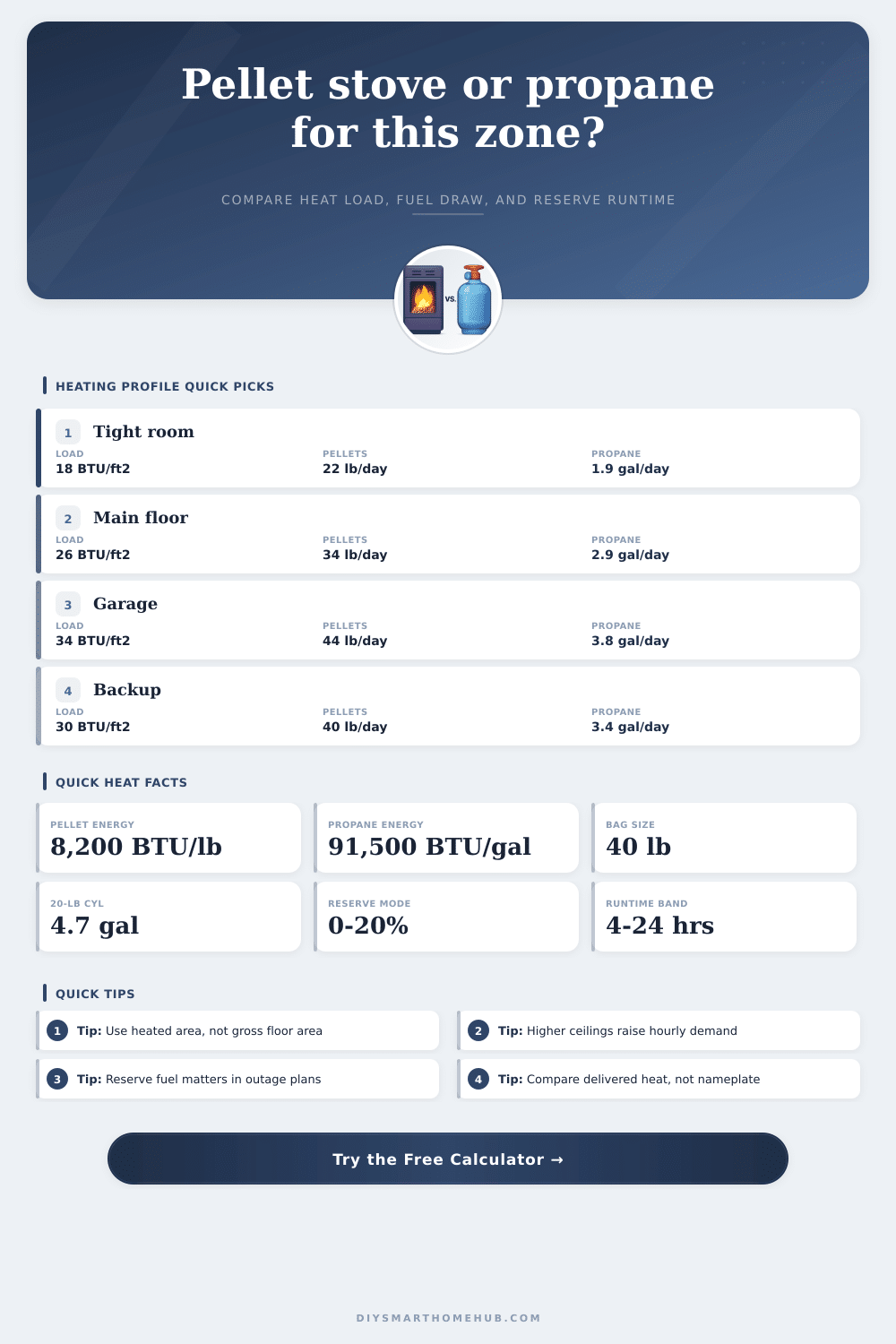
Wood pellets contain approximately 8,200 BTUs of heat per pound of fuel, while propane fuel contains approximately 91,500 BTUs of heat per gallon of fuel. However, you cannot compare these two fuel types based only on these numbers alone, because no heating appliance can reach 100% efficiency in converting the fuel to heat. For instance, pellet stoves typically release between 75% and 80% of the heat that is generated from the burning of the wood pellets, while propane burners typically release between 85% and 95% of the heat that is generated from the propane fuel due to the higher efficiency of propane heaters.
Choosing Between Wood Pellets and Propane
Thus, you must calculate the amount of heat that each type of fuel will actualy provide to your space. In order to calculate how much fuel you need to heat your space, you must consider the conditioned area size of the space that you intend to heat. For example, the conditioned area is the total number of cubic feet of air that you wish to heat to a certain temperature, such as 68 degrees.
Small enclosed rooms may require 18 BTUs of heat per square foot of area per hour of heating, while areas like a garage or sunroom may contain more BTUs need per square foot of area due to the difficulty of heating those spaces to the desired temperature. Additionally, spaces with high ceilings will require more BTUs to heat the floor areas of the space, as heat rise; a room with 12-foot ceilings will require more heat than a smaller room that has 8-foot ceilings. In addition to calculating BTUs per area, you must also calculate the runtime that your heating appliance will need to operate in order to calculate the amount of fuel that your heating appliance will use.
For instance, if you determine that your space requires 10,000 BTUs to heat the space, and your heating appliance will need to operate for four hour per day to provide that amount of heat, then the heating appliance will use less fuel than if it needed to operate for twenty-four hours per day. Finally, you should also calculate a reserve buffer of between 10% and 20% to the amount of fuel that you calculate for your space, as a buffer against potential weather conditions that may be colder than you had originally calculate for your heating needs. Thus, a space that requires 22 pounds of wood fuel over a period of 12 hours may also require 1.9 gallon of propane fuel over the same period of time.
In addition to considering the amount of fuel that will be required to heat a space, you must also consider the storage requirements for each type of fuel. For example, wood pellets can be stored in the bags in which they are packaged, or may be stored within a hopper that is included within the pellet stove. Hoppers that contain 40 pounds of wood pellets may only be able to provide heat to a space for four to eight hours of continuous use, however.
In contrast, propane fuel can be stored within tanks of propane, such as a 20-pound propane tank, which can provide heat to a space for several days of use. Thus, although wood pellets may be cheaper to purchase, propane fuel may be more convenient because you dont have to manually replenish it as often. One must also ensure that the heating appliance that is purchased for a space will match the type of fuel that will be used within that space.
For instance, if wood pellets are to be used as the fuel for heating the space, a pellet stove or insert must be purchased. Additionally, the BTU output of the stove must be enough to heat the square footage of the area that is to be heated. Likewise, if propane is to be used as the fuel for heating the space, a propane heater must be purchased.
Additionally, the propane heater must contain enough BTUs to heat the area that the appliance is to heat. If the appliances are too small for the space that is to be heated, the space will remain too cold for comfort. However, if the heating appliances are too large for the area that is to be heated, fuel will be wasted during periods of the day when the BTUs output by the heater are not required to heat the space.
Finally, you should be aware of some of the mistakes that many individuals make when considering the fuel sources of wood pellets vs. Propane. For instance, many individuals fail to consider the cubic volume of space that must be heated if the ceilings within a space are high. Additionally, spaces that contain glass walls allow for heat to escape from those spaces, and thus more fuel is required to compensate.
Another mistake is to store wood pellets in areas that are too damp and wet for the fuel to remain in usable condition; moisture within the pellets can cause the pellets to clump together and prevent the auger of the stove from adequately feeding the wood to the fire. Additionally, propane fuel can potentially freeze within fuel tanks if the temperatures drop to extremely low amounts; however, this does not often occur in most climates. Finally, pellet stoves may fail to provide heat during periods of power outages, as they rely on electricity to operate the pellet blower.
Propane heaters, however, do not rely on electricity and will continue to provide heat to an area during a power outage.