Oil Boiler Size Calculator
Estimate hydronic design heat loss, indirect-tank pickup, AFUE input BTU, corrected oil nozzle firing rate, recommended boiler input class, and annual heating-oil gallons.
🏠Oil Boiler Presets
Load a realistic hydronic profile, then tune area, design temperature split, heat-loss level, AFUE, oil heat content, nozzle setup, indirect-tank pickup, and heating degree days.
📏Hydronic Boiler Inputs
⚙Oil Boiler And Burner Spec Grid
Common planning heat content for residential No. 2 heating oil.
At 140 psi it fires about 0.77 GPH because flow rises with pressure.
AFUE converts rated input into delivered seasonal heating output.
Added output capacity for indirect tank recovery and hydronic piping load.
📘Reference Tables
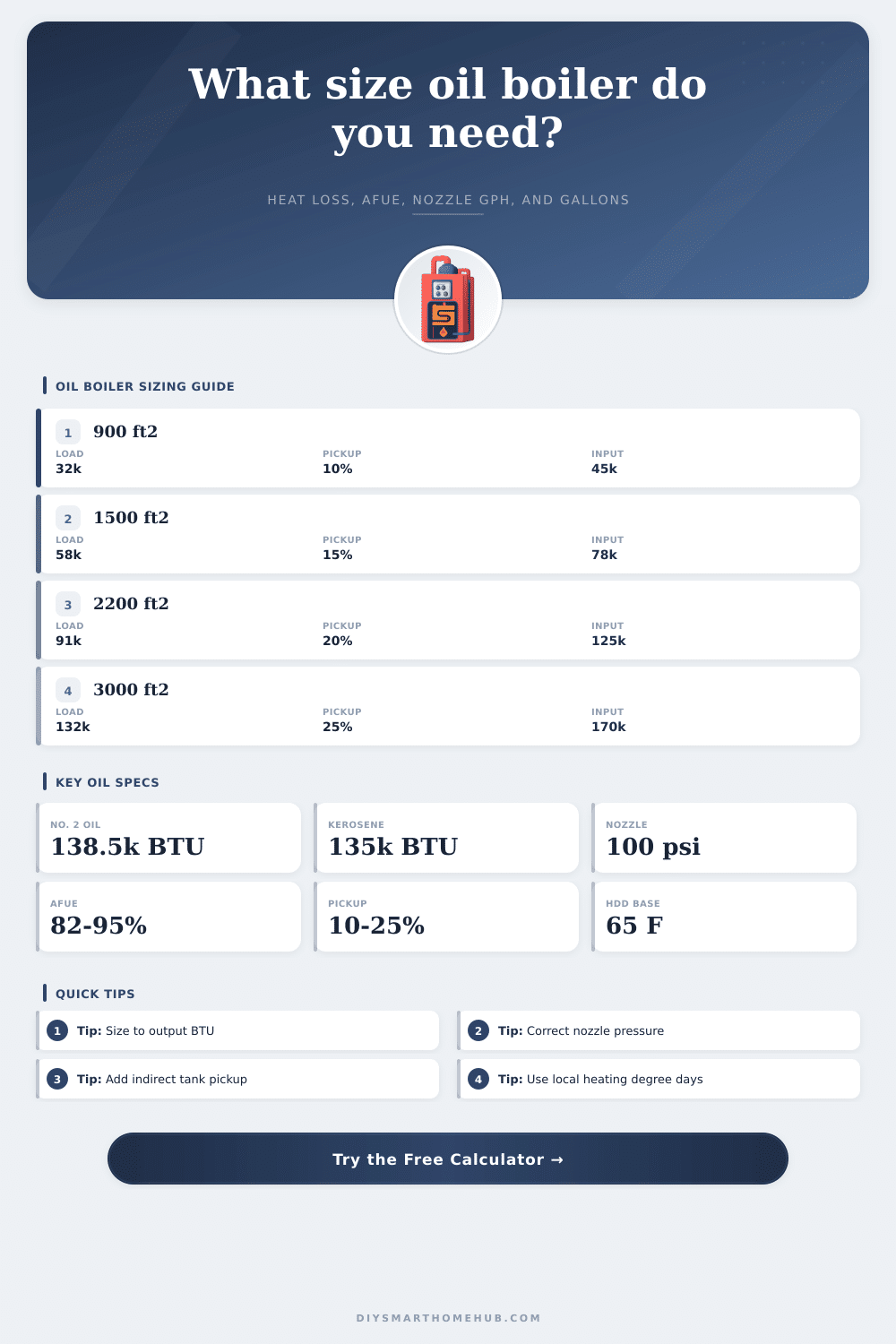
Use these tables to compare heat-loss assumptions, oil heat content, nozzle-pressure correction, and common residential oil boiler input classes.
| Heat-loss profile | BTU/hr per sq ft at 70 F split | Hydronic pickup | Typical building condition |
|---|---|---|---|
| Excellent tight envelope | 12 | 8% piping allowance | Modern shell, low infiltration, good windows |
| Good upgraded envelope | 16 | 10% piping allowance | Updated attic, air sealing, mixed wall insulation |
| Average mixed-age home | 22 | 12% piping allowance | Typical baseboard or radiator retrofit |
| Older partial insulation | 30 | 15% piping allowance | Older windows, high water volume, more leakage |
| Leaky underinsulated shell | 40 | 18% piping allowance | Drafty shell where room-by-room load is important |
| Fuel selection | Planning BTU per gallon | 1.00 GPH input | Output at 86% AFUE |
|---|---|---|---|
| Kerosene / No. 1 fuel oil | 135,000 BTU/gal | 135,000 BTU/hr | 116,100 BTU/hr |
| No. 2 residential heating oil | 138,500 BTU/gal | 138,500 BTU/hr | 119,110 BTU/hr |
| B20 heating-oil blend | 136,700 BTU/gal | 136,700 BTU/hr | 117,562 BTU/hr |
| No. 4 fuel oil | 145,000 BTU/gal | 145,000 BTU/hr | 124,700 BTU/hr |
| Nozzle marked GPH | Actual GPH at 100 psi | Actual GPH at 140 psi | No. 2 oil input at 140 psi |
|---|---|---|---|
| 0.40 GPH | 0.40 GPH | 0.47 GPH | 65,552 BTU/hr |
| 0.50 GPH | 0.50 GPH | 0.59 GPH | 81,940 BTU/hr |
| 0.65 GPH | 0.65 GPH | 0.77 GPH | 106,522 BTU/hr |
| 0.75 GPH | 0.75 GPH | 0.89 GPH | 122,910 BTU/hr |
| 0.85 GPH | 0.85 GPH | 1.01 GPH | 139,298 BTU/hr |
| 1.00 GPH | 1.00 GPH | 1.18 GPH | 163,880 BTU/hr |
| 1.25 GPH | 1.25 GPH | 1.48 GPH | 204,850 BTU/hr |
| Nominal input class | Output at 82% AFUE | Output at 86% AFUE | Best-fit required output range |
|---|---|---|---|
| 70,000 BTU/hr | 57,400 BTU/hr | 60,200 BTU/hr | 42,000 to 56,000 BTU/hr |
| 84,000 BTU/hr | 68,880 BTU/hr | 72,240 BTU/hr | 57,000 to 68,000 BTU/hr |
| 105,000 BTU/hr | 86,100 BTU/hr | 90,300 BTU/hr | 69,000 to 86,000 BTU/hr |
| 126,000 BTU/hr | 103,320 BTU/hr | 108,360 BTU/hr | 87,000 to 103,000 BTU/hr |
| 140,000 BTU/hr | 114,800 BTU/hr | 120,400 BTU/hr | 104,000 to 115,000 BTU/hr |
| 168,000 BTU/hr | 137,760 BTU/hr | 144,480 BTU/hr | 116,000 to 138,000 BTU/hr |
💡Oil Boiler Sizing Tips
The hydronic load is an output requirement. AFUE is applied after heat loss and pickup are added, so the calculator reports both output BTU/hr and input BTU/hr.
Nozzle GPH changes with pump pressure. The calculator corrects the marked nozzle flow before converting gallons per hour into burner input and output BTU/hr.
Boilers burn fuel to produce heat for homes. When choosing the right oil boiler for a house, understanding the heating load that a house requires involve understanding how much heat a house loses from its walls, windows, and the rest of its structure. The heat loss of a house depend on the quality of its insulation and how draftily the structure of a house is, as well as the temperature outside of the house on the design day.
Based off the heating load of a house, you can determine the required output of an oil boiler for heating that house, the size of the burner nozzle for that oil boiler, and the use of that oil boiler over the heating season. The calculator include on this page will calculate these values for you based on the number of square foot of your floors, how warm you like your house, the insulation profile of your house, and the details for the burner of your oil boiler. Using the oil boiler load calculator will save you the trouble of having to calculate these values yourself.
Find the Right Oil Boiler Size for Your Home
The values that you enter into the calculator will impact the output of that calculator. For instance, you can enter the square footage of your house, as well as the heat-loss profile of your house. A moddern house with great insulation will lose less heat than an older house that is drafty and poorly insulate.
Furthermore, you can enter the split of the design temperature for your climate. The design temperature split is the difference in temperature between how warm you like the houses and how cold it can get outside. An additional factor for determining the size of your oil boiler is the amount of heat that is necessary to heat the water in an indirect water heater.
Indirect water heaters will draw heat from the oil boiler to heat the water, so oil boilers will need to have an additional output for these needs. To account for this, you can provide the percentage of additional output in the form of a pickup percentage. This will ensure that oil boilers dont cycle on and off too frequent, as this can cause the component of those oil boilers to wear out over time.
Another factor that depends on the nozzle of your oil boiler is the size of the nozzle and the pressure at which the oil boilers burner will operate. The larger the size of the nozzle (measured in gallons per hour at a certain psi), the more fuel that will reach the burner of the oil boiler. The flow of that fuel will increase if the oil boiler’s pressure increase.
Furthermore, the calculator will allow you to enter the size of the nozzle and the pressure at which you would like to operate the oil boiler. The calculator will convert the gallons per hour into BTUs using the heat content of the oil that you select. Using the oil boiler load calculator will allow you to find the amount of fuel that an oil boiler uses each year.
The fuel that an oil boiler uses each year is the result of the heat loss of that house multiplied by the number of heating degree days that exist within the heating season. Furthermore, the amount of fuel that is used will depend on the pickup load of the oil boiler and the percentage of fuel that oil boilers utilize (AFUE). The annual fuel use for oil boilers is calculated in the oil boiler load calculator.
The tables provided on this page are used to find the assumption that is made in the calculation of the fuel load for oil boilers. These tables include the heat content of various types of oil and various corrections to the flow of fuel through nozzles at different psi reading. These tables can be used to verify your calculation before you contact an oil boiler contractor.
For instance, if the recommended input class for your house is much higher than the heat load of your house, then your oil boiler may be too large for your house and will waste fuel while cycling on and off constant. If the nozzle output that is recommended is too low for your oil boiler, then your oil boiler will have to run constantly to compensate for the lack of fuel for the burner. In reality, most houses are not like the models of heat loss of houses that are calculated in the oil boiler load calculator.
There are various variable in real houses that affect the heating load of those structures. For instance, if your house shares walls with another house in a duplex, it may lose heat to that other house. Furthermore, if your basement is well-insulated and does not lose as much heat as the remainder of your house, that will impact the heat loss of your home.
Instead of the general estimate of heat load that the oil boiler load calculator produces, you can perform a more accurate calculation of the heat load of each room in your home using a Manual J load calculator. The oil boiler load calculator will provide both the output requirements of the oil boiler and the recommended input class for oil boilers of that size. This value represent the headroom that oil boilers have in providing heat to the house.
Oil boilers do not exist in isolation from the remainder of a homes heating system. For instance, most oil boilers are used to heat radiators. Cast iron radiators contain alot of mass and can release a lot of heat over time, which impacts the cycling of burners within oil boilers.
Furthermore, if the oil boiler system loses heat rapidly (low water volume system), it may require outdoor reset controls to allow the system to lose heat at a lower rate. These controls may extend the life of your heating system and reduce the amount of fuel that is burned to heat your home. These feature are outside the scope of calculating the heat load of a house, but they can impact the performance of your oil boiler.
When choosing an oil boiler for a home, there are a variety of factors to consider to ensure that the oil boiler will efficiently heat the home. The oil boiler should be able to heat the home on the design day, provide sufficient output to heat water for domestic uses, and provide even heating to the home on mild days without cycling too often on and off. By meeting each of these conditions, the oil boiler will function quiet and efficient, with easily predictable fuel costs and an oil boiler with a long life.
This oil boiler load calculator will remove the need to manually calculate these number for oil boilers when making your decision.