Off-Grid Solar System Calculator
Estimate solar array size, battery bank storage, inverter class, and charge controller current from your daily load, autonomy target, battery chemistry, and site sun hours.
📌Scenario presets
These presets cover small emergency kits through full-time cabins. Each one updates the daily load, power peaks, storage days, and seasonal design assumptions so you can compare typical off-grid system sizes quickly.
🔌System inputs
💡Live assumptions
Use the form or a preset to estimate array size, storage, inverter class, and controller current.
🔋Battery chemistry snapshot
📊Daily load classes
| Load class | Daily energy | Typical inverter | Where it fits |
|---|---|---|---|
| Emergency network | 0.3 to 0.8 kWh/day | 300 to 600 W | Router, modem, charging shelf, and a few LED loads. |
| Weekend cabin | 1.5 to 3.0 kWh/day | 800 to 1500 W | Small fridge, lighting, fans, and short device charging windows. |
| Tiny house | 4.0 to 7.0 kWh/day | 2000 to 4000 W | Daily living loads with modest cooking or appliance overlap. |
| Full cabin | 7.0 to 10.0 kWh/day | 4000 to 6000 W | Kitchen gear, refrigeration, water pressure, and more consistent occupancy. |
📑Battery chemistry comparison
| Chemistry | Usable DoD | Round-trip | Best use |
|---|
🏡Common off-grid scenarios
| Scenario | Daily load | Battery goal | Solar goal |
|---|
🚧Planning notes
If the site must keep working through cloudier seasons, design around those peak sun hours instead of the sunny average. Seasonal bias often changes the array more than the battery chemistry does.
Energy tells you how long the loads can run, while amp-hours reveal how heavy the DC current becomes at 12 V, 24 V, or 48 V. Large systems usually calm down at higher bus voltages.
Off-grid solar systems require careful planning because the off-grid solar system must be able to provide the electricity that the individual or individuals in an off-grid location need without any connection to a utility company. You should calculate the total energy need of the home because if the calculation are not performed correctly, the off-grid solar system will not be able to provide enough power to the home. Energy consumption to be accounted for include all of the electrical appliance in the home, the watt-hours that they use each day, and the energy that the inverter will use.
Inverters convert the DC power from the battery bank to the AC power that the electrical appliances in the home need; inverters use approximately 10% of the energy to perform this conversion. Because the inverter use energy to perform its function, the user must increase the size of the battery bank to compensate for the energy that is lost to the inverter. Off-grid solar system design often incorporate the concept of “autonomy days,” which are the number of days that the off-grid system is to operate without any sunlight falling upon the solar panels.
How to Plan and Size an Off-Grid Solar System
Many off-grid solar system designs incorporate two days of autonomy to provide for periods of cloudy weather. Three day of autonomy may be required for those individuals who reside in areas where cloudy weather is present for longer periods of time. The chemistry of the batteries that the off-grid system will utilize also affect the autonomy of the system; batteries with higher chemistry losses permit the user to use a higher percentage of the battery banks capacity.
For instance, lithium batteries permit the users to utilize 90% of the battery bank’s capacity, but lead acid batteries only permit the users to utilize 50% of that bank’s capacity. Therefore, individuals that elect to use lead-acid batteries will have to purchase a larger battery bank to provide the same amount of energy then a bank of lithium batteries. Additionally, lead-acid batteries has lower round-trip efficiencies than lithium batteries.
The solar array that the user will implement into the off-grid system should be sized according to the number of peak sun hour that fall upon the system. The solar array should be sized according to the month that receives the least amount of sunlight; sizing the array according to the sunlight that falls upon the system during the summer months will cause the solar array to not provide enough electricity for that system during the winter months. Solar panels may lose efficiency due to factors like dust accumulation on the panels, heat generated by the panels, the electrical wiring in the system, and the angle of the panels relative to the sunlight.
To account for these losses, you should size the solar array with a buffer of 15-20% of the calculated size of the array. The inverter that will be used will need to be sized according to the watts that the electrical appliances in the off-grid system require (known as the running watts), and the surge watts that those appliances require when they are first turned on. If the surge watts are not provided to the inverter, the inverter will shut off those appliances when they are turned on.
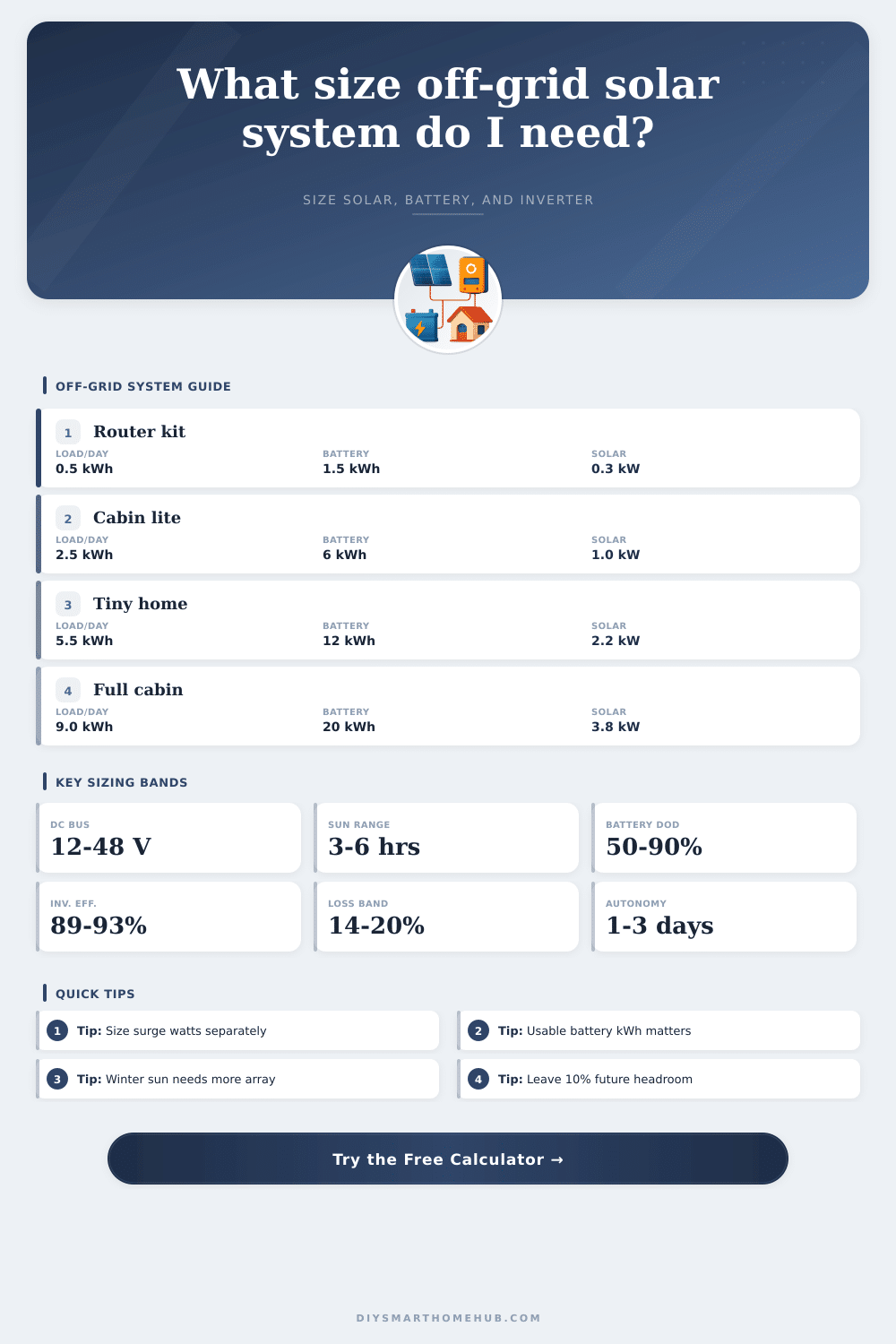
The charge controller that regulates the batteries will need to be sized according to the electrical output of the solar array; it should be sized at 125% of the electrical current output of the solar array to prevent overheating of the charge controller. Many off-grid solar system planning software programs includes preset designs for different types of off-grid locations. For instance, a router kit might use half a kilowatt-hour of energy each day.
Such a system would require only a small solar array and small lithium battery bank. A full cabin might use nine kilowatt-hours per day. Such a system would require a 20 kWh of battery storage and nearly four kilowatts of solar panels.
The off-grid solar system that is designed will require the inclusion of 10-20% extra capacity within the system. The extra capacity allows for the inclusion of additional electrical appliances in the future, and accounts for the aging of the components of the system. Many people tend to make mistake when they use the yearly averages in place of the amount of sunlight that falls on the panels each month.
This value should be the lowest value of sunlight each month. Additionally, the size of the battery bank should also be sized correctly in terms of the number of amp-hours in the battery bank to prevent the bus bars in the battery bank from overheating. If each of these factors is correctly calculated within the off-grid system, the off-grid solar system will reliably provide electricity to the off-grid location.