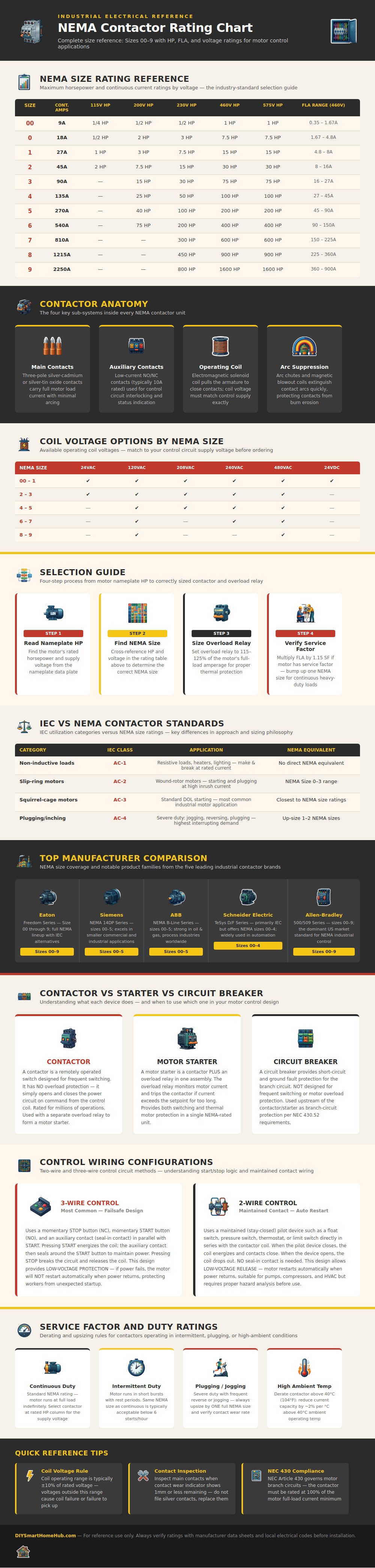
To select a contactor for an industrial control panel, you must match the contactor to the motor requirements. Motor requirements include the horsepower, the voltage, and the currents of the motor. Use these specification to select the contactor size.
Using a contactor that is too small for the motor will cause the contactor to fail quick. Using a contactor that is too large for the motor will cost more money for the installation of the control panel and will take up more space within the control panel. Therefore, you must consider the motor requirements for select a contactor.
Choose the Right Contactor for a Motor
Contactors is categorized according to the NEMA size of the contactor. Each NEMA size indicate the amount of load that the contactor can handle. Each Size 3 contactor from each manufacturer will handle the same amount of load.
You can use a rating chart to find the correct NEMA size for the motor. The rating chart indicates the horsepower of contactors at each of the available voltage. Additionally, the rating chart shows the continuous current ratings for the contactors and the full-load amp range of the contactors.
Use the rating chart to ensure that the contactor can handle the current of the motor that the contactor will control. A contactor have several different components. The main contacts of the contactor are used to carry the current from the motor to the motors load.
These main contactors must be able to survive the arcing of the motors contacts. There are auxiliary contacts on the contactor that indicate to other devices whether the motor is running. The coil of the contactor is used to create the magnetic force that closes the main and auxiliary contacts of the contactor.
Arc chutes within the contactor help to extinguish the arc between the main contacts of the contactor when they open. If any of the components of the contactor is too small relative to the size of the motor, the contactor will fail more earlier than expected. The coil voltage of the contactor must match the voltage of the control circuit.
The coil voltage of the contactor must match the control circuit to which you are to connect the contactor. Using a voltage that is too low for the contactors coil will prevent the contacts of the contactor from fully closing. Using a voltage that is too high for the contactors coil will cause the coil to overheat.
If the contactors coil overheats, the contactor will fail. Therefore, make sure the control circuit voltage is within the rating of the contactor coil voltage. A contactor is a heavy duty relay switch that a coil operates.
However, a contactor is not the same than a motor starter or a circuit breaker. A motor starter consists of a contactor and an overload relay. The overload relay is used to protect the motor from running too hard for too long.
The overload relay is set to a slightly higher value then the full-load current of the motor. A circuit breaker is used to handle short circuits and ground faults in the control circuit. A circuit breaker is not designed for frequent operation.
Use each of these device for its specific intended purpose. The duty cycle of the motor and the ambient temperature of the contactor will impact the sizing requirements for the contactor. For motors that run continuously, use the specifications from the contactor rating chart.
However, for motors that frequently jog or reverse direction, the contactors contacts wear out more rapid. In this case, use a contactor that is one size larger in NEMA size. Additionally, contactors can carry more current in cooler ambient temperature.
You can find the ambient temperature of the environment in which the contactor will be installed. Additionally, you can find the duty cycle of the motor. These specifications will tell you if a larger contactor or a derating table should of be use when installing the contactor.