Natural Gas Unit Converter
Convert natural gas across utility billing units, appliance energy, and metric engineering units while keeping gas quality, efficiency, and operating time in the same planning view.
📌Quick Presets
⚙Conversion Inputs
Conversion Results
Run a conversion to compare utility units, metric energy, and useful appliance output in one panel.
📊Unit Snapshot Grid
Monthly statement anchor
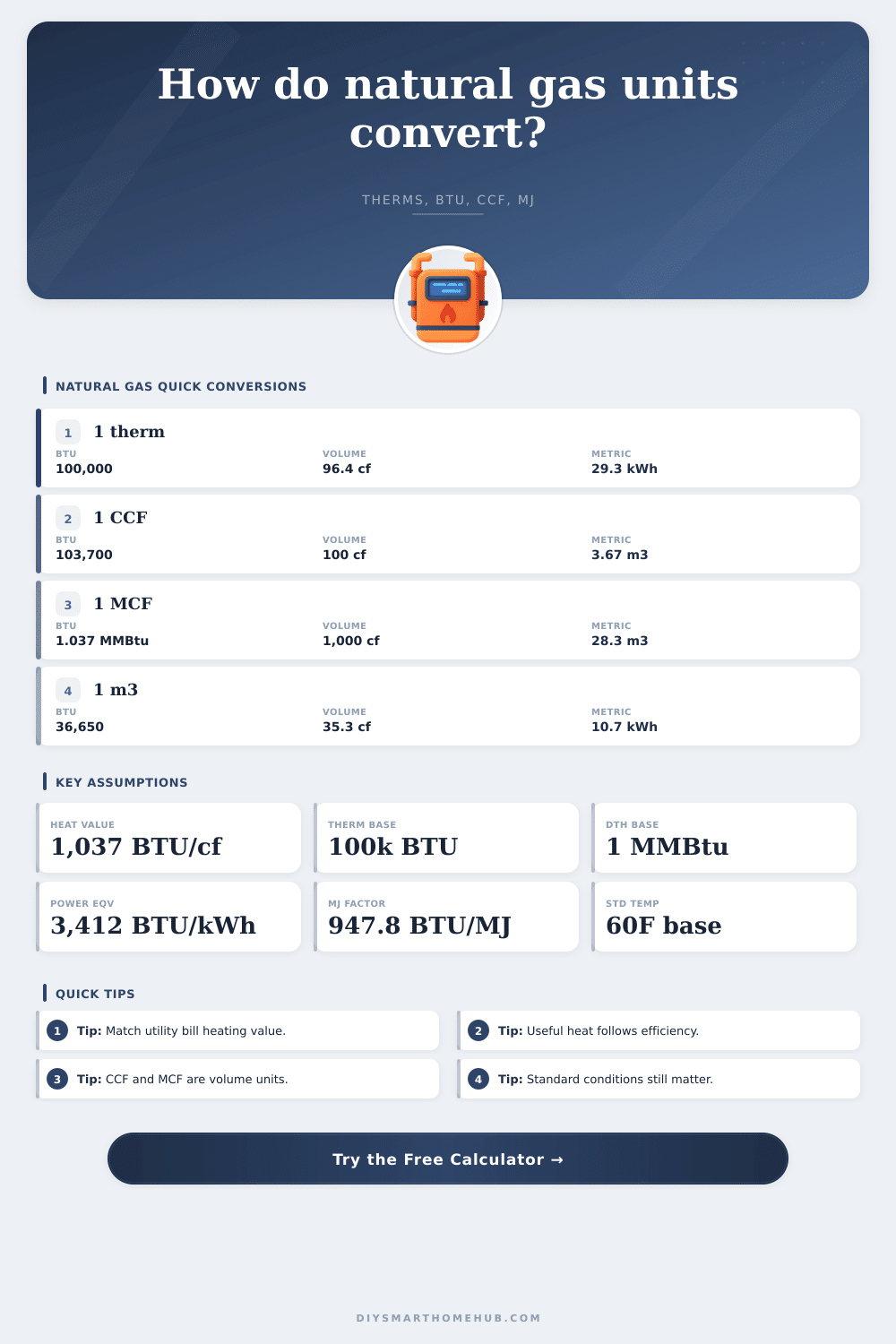
One therm is always 100,000 BTU, making it the cleanest bridge between bill totals and appliance energy.
Hundred cubic feet
CCF tracks metered volume. Its energy changes with heating value, so it may land slightly above or below one therm.
Large load shorthand
MMBtu and Dth simplify boiler plants, pool heaters, and seasonal totals where raw BTU values become unwieldy.
Engineering reference
Cubic meters line up with SI energy and international equipment data, especially when gas quality is published in MJ per cubic meter.
📑Quick Conversion Matrix
| Reference Unit | BTU | Therms | Volume at 1037 BTU/cf |
|---|---|---|---|
| 1 BTU | 1 | 0.00001 | 0.0010 cf |
| 1 Therm | 100,000 | 1.000 | 96.43 cf |
| 1 CCF | 103,700 | 1.037 | 100 cf |
| 1 MCF | 1,037,000 | 10.37 | 1,000 cf |
| 1 kWh equivalent | 3,412 | 0.034 | 3.29 cf |
| 1 cubic meter | 36,633 | 0.366 | 35.31 cf |
Volume rows assume the utility-average heat content of 1,037 BTU per cubic foot. Changing gas quality in the calculator updates the live results.
🔬Heating Value Profiles
| Profile | BTU per cf | MJ per m3 | Typical Use |
|---|---|---|---|
| Lean Distribution | 950 | 35.40 | Lower-energy local blend |
| Standard Tariff | 1,000 | 37.26 | Round-number utility planning |
| Utility Average | 1,037 | 38.64 | Common North American bill factor |
| Winter Peaking | 1,075 | 40.05 | Colder-season pipeline mix |
| RNG Blend | 980 | 36.51 | Renewable gas blend checks |
| High Methane | 1,090 | 40.61 | High-energy supply stream |
🏠Appliance Demand Table
| Appliance | Nominal Input | Therms per hr | CFH at 1037 |
|---|---|---|---|
| Condensing Furnace | 80,000 BTU/h | 0.80 | 77.1 |
| Storage Water Heater | 40,000 BTU/h | 0.40 | 38.6 |
| Tankless Water Heater | 199,000 BTU/h | 1.99 | 191.9 |
| Gas Dryer | 22,000 BTU/h | 0.22 | 21.2 |
| Vented Fireplace | 30,000 BTU/h | 0.30 | 28.9 |
| Pool Heater | 250,000 BTU/h | 2.50 | 241.1 |
📈Home Use Scenarios
| Scenario | Energy Input | Gas Volume | Useful Heat at Eff. |
|---|---|---|---|
| One furnace hour | 80,000 BTU | 77.1 cf | 76,000 BTU at 95% |
| Dryer cycle | 16,500 BTU | 15.9 cf | 13,695 BTU at 83% |
| Fireplace evening | 120,000 BTU | 115.7 cf | 84,000 BTU at 70% |
| Whole-home winter day | 1.2 MMBtu | 1,157 cf | 1.14 MMBtu at 95% |
| Pool heater session | 750,000 BTU | 723.2 cf | 630,000 BTU at 84% |
| Thirty therm month | 3.0 MMBtu | 2,893 cf | 2.55 MMBtu at 85% |
Utilities may post a monthly heat-content factor. Use that value before translating CCF or MCF into therms so your converter matches the statement instead of a rounded textbook assumption.
Total converted energy helps with monthly planning, but meter and regulator checks still depend on average or peak cubic feet per hour during the chosen runtime window.
Natural gas is often use as a fuel source for heating. The unit of measure for natural gas is in several different unit, such as therms, cubic feet, and BTUs. Due to the fact that there are many different unit of measurements on a natural gas bill, it can be dificult for individual to understand the amount of energy that they are using.
The unit of measurement of natural gas is often in therms and cubic feet, but the two units are relate differently due to the fact that the heat content of the natural gas can change. Natural gas is composed of methane, but the amount of heat in the methane can changes. The heat content of natural gas is largely important in that it determine the amount of energy that is contained within a unit of natural gas.
How We Measure Natural Gas
For instance, one cubic foot of natural gas can contain 1,000 BTUs of energy; however, it could also have 1,075 BTUs. The more greater the amount of heat content of the natural gas, the more energy that is create, and the less cubic feet of natural gas that is required to meet the heating goals of a home. Natural gas company often change the heat content of their natural gas products.
It is important for individuals to account for this heat content so that their calculation of the amount of natural gas that they need are accurate. Appliances that use natural gas, such as furnaces, will often display the energy requirement of the appliance in BTUs per hour. For example, a furnace may require 80,000 BTUs per hour to function appropriate.
The energy unit of the natural gas that the furnace burns will be less than 80,000 BTUs due to the efficiency of the furnace. For instance, if the efficiency of a furnace is 95% (which is relatively high), then the furnace will release 95% of the energy from the natural gas into the home; the other 5% of the energy will be lost. Older furnaces often have less energy efficiency than newer furnace.
Due to the need for natural gas unit to be measured, there are several different unit of natural gas. For instance, one CCF of natural gas is equal to 100 cubic feet of natural gas. The CCF is also roughly equal to one therm of natural gas.
Additionally, one MCF of natural gas is equal to 1,000 cubic feet of natural gas. This unit is used for measuring the natural gas need for larger load. If the metric system is use, the unit of natural gas that is use is the cubic meter of natural gas, which contain approximately 36,000 BTUs of energy.
It is important that the correct units is used to calculate the amount of natural gas that is needed for an individual’s needs. The incorrect units will produce incorrect calculation for the energy needs for natural gas. The flow rate for natural gas is the amount of natural gas that move through a pipe over a period of time.
The unit for flow rate is often expressed in CFH, which is the number of cubic feet of natural gas that pass through a pipe per hour. The flow rate is important to determine whether the gas line that supply a home to the appliances are large enough to supply the amount of natural gas that is needed by those appliances. For instance, if a home has a tankless water heater, the gas lines must be able to supply the flow rate of the water heater.
If the water heater requires a flow rate of 500 CFH, but the gas lines can only move 300 CFH of natural gas, the water heater will not be able to function correct. It is important to determine the flow rate of natural gas appliance if those appliances are to be installed in a home. Additionally, if the appliances is large, the flow rate should be calculated at the time of installation to ensure that the natural gas line can supply the amount of natural gas that is required by those appliances.
Another factor to consider when calculating the amount of natural gas that is require for a home is the use of a buffer in the calculations. A buffer accounts for an additional amount of natural gas to be supply to the appliances to supply the heat demand of the appliances during periods of cold weather. During cold weather in winter, more heat is require by the appliances, which means that more natural gas is required to provide that heat to the appliances.
Should individuals calculate the amount of natural gas that is required for the appliances without considering the buffer, they may find that their natural gas usage is much higher then they had calculate for the winter month. An additional consideration for gas versus electricity is the use of BTUs to express the energy in both form of power. One kilowatt-hour of electricity is equal to 3,400 BTUs.
This value is useful in comparing the energy value of natural gas and electricity for a home.