Natural Gas to Propane Conversion Calculator
Convert natural gas load, utility usage, and flow into propane gallons, pounds, vapor demand, and reserve-aware tank draw so you can compare fuels on the same energy basis.
📌Preset Scenarios
⚙Calculator Inputs
Propane Conversion Snapshot
Run a calculation to compare natural gas energy with propane gallons, vapor flow, and reserve-aware tank coverage.
💡Core Conversion Constants
Natural Gas Energy
This default heat content is used to turn natural gas flow into usable energy. Adjust it if your utility publishes a different average BTU factor.
Propane Liquid Energy
One gallon of propane stores enough heat to replace about 88.4 standard cubic feet of natural gas at the default heating value.
Propane Vapor Rate
Vapor volume matters when you compare appliance demand to small cylinders, cold-weather draw, or continuous-burn standby loads.
Pressure Reminder
Natural gas and propane use different manifold pressures, so equal-BTU math does not replace a listed conversion kit or rated setup parts.
📋Natural Gas to Propane Equivalency Table
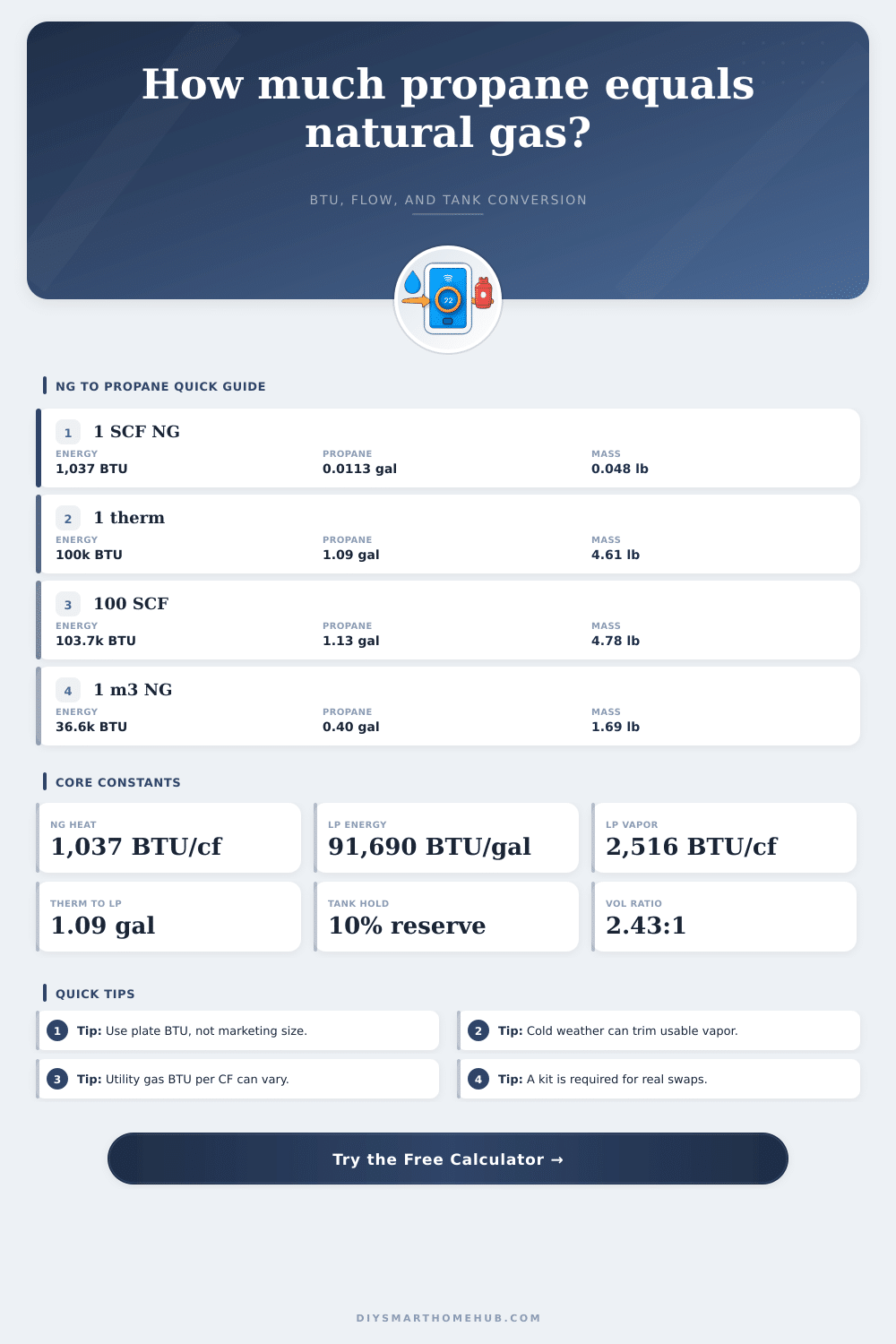
These rows use the same constants as the calculator: 1,037 BTU per natural-gas cubic foot and 91,690 BTU per propane gallon.
| Natural gas basis | Energy | Propane gallons | Propane pounds | LP vapor SCF |
|---|---|---|---|---|
| 1 SCF natural gas | 1,037 BTU | 0.0113 gal | 0.048 lb | 0.41 SCF |
| 10 SCF natural gas | 10,370 BTU | 0.113 gal | 0.48 lb | 4.12 SCF |
| 1 therm natural gas | 100,000 BTU | 1.09 gal | 4.61 lb | 39.75 SCF |
| 1 m3 natural gas | 36,620 BTU | 0.40 gal | 1.69 lb | 14.55 SCF |
| 100 m3 natural gas | 3.66M BTU | 39.94 gal | 168.93 lb | 1,455 SCF |
| 1 million BTU | 1.00M BTU | 10.91 gal | 46.16 lb | 397.46 SCF |
🔥Typical Appliance Conversion Field Guide
The appliance rows below assume the same input rating after conversion. Always confirm the actual rating plate, kit instructions, and local fuel specifications.
| Appliance | Typical input | NG flow | Propane rate | LP vapor flow |
|---|---|---|---|---|
| Backyard grill | 48,000 BTU/h | 46.3 SCF/h | 0.52 gal/h | 19.1 SCF/h |
| Warm-air furnace | 80,000 BTU/h | 77.1 SCF/h | 0.87 gal/h | 31.8 SCF/h |
| Tankless water heater | 180,000 BTU/h | 173.6 SCF/h | 1.96 gal/h | 71.5 SCF/h |
| Standby generator | 250,000 BTU/h | 241.1 SCF/h | 2.73 gal/h | 99.4 SCF/h |
| Pool heater | 300,000 BTU/h | 289.3 SCF/h | 3.27 gal/h | 119.2 SCF/h |
| Hydronic boiler | 150,000 BTU/h | 144.6 SCF/h | 1.64 gal/h | 59.6 SCF/h |
📈Preset Planning Snapshot
These rows are generated from the preset scenarios at the top so you can compare appliance loads and utility usage patterns quickly.
| Scenario | Basis | Input | Propane need | Tank match |
|---|
Natural gas varies by utility and season, so replacing the default BTU-per-cubic-foot value with your bill data tightens the propane estimate more than changing any other input.
Reserve and buffer settings often decide whether a small cylinder works, especially when a converted appliance runs for long stretches or sees heavy cold-weather demand.
To convert an appliance that run on natural gas to one that uses propane, you must calculate the energy requirements of the appliance using BTUs. Propane and natural gas has different energy output levels. Natural gas is measured in cubic foot or therms, and propane is measured in gallons or pounds.
One BTU is equal to one unit of energy. Because propane and natural gas have different energy density, you cant simply use propane gas for an appliance that utilizes natural gas. One cubic foot of natural gas contain a different amount of heat energy than one cubic foot of propane vapor.
How to Convert a Natural Gas Appliance to Propane
Propane vapor contains more energetic per cubic foot than natural gas does. To change an appliance’s fuel source from natural gas to propane, you must look at the nameplate of the appliance. The nameplate will have the BTU output of the appliance, which will allow you to determine how much heat is required for the appliance to perform its functions.
For example, if the grill is rated at 48,000 BTUs per hour for natural gas, the propane setup should be able to provide 48,000 BTUs per hour. However, the propane tank and appliance must also be compatible with propane gas. Natural gas and propane operate at different gas pressures.
To accommodate this difference, you should use a propane conversion kit. Without a propane gas conversion kit, the appliances flame will not burn evenly, and the appliance might create soot. Another factor to consider when calculating the propane need of an appliance is the duty cycle.
The duty cycle of an appliance indicates the amount of time the appliance will be running in comparison to the total amount of time available for which it can run. Appliances, like furnaces, do not run at their maximum capacities continuously. Instead, their duty cycle will cause their furnace to run at a lower average capacity.
Calculating the average amount of fuel the appliance will use per day will depend on this duty cycle. If the appliance to be converted to propane fuel is a generator or a heater, you should base the duty cycle for its fuel needs on the peak load capacity of the appliance. This will ensure that the fuel calculations are enough to meet the demand of the appliance.
Another consideration is the size of the propane tanks to be used. Propane tanks should not be filled to 100% of their capacity when refilled with propane liquid. Tanks should only be filled to 80% of their total volume with propane liquid.
There is a need to leave space within the propane tank for the propane liquid to expand. The propane reserve within the tank is also necessary. A propane reserve allows for the propane to vaporize, which it does when it is in contact with the hot appliance.
If the temperature of the environment drops below 20 degrees Fahrenheit, the propane will not vaporize proper. In these conditions, propane tanks will need to be larger in size for the propane to properly vaporize. A second difference between propane and natural gas is that propane is stored in liquid form in propane tanks.
However, appliances use propane in the form of vapor. One cubic foot of propane vapor contains around 2,500 BTUs of energy. This is more energy per unit volume of propane than natural gas contain.
Because propane vapor is more dense than natural gas, propane burners must utilize a propane conversion kit. This will allow propane tanks to meter the propane properly into the appliance to prevent using too much or too little propane fuel for the appliances needs. If you are calculating the needs for propane for a longer period of time, such as a month, you should review the utility bills for that appliance to determine the average amount of therms of natural gas that is used.
These therms can be converted into the number of gallons or pounds of propane that will be needed to operate the appliance for that specific time period. You must ensure that the propane fuel that is used to power an appliance has the same BTU output as the natural gas that is currently used. The propane tank and appliance must be converted to propane using a propane conversion kit to accommodate the difference in the gas pressure of propane and natural gas.
Finally, you should determine the size of the propane tank based off the climate in which the propane appliance will be used and the appliances duty cycle. In cold climates, propane tanks will need to be larger in size to allow for proper vaporization of the propane fuel. Additionally, the greater the duty cycle of the appliance, the more larger the propane tank will need to be.