Natural Gas to kWh Converter
Convert appliance input, gas flow, CCF, therms, or cubic meters into gross kWh, useful delivered kWh, electric backup sizing, and combustion totals on one consistent energy model.
📌Preset Scenarios
⚙Calculator Inputs
Energy Conversion Snapshot
Enter a scenario to compare gross fuel energy, useful delivered kWh, and the electric capacity needed to replace that gas load.
📊Quick Spec Grid
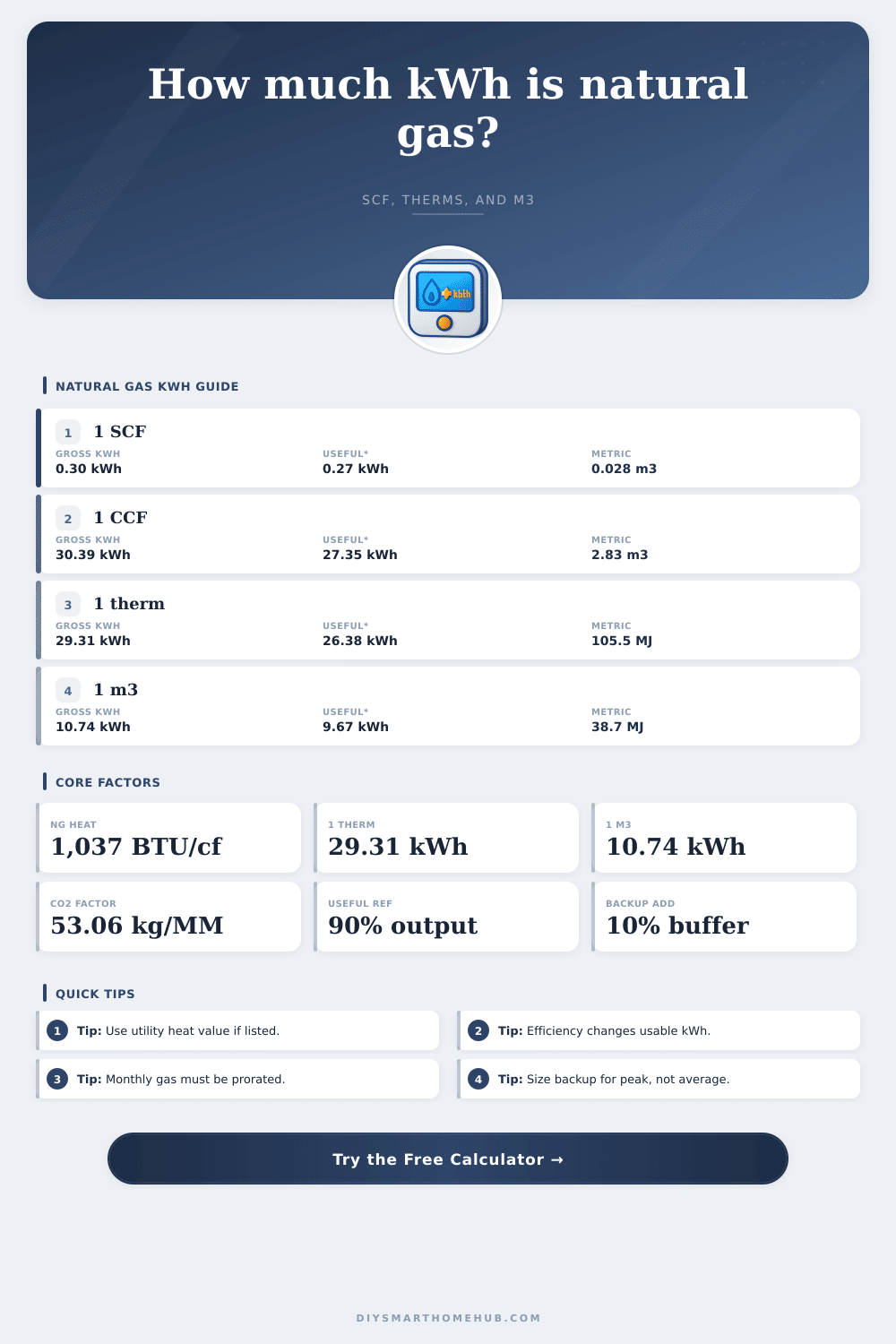
1 standard cubic foot
At 1,037 BTU per cubic foot, one SCF of natural gas contains about 0.304 gross kWh.
100 cubic feet
A single CCF on a utility bill converts to roughly 30.39 gross kWh before appliance losses.
Billing therm
One therm is 100,000 BTU, which equals about 29.31 gross kWh on the same heating-value basis.
1 cubic meter
At average utility gas quality, one cubic meter contains about 38.7 MJ or 10.74 gross kWh.
📘Natural Gas Unit Conversion Table
| Input basis | Natural gas energy | Gross kWh | Useful kWh at 90% |
|---|---|---|---|
| 1 SCF | 1,037 BTU | 0.304 kWh | 0.273 kWh |
| 1 CCF | 103,700 BTU | 30.39 kWh | 27.35 kWh |
| 1 therm | 100,000 BTU | 29.31 kWh | 26.38 kWh |
| 1 m³ | 38.7 MJ | 10.74 kWh | 9.67 kWh |
⚡Common Appliance Input Comparison
| Appliance input | Gross kWh per hour | Useful kWh at 90% | SCF per hour |
|---|---|---|---|
| 30,000 BTU/h fireplace | 8.79 kWh | 7.91 kWh | 28.9 SCF/h |
| 80,000 BTU/h furnace | 23.44 kWh | 21.10 kWh | 77.1 SCF/h |
| 199,000 BTU/h tankless | 58.32 kWh | 52.49 kWh | 191.9 SCF/h |
| 250,000 BTU/h pool heater | 73.27 kWh | 65.94 kWh | 241.1 SCF/h |
📃Monthly Utility Bill Crosswalk
| Monthly use | Equivalent therms | Gross kWh | Average useful kWh/day at 90% |
|---|---|---|---|
| 30 CCF | 31.11 therms | 911.7 kWh | 27.4 kWh/day |
| 60 CCF | 62.22 therms | 1,823.3 kWh | 54.7 kWh/day |
| 90 CCF | 93.33 therms | 2,735.0 kWh | 82.1 kWh/day |
| 120 CCF | 124.44 therms | 3,646.6 kWh | 109.4 kWh/day |
📋Preset Energy Snapshot Table
| Preset | Basis | Input | Gross kWh | Backup kW |
|---|
💡Calculation Tips
Metered SCF, CCF, and m³ are only as accurate as the heat-content factor behind them. If your bill lists BTU per cubic foot or MJ per cubic meter, enter that number instead of the default.
When you compare gas to electric backup, gross fuel kWh can overstate the electric need. Size the backup from peak useful kW after efficiency, load factor, and reserve are all applied.
In order to convert the energy of natural gas into electric energy, it is first important to understand the difference between the energy that is contained within the natural gas and the usable heat that the natural gas provide to the home. The energy that is contained within natural gas is measured in units of British Thermal Units (BTUs), while electric energy are measured in kilowatt-hours (kWh). Thus, in order to determine how much electric energy is required to replace the energy that natural gas would otherwise supplied, it is first necessary to perform a mathematical conversion of the energy units.
The energy that is contained within natural gas is not consistent; the chemical composition of natural gas can contain hydrocarbon other than methane, the main component of natural gas. As a result, the BTUs that are contained within one cubic foot of natural gas can range from one cubic foot containing 1,000 BTUs to a different cubic foot of natural gas containing a different amount of BTU. Thus, one cubic foot of natural gas contains roughly 0.3 kWh of raw energy.
How to Convert Natural Gas Energy to Electricity for Home Heating
However, this raw energy is not the same as the amount of usable heat that the heating appliance that utilize the natural gas provides to the home. Many heating appliance dont utilize all of the energy that is contained within the natural gas; some of that energy is often lost through the flue of the heating appliance. For instance, a moddern heating appliance may have an efficiency of 90% while an older appliance may only have an efficiency of 70%.
Thus, to determine the amount of electric energy that is required to provide the same amount of heat as the natural gas, you must multiply the raw energy of the natural gas by the efficiency of the heating appliance. In addition to calculating the efficiency of the heating appliance, it is also important to consider the load factor of the gas furnace. The load factor indicates the amount of time that the furnace is running at peak efficiency relative to the number of minutes in a day; the furnace does not run at full capacity every single minute of every day.
Thus, the average load of the furnace is typically not the same as the peak load. Those that wish to create an electric backup for the heating system made with natural gas may make the mistake of calculating the size of the electric backup based off only upon the peak energy load of the natural gas heating appliance. However, calculating only the peak load will produce incorrect result.
Instead, one can consider the number of minutes that the heating appliance operates at peak efficiency each day in order to determine the actual amount of energy that is consume by the gas heating appliance. The information that natural gas utility bills provide can aid in the calculation of the amount of energy that is used by a home that utilize natural gas for heating. The utility bills may indicate, for instance, the number of CCF or therms of natural gas that the home used during a given period.
Each therm is equivalent to 100,000 BTUs of energy, as well as approximately 29 or 30 kWh of gross energy. Furthermore, one CCF of natural gas is equivalent to 100 cubic feet of natural gas. These units can be used to determine the total amount of energy that was used by the home during the period described on the bill.
However, it is important to note that these bills typically display only the average amount of natural gas that was used by the home during the month. Thus, these bills may not reflect the increase in the amount of natural gas that is used by the home during days when the outdoor temperatures is particularly cold. As a result, it is important to prepare for these cold days when establishing an electric backup system for the appliances that utilize natural gas.
Finally, it is important to ensure that the electric backup system that is established for appliances that utilize natural gas contains enough electric power (in terms of peak kilowatts, or kW) to handle the demand of those appliances. Any electric system that is too small relative to the amount of energy that those appliances require will fail to supply the necessary power to those appliances. For instance, tankless water heaters may require a higher peak kW of electric power than a gas furnace, though each may require a different amount of peak kW.
Thus, by calculating the amount of usable heat that the natural gas provides within the home, accounting for the efficiency of the appliances that utilize that natural gas, and considering the load factor of those appliances, you could of determined the amount of kWh and kW that is required by the electric backup system to replace the energy that the natural gas appliances previously provided.