⚡ Lux to Watts Calculator
Convert illuminance (lux) to electrical power (watts) by light source type and room size
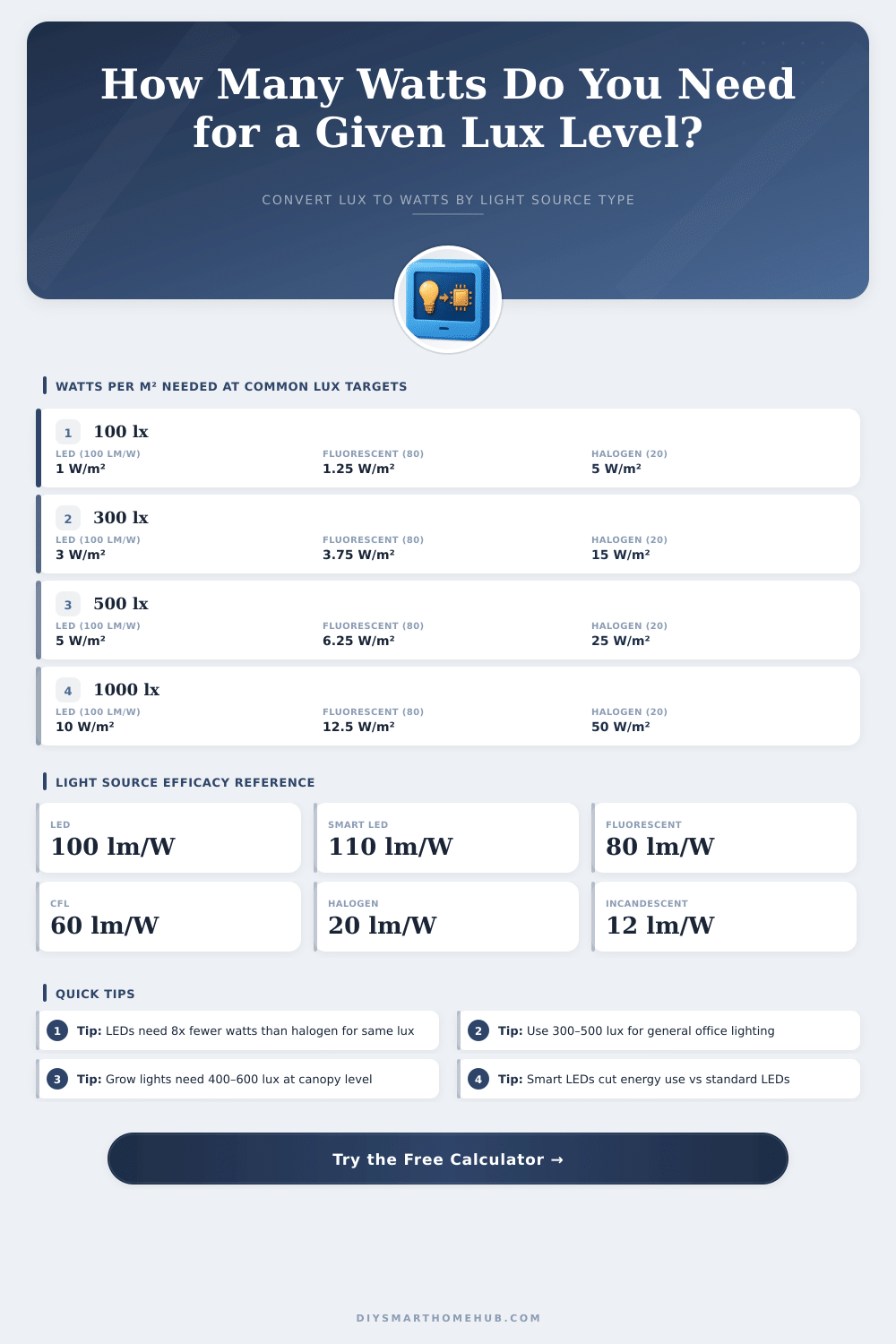
| Lux Target | LED 100 lm/W | Smart LED 110 | Fluorescent 80 | CFL 60 | Halogen 20 | Incandescent 12 |
|---|---|---|---|---|---|---|
| 50 lx (accent) | 0.5 W/m² | 0.45 W/m² | 0.63 W/m² | 0.83 W/m² | 2.5 W/m² | 4.17 W/m² |
| 100 lx (ambient) | 1.0 W/m² | 0.91 W/m² | 1.25 W/m² | 1.67 W/m² | 5.0 W/m² | 8.33 W/m² |
| 200 lx (lounge) | 2.0 W/m² | 1.82 W/m² | 2.5 W/m² | 3.33 W/m² | 10.0 W/m² | 16.67 W/m² |
| 300 lx (general) | 3.0 W/m² | 2.73 W/m² | 3.75 W/m² | 5.0 W/m² | 15.0 W/m² | 25.0 W/m² |
| 500 lx (task) | 5.0 W/m² | 4.55 W/m² | 6.25 W/m² | 8.33 W/m² | 25.0 W/m² | 41.67 W/m² |
| 750 lx (detailed) | 7.5 W/m² | 6.82 W/m² | 9.38 W/m² | 12.5 W/m² | 37.5 W/m² | 62.5 W/m² |
| 1000 lx (bright) | 10.0 W/m² | 9.09 W/m² | 12.5 W/m² | 16.67 W/m² | 50.0 W/m² | 83.33 W/m² |
| Wattage | Daily kWh (8 hrs) | Weekly kWh | Monthly kWh (30d) |
|---|---|---|---|
| 5 W | 0.04 kWh | 0.28 kWh | 1.2 kWh |
| 10 W | 0.08 kWh | 0.56 kWh | 2.4 kWh |
| 20 W | 0.16 kWh | 1.12 kWh | 4.8 kWh |
| 40 W | 0.32 kWh | 2.24 kWh | 9.6 kWh |
| 60 W | 0.48 kWh | 3.36 kWh | 14.4 kWh |
| 100 W | 0.80 kWh | 5.60 kWh | 24.0 kWh |
| 150 W | 1.20 kWh | 8.40 kWh | 36.0 kWh |
| 200 W | 1.60 kWh | 11.20 kWh | 48.0 kWh |
Lux and watts measure entirely different things and folks commonly confuse them. They are not interchangeable. Watts show the power, while lux show how much light indeed falls on surface, so illuminance.
Base it is lumens divided by square of distance, but when you consider actual complications, everything quickly gets messy. Basically: watts do not have direct relation to lux or lumens.
What is the difference between lux and watts
There is no simple conversion of lux to watts, because it depends on the kind of lamp and where the light hits. Here what most commonly messes up: watts are genuinely bad measures for brightness. They only say how much power the lamp takes, not about the real intensity.
Some producers entirely skip lumens and show brightness by lux or footcandles, that both genuinely measure the intensity of the light.
Even so, if you want to count yourself, here is a formula. Watts match 0.09290304 times the illuminance in lux, times the area in square feet, then divided by the efficacy in lumens each watt. Efficacy shows how efficient is your source, how many lumens it gives for one watt.
Use lux for your target brightness and area in square metres or feet, according to the formula.
Here is another mode, that seems easier. First, estimate total lumens multiplying lux by area in square metres. Later share that number by efficacy to receive watts.
For instance: room requires 500 lux on 20 square metres. That does 10 000 lumens. If the source gives 90 lumens each watt, you requier around 111 watts.
Convert lux to watts for square metre gets harder because of the frequency of the light. For green light in 555 nanometers, middle of the visible spectrum, 683 lux match 1 watt for square metre. Other colors are much less efficient, do not know where it comes.
Some use factor 0.0079 to turn lux in watts for square metre, giving almost same results. Popular effect is share the lux-value by 6830 and adapt for eye-feeling according to length.
Lux-to-watt-calculator helps to understand how power and efficiency relate at various sources. Finding the relation between watts and lux for your installation allow to lower energycosts, using only the necessary power for good lighting in any space. Fast memory: 1 lux are 1 lumen spread across square metre.
That deserves to recall.