🌞 Lux to DLI Calculator
Convert lux readings to Daily Light Integral for smart home plant lighting automation
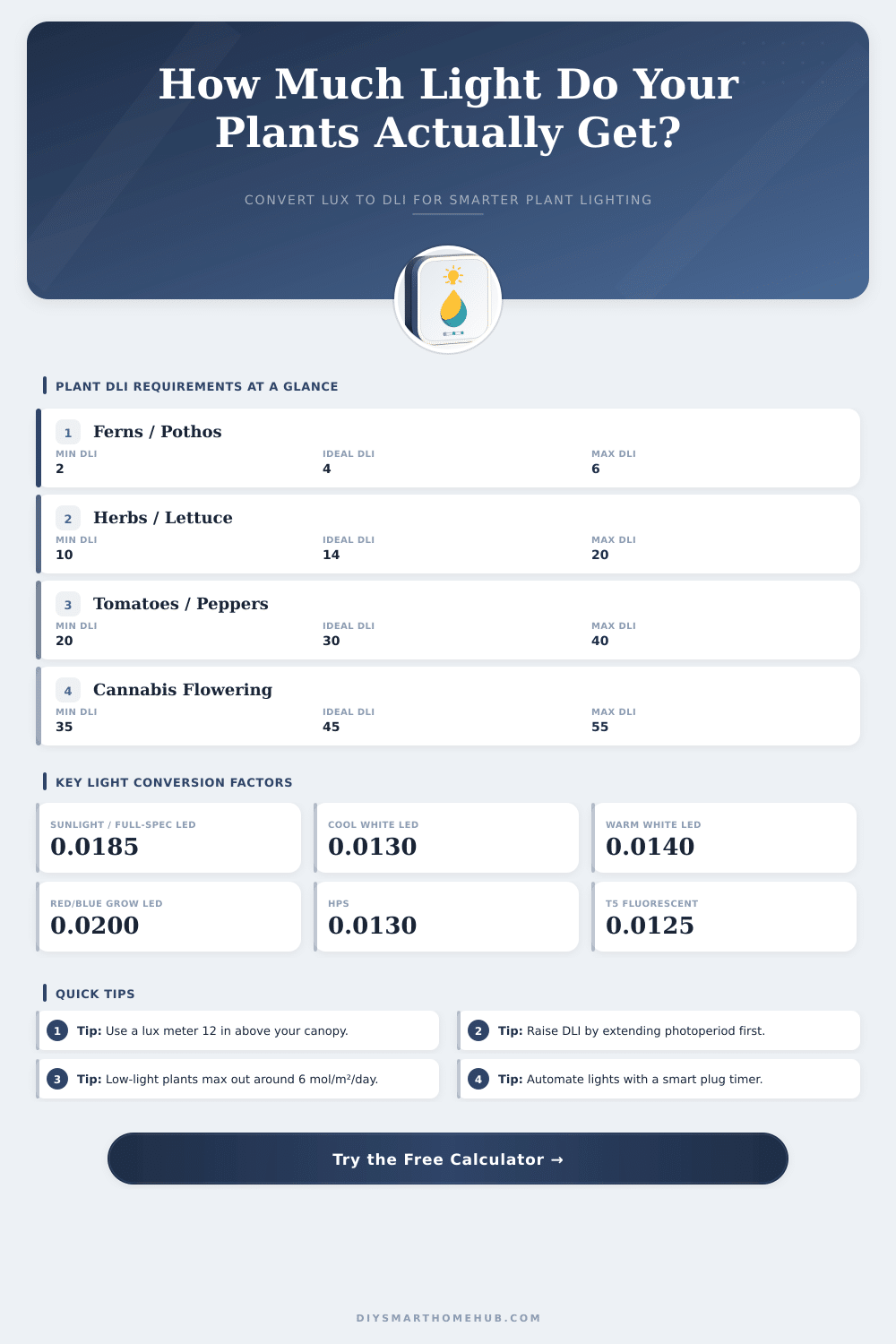
| Light Type | Conversion Factor | Typical Lux Range | PPFD at Mid-Range |
|---|---|---|---|
| Sunlight (clear sky) | 0.0185 | 50,000–100,000 lx | 1,388 µmol/m²/s |
| Full Spectrum LED | 0.0185 | 10,000–60,000 lx | 648 µmol/m²/s |
| Cool White LED | 0.0130 | 5,000–40,000 lx | 293 µmol/m²/s |
| Warm White LED | 0.0140 | 5,000–40,000 lx | 315 µmol/m²/s |
| Red/Blue Grow LED | 0.0200 | 5,000–50,000 lx | 550 µmol/m²/s |
| HPS (High-Pressure Sodium) | 0.0130 | 20,000–80,000 lx | 650 µmol/m²/s |
| T5 Fluorescent | 0.0125 | 2,000–15,000 lx | 106 µmol/m²/s |
| Plant | Min DLI | Ideal DLI | Max DLI | Photoperiod Note |
|---|---|---|---|---|
| Pothos / Ferns | 2 | 4 | 6 | 10–12h sufficient |
| Peace Lily | 3 | 6 | 8 | 12–14h moderate |
| Lettuce | 10 | 14 | 20 | 14–16h optimal |
| Basil / Herbs | 12 | 16 | 22 | 14–18h recommended |
| Orchids | 10 | 14 | 18 | 12–14h typical |
| Succulents | 8 | 15 | 25 | 12–14h with bright light |
| Tomatoes / Peppers | 20 | 30 | 40 | 14–16h with high lux |
| Cannabis Flowering | 35 | 45 | 55 | 12h strict photoperiod |
Converting lux to DLI commonly matters when you grow plants indoors or in greenhouses. Daily Light Integral (DLI) is a measure of the total amount of PAR light that a surface receives during a day. That is a useful metric to estimate whether a place receives enough light so plants grow well Low light plants require DLI between 5 and 10, medium require 10 to 15, and high light plants require more than 15.
Basically, DLI shows you how much photosynthesis can happen. It is the amount of photosynthetically active photons gathered for a square meter during the whole day. PPFD, which means photosynthetic photon flux density, is the light intensity in a spot, measured in umol/m2/sec.
Convert lux to DLI for plants
PPFD and DLI are two essential measures that help growers count the amount and the quality of light that their plants recieive.
Here is the thing: lux is not a useful measure for plants, because it relates to visible light, while plants mainly use the red and blue parts of the spectrum. Even so many folks already have lux meters. So the solution is first convert lux to PPFD, and then PPFD to DLI.
For white LEDs, you can take the lux value and divide by 70 to get PPFD. Some makers of LED lights suggest to instead divide by 65. The conversion factor of around 70 lux for 1 umol/m2/sec counts mostly for lights with CRI 80.
A free phone app called Sensor Box allows you to use the light sensor of your phone to get a lux reading. Later you take that lux value, divide by 70 to get PPFD, and from hear convert PPFD to DLI. Some apps, like Photone, also work as calculators.
When using Photone, focus on PPFD, because that measures what plants indeed see.
In greenhouses the conversion becomes a bit more complex. You measure lux outside and inside, and then divide the inside value by the outside for a percentage. Then you multiply the DLI values by that percentage to get the DLI in the greenhouse.
For instance, if outside the reading is 1500 lux and inside 750 lux, the ratio is 0.5.
For most species it is better to use lower PPFD during a longer duration to reach the same DLI. Many species will die if you give them more than 16 hours of light a day. Some species, like sphagnum, grow best with 24 hours of light.
For tomatoes, optimum growth can be reached at around 30,000 to 40,000 lux for 16 hours at the top of the canopy. Online tools and calculators exist to convert lux to PPFD and calculate DLI, which makes thewhole process easier.