Lithium Ion vs VRLA Battery Comparison Calculator
Compare smart home backup battery sizing by usable energy, installed capacity, pack weight, cycle life, service-year fit, and replacement count.
⚙Real Backup Presets
🔋Battery Comparison Inputs
📊Selected Battery Spec Grid
✔Comparison Results
📘Battery Reference Tables
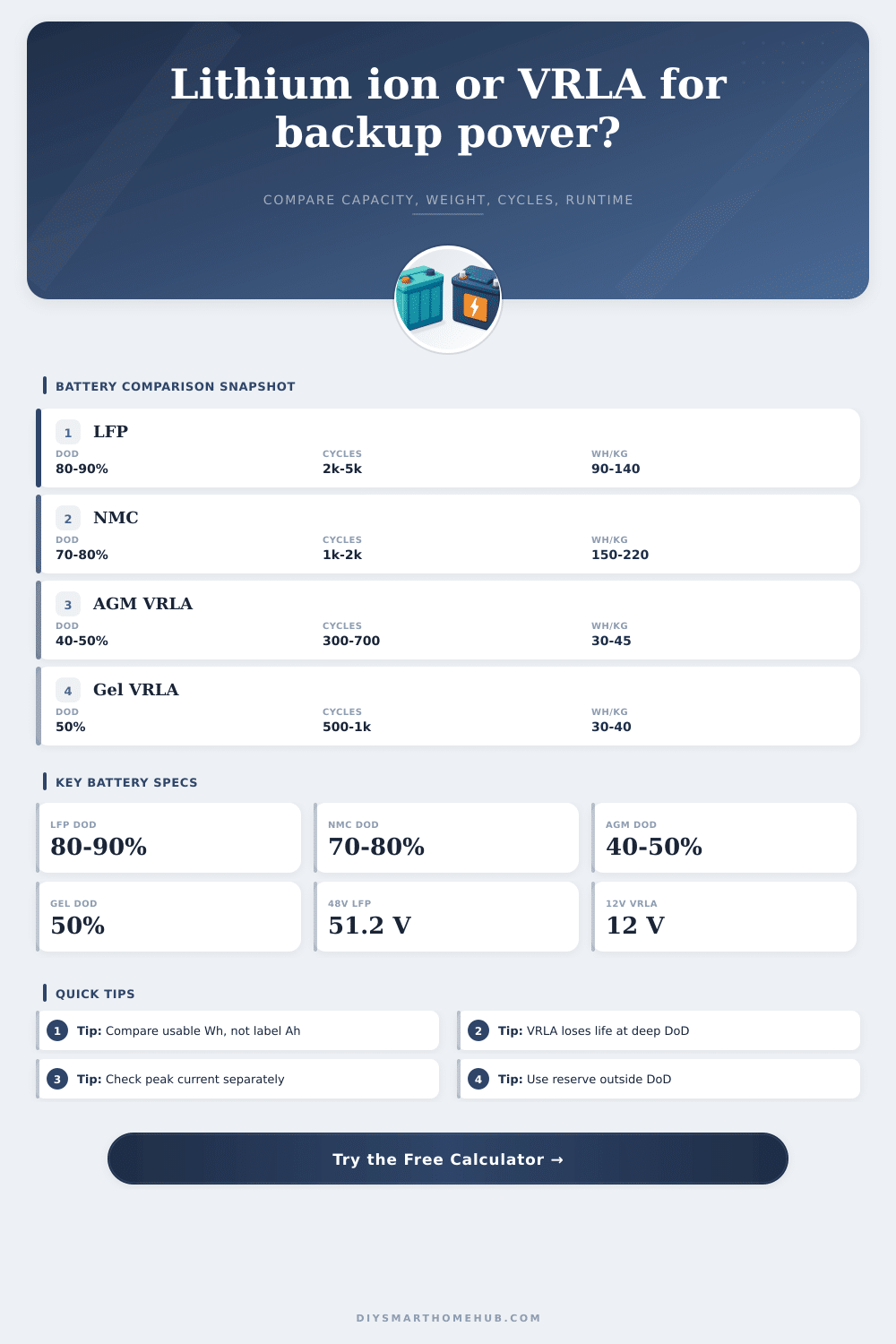
Usable Depth, Cycle Life, And Energy Density
| Battery type | Typical usable DoD | Typical cycle range | Energy density |
|---|---|---|---|
| LiFePO4 / LFP | 80% to 90% | 2,000 to 5,000 | 90 to 140 Wh/kg |
| Lithium NMC | 70% to 80% | 1,000 to 2,000 | 150 to 220 Wh/kg |
| Lithium titanate | 80% to 90% | 7,000 to 15,000 | 60 to 90 Wh/kg |
| AGM VRLA deep-cycle | 40% to 50% | 300 to 700 | 30 to 45 Wh/kg |
| Gel VRLA deep-cycle | 50% | 500 to 1,000 | 30 to 40 Wh/kg |
| High-rate UPS VRLA | 30% to 40% | 200 to 400 | 25 to 35 Wh/kg |
Nominal Voltage Building Blocks
| Nominal bus | LFP pack model | VRLA string model | Common smart-home use |
|---|---|---|---|
| 12 V | 4S LFP, 12.8 V nominal | 1 x 12 V monobloc | Router, alarm, small DC loads |
| 24 V | 8S LFP, 25.6 V nominal | 2 x 12 V in series | PoE switch, camera rack, lighting |
| 48 V | 16S LFP, 51.2 V nominal | 4 x 12 V in series | Inverter, rack UPS, home essentials |
| High DC bus | Series lithium modules | Large VRLA string | Dedicated UPS cabinets |
Common Smart Home Backup Examples
| Protected load | Average watts | Runtime target | Load-side energy |
|---|---|---|---|
| Router and fiber ONT | 18 to 35 W | 8 to 24 h | 0.14 to 0.84 kWh |
| Alarm panel and sensors | 8 to 20 W | 24 to 72 h | 0.19 to 1.44 kWh |
| PoE cameras plus NVR | 70 to 180 W | 4 to 12 h | 0.28 to 2.16 kWh |
| Network rack and hubs | 120 to 350 W | 2 to 8 h | 0.24 to 2.80 kWh |
| Whole-home essentials | 400 to 900 W | 2 to 12 h | 0.80 to 10.8 kWh |
Comparison Interpretation Guide
| Metric | Lithium-ion tends to help when | VRLA tends to fit when | Calculator signal |
|---|---|---|---|
| Usable energy | Runtime must fit in a compact space | Depth of discharge stays shallow | Installed kWh gap is large |
| Weight | Wall shelves or cabinets have limits | Floor loading is not a constraint | Weight ratio exceeds 2:1 |
| Cycle life | Frequent outages or testing are expected | Outages are rare and float life dominates | VRLA cycle years are short |
| Voltage stability | Loads dislike voltage sag near low SOC | UPS charger is already lead-acid tuned | Use battery type notes |
💡Calculation Tips
When choosing between a VRLA and an LiFePO4 battery, you need to understand the difference between the capacity listed on the battery label and the usable energy that the battery will provide to your devices. Many peoples make the mistake of thinking that the amp hours listed on the battery label represent the total energy that the battery will provide to there devices. However, a person must understand the difference between the nameplate capacity of the battery and the usable energy of that battery.
VRLA batteries has a few limitations regarding the energy that a person can use from the battery. For instance, manufacturers design VRLA batteries to be used in systems where the battery will only be deeply discharged a small fraction of the time. If a person deeply discharge a VRLA battery, the chemical structure of the battery will be permanent damaged.
Which Battery Is Better: VRLA or LiFePO4?
Additionally, if a person deeply discharges the battery relative to the rating of the battery, the VRLA battery will lose it’s lifespan and eventually fail. Because VRLA batteries can only be used for a small fraction of their rated capacity, a person will have to purchase a much larger VRLA battery bank to provide the same amount of usable energy as a smaller lithium battery. The other type of battery, the LiFePO4 battery, allow the battery to be deeply discharged to a much more greater extent.
When deeply discharging a LiFePO4 battery, no chemical damage will occur to the battery. Additionally, the LiFePO4 battery will not lose any of its lifespan or its ability to hold a charge. When purchasing a LiFePO4 battery, a person is paying for the usable energy that the battery will provide to the devices in use.
In contrast, when purchasing a VRLA battery, a person is paying for the theoretical capacity of the battery. Another factor to consider between these two battery type is the weight of the batteries. VRLA batteries contain lead, which is a very heavily material.
If a person uses VRLA batteries in a system that is mounted on a shelf, for example, the shelf may bend or fail under the weight of the batteries. On the other hand, LiFePO4 batteries contain less lead and have a higher energy density. High energy density allows batteries to contain alot of energy relative to there size and weight.
The replacement cycle of a battery is another factor to consider when choosing between these two batteries. A VRLA battery will have a limited number of times that it can be charged and discharged before it can no longer hold a charge. If a person uses a VRLA battery in a system that is frequently cycling in and out of charge, the available number of cycle will be used up quickly.
After the VRLA battery is depleted of its available cycles, a person will have to replace it. On the other hand, a LiFePO4 battery will have a much higher replacement cycle than a VRLA battery. Therefore, a LiFePO4 battery will last much longer then a VRLA battery under the same condition.
Although a VRLA battery may have a relatively low cost when purchased, the total cost of ownership may end up being higher due to the need to replace the battery more frequent. Lastly, losses in efficiency are another factor to consider when choosing between these two battery types. For instance, if a person uses a DC-DC converter or an inverter to power the devices that the battery will power, some energy will be lost as heat.
If a person loses some of the energy that the battery provide to the devices, the battery will have to provide more energy than the devices consume. This lost energy has to be accounted for when calculating the necessary size of the battery. A person should choose a VRLA battery if the system is rarely deeply discharged so that the battery remains in its float state the majority of the time.
However, a person should choose a LiFePO4 battery if the system will be deeply discharged more often or if the system has weight limitations for its installation location. A person has to look beyond the number on the battery label to determine the correct battery for their devices. The number on the label isnt the same as the usable energy that the battery will provide to the device.