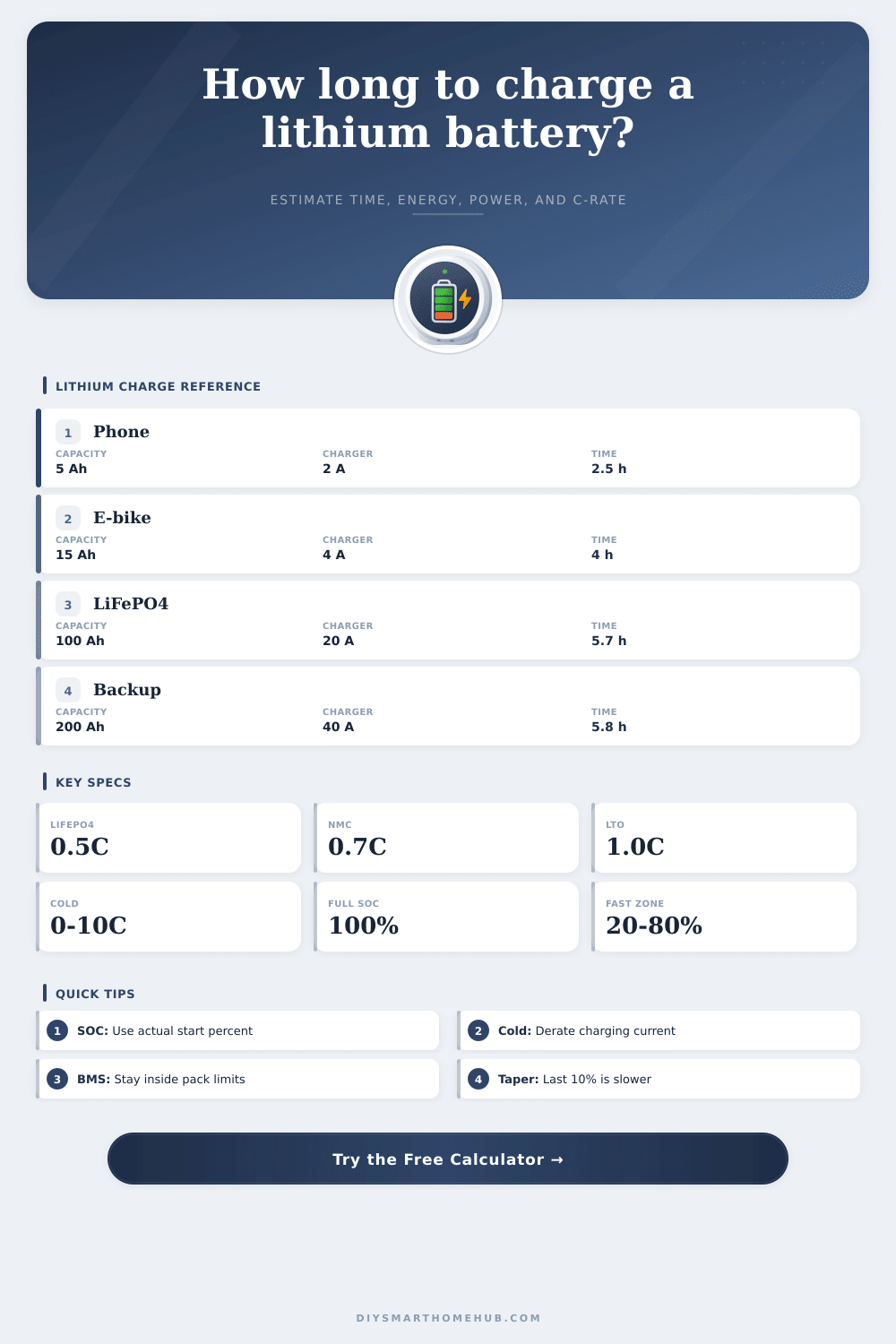
Lithium Battery Charging Time Calculator
Estimate charge duration, energy added, wall energy, charger load, and C-rate for lithium packs.
🔋 Real-World Battery Presets
⚙ Battery And Charger Inputs
This calculator estimates charging behavior using constant-current plus constant-voltage taper. Always follow the pack label, BMS limits, and charger manufacturer limits for the actual hardware.
📊 Chemistry Spec Grid
📐 Lithium Chemistry Comparison
| Chemistry | Nominal cell | Full cell | Typical max charge | Calculator taper |
|---|---|---|---|---|
| LiFePO4 / LFP | 3.2 V | 3.65 V | 0.5C to 1C | 12% at reduced current |
| NMC lithium-ion | 3.6-3.7 V | 4.20 V | 0.5C to 1C | 18% at reduced current |
| NCA lithium-ion | 3.6-3.7 V | 4.20 V | 0.5C to 0.7C | 20% at reduced current |
| LCO phone/tablet | 3.7 V | 4.20 V | 0.5C to 0.8C | 22% at reduced current |
| LMO power cell | 3.7 V | 4.20 V | 0.7C to 1C | 16% at reduced current |
| LTO lithium titanate | 2.3-2.4 V | 2.80 V | 1C or higher | 8% at reduced current |
⚡ Charger Current And Time Reference
| Battery size | 10A charger | 20A charger | 40A charger | Notes |
|---|---|---|---|---|
| 20 Ah pack | About 2.2 h | About 1.2 h | Check BMS limit | Small UPS or compact power station |
| 50 Ah pack | About 5.4 h | About 2.8 h | About 1.6 h | Common 12V portable packs |
| 100 Ah pack | About 10.8 h | About 5.6 h | About 3.0 h | Typical 12V LiFePO4 battery |
| 200 Ah pack | About 21.5 h | About 11.0 h | About 5.8 h | Large backup or RV bank |
🌡 Temperature Derating Table
| Condition | Battery temperature | Current factor | Charging effect |
|---|---|---|---|
| Normal | 15-35°C / 59-95°F | 1.00x | Rated charger current is usually available |
| Cool | 10-15°C / 50-59°F | 0.85x | Moderate current reduction |
| Cold | 0-10°C / 32-50°F | 0.55x | Slow charging; many BMS units limit current |
| Hot | 35-45°C / 95-113°F | 0.80x | Reduced current protects cells and electronics |
🗂 Common Battery Preset Comparison
| Preset | Pack | Typical charger | SOC window | Estimated use |
|---|---|---|---|---|
| Phone power bank | 3.7V 5Ah LCO | 2A | 15% to 100% | Small USB device estimate |
| 48V e-bike pack | 48V 15Ah NMC | 4A | 20% to 90% | Partial daily charge |
| 12V LiFePO4 | 12.8V 100Ah LFP | 20A | 20% to 100% | Solar, RV, and backup battery |
| Home backup | 25.6V 200Ah LFP | 40A | 30% to 100% | Large home energy bank |
| Server rack | 51.2V 100Ah LFP | 50A | 20% to 95% | Rack battery module |
✅ Charging Calculation Tips
Lithium batteries doesnt charge at a constant speed. Because lithium batteries do not charge at a constant speed, it is not possible to calculate the charging time for a lithium battery by dividing the battery’s capacity by the battery’s current. While you might assume that dividing the battery’s capacity by the batterys current will result in the charging time for the battery, that calculated time isnt accurate.
Lithium batteries change how they accept the energy that the battery is receiving as the battery fills with that energy. Lithium batteries perform charging in two phases. During the first phase, the battery receives an even amount of current while the battery is charging, and this phase is used to charge the battery to approximately eighty percent of its capacity.
Why Lithium Batteries Do Not Charge at a Constant Speed
During the second phase, the battery evenes out the voltage while the current being provided to the battery evened out and decreased, and this phase is used to perform the final charge of the battery. During this second phase, the decrease of current to the battery indicates that the final ten percent of charge to the battery takes the same amount of time than the first thirty percent of charging the battery. The chemical composition of the lithium battery impact how the battery charges.
For instance, a LiFePO4 battery will have a different charging cycle than an NMC battery. Additionally, people often use LiFePO4 batteries in solar battery setups while people often use NMC batteries in power tools. The chemical composition of the battery also impacts the rate at which people charge the battery.
A 1C rate for charging a battery will result in the charging current being provided to the battery that is equal to the battery’s capacity. However, batteries often perform best at a rate that is less than 1C, such as a 0.5C rate. Additionally, charging a battery at high rates results in an increase to the heat that the battery creates, and increasing the heat to which the battery is exposed can decrease the lifespan of that battery.
The temperature of the battery impacts both the movement of the lithium ions within the electrolyte of the battery, as well as the resistance of the batterys internal components. Warm temperatures allow for the lithium ions to easily travel through the electrolyte of the battery, but the cold temperatures allow for the movement of the lithium ions to slow within that electrolyte. If an individual attempts to charge a battery that is experiencing cold temperatures with a high charging current, the battery may experience the formation of plating of the metallic lithium, which can permanent damage the battery.
Battery management systems will often automatically reduce the current that they provide to the battery if they detect that the battery is experiencing low temperatures, which is one method by which they protect the battery from damage. The efficiency in which a battery is charged introduces another variable into the charging process. Not all of the energy that is sourced from the charger will enter the battery cells.
Some of the energy will be lost to the charging cables, as well as within the internal electronics of the battery charger. Because the charging cables and the internal electronics of the battery charger lose some of the energy as heat, the amount of electricity that is used from the electrical outlet will be more than the energy that is stored within the battery. Additionally, managing the state of charge of the battery can improve the longevity of the battery.
While many individuals charge their batteries to achieve one hundred percent charge, staying between twenty and eighty percent can help to reduce the stress placed upon the battery. Additionally, by avoiding charging the battery to one hundred percent, the battery avoids entering the constant voltage phase of charging, and avoiding the constant voltage phase allows for the battery to charge more quickley.