Lithium Battery Capacity Calculator
Estimate Wh, Ah, series cells, parallel strings, runtime, and peak C-rate for smart home backup packs.
LiFePO4 for fixed backup
Best fit for router UPS, camera backup, automation hubs, and wall-mounted home batteries where cycle life and thermal stability matter.
NMC / NCA for compact packs
Higher energy density helps when the enclosure is small, but conservative DoD and good battery management are more important.
LTO for high-cycle systems
Lower cell voltage means more series cells, yet very high cycle life suits frequent charge and discharge automation projects.
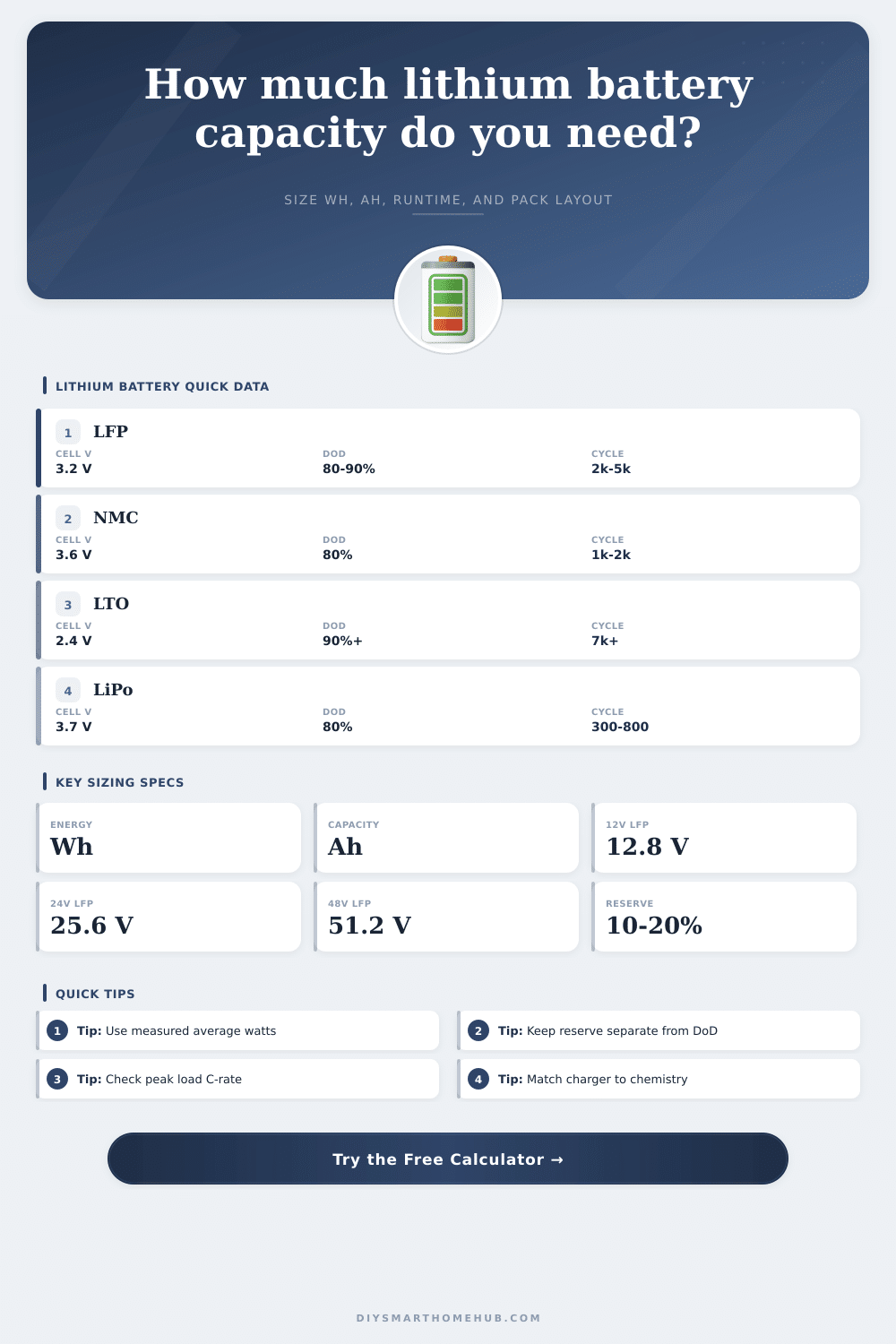
| Chemistry | Nominal Cell V | Full Charge V | Typical Usable DoD | Typical Cycle Range |
|---|---|---|---|---|
| LiFePO4 (LFP) | 3.2 V | 3.65 V | 80-90% | 2,000-5,000+ |
| Lithium NMC | 3.6 V | 4.20 V | 70-80% | 1,000-2,000 |
| Lithium NCA | 3.6 V | 4.20 V | 70-80% | 500-1,500 |
| Lithium polymer | 3.7 V | 4.20 V | 70-80% | 300-800 |
| Lithium titanate (LTO) | 2.4 V | 2.80 V | 90%+ | 7,000-15,000+ |
| Lithium manganese oxide | 3.7 V | 4.20 V | 70-80% | 300-700 |
| Smart Home Load | Typical Watts | 12 Hour Energy | 24 Hour Energy | Useful Voltage Class |
|---|---|---|---|---|
| WiFi router plus modem | 15-30 W | 180-360 Wh | 360-720 Wh | 12 V or 24 V |
| Security panel plus LTE | 8-18 W | 96-216 Wh | 192-432 Wh | 12 V |
| Home Assistant mini PC | 20-45 W | 240-540 Wh | 480-1,080 Wh | 12 V or 24 V |
| Two to four PoE cameras | 25-60 W | 300-720 Wh | 600-1,440 Wh | 24 V or 48 V |
| Network rack with NVR | 120-350 W | 1.44-4.2 kWh | 2.88-8.4 kWh | 48 V class |
| LFP Bank Class | Series Cells | Nominal Voltage | 100 Ah Energy | Common Smart Use |
|---|---|---|---|---|
| 12 V class | 4S | 12.8 V | 1.28 kWh | DC UPS and small hubs |
| 24 V class | 8S | 25.6 V | 2.56 kWh | Compact inverter backup |
| 36 V class | 12S | 38.4 V | 3.84 kWh | Special DC bus projects |
| 48 V class | 16S | 51.2 V | 5.12 kWh | Rack batteries and larger loads |
| Project Size | Average Load | Runtime Target | Usable Energy | Practical Starting Point |
|---|---|---|---|---|
| Router shelf | 22 W | 12 h | 264 Wh | 12.8 V 30 Ah LFP |
| Security cabinet | 12 W | 48 h | 576 Wh | 12.8 V 60 Ah LFP |
| Camera corner | 35 W | 24 h | 840 Wh | 25.6 V 50 Ah LFP |
| Smart lighting zone | 120 W | 6 h | 720 Wh | 25.6 V 50 Ah LFP |
| Home network rack | 300 W | 12 h | 3.6 kWh | 51.2 V 100 Ah LFP |
A smart home backup system is a collection of component that are used to provide electricity to the device in a smart home when the main power grid fail. Many people may believe that any battery could be used as a smart home backup system. However, careful planning are required for creating an effective system that accounts for the chemistry of the battery, the voltage of the battery, and the energy that is lost during the discharge cycle of the battery.
To create an effective battery backup system for a smart home, it is critical to consider each of these factor. The first factor to consider when creating a backup system for a smart home is the depth of discharge of the battery. The depth of discharge percentage represent how much of a battery’s total capacity can be used before the battery management system stop the discharge cycle of the battery to avoid damaging the battery.
How to Choose a Battery Backup for Your Smart Home
Using 100% of the battery’s capacity will damage the battery over time. Therefore, you can calculate the power needs of the smart home based off the usable capacity of the battery, which is less than the battery’s total capacity. The second factor to consider for a smart home backup system is the chemistry of the batteries.
There is different benefits to each type of battery chemistry. For example, people commonly use lithium iron phosphate (LiFePO4) batteries, also known as LFP batteries, for smart homes because the chemical element are chemically stable, and the batteries last for numerous charge cycles. If a smart home backup system must run for extended periods, these battery are a good option.
However, another alternative is using batteries with a different chemistry, such as NMC or polymer batteries. These batteries have more higher energy densities and are smaller in size. However, they do not last as long than LFP batteries.
The third factor to consider in the creation of a backup battery system is the voltage of the battery. Many small device have a 12-volt requirement. For larger devices, 24-volt or 48-volt batteries is used to improve the efficiency of the smart homes electrical system.
Using higher voltages allow for the movement of power with less current. Using less current allow for the reduction of heat within the system and the use of thinner wires to conduct the power. If the smart home has only a few small device to power, 12-volt batteries are sufficient.
However, if the smart home include larger devices, such as server racks, using a higher voltage will increase the efficiency of the power backup system. Efficiency is the fourth factor that must be considered when creating a backup battery for a smart home. Whenever power is converted from the battery to the devices in the smart home, some of that energy are lost as heat.
If the efficiency of the power converter is 90%, for example, 10% of the power from the battery is lost as heat. This loss of energy mean that the battery will not be able to power the devices in the smart home for as long as the number suggest it should of be able to. Considering the loss of efficiency ensure that the battery will be able to provide power for the amount of time that is needed for the smart home backup system.
The fifth factor to consider for a smart home backup battery system is the inclusion of a reserve buffer. The reserve buffer is not the same than the depth of discharge. While the depth of discharge protects the battery from being damaged, the reserve buffer protect the system against battery degradation.
Over time, batteries lose the ability to hold as much power as they used to be able. The same can be said for cold temperature and the power that batteries can hold. Adding a ten or twenty percent reserve to the battery ensure that the system will continue to function even as the batteries lose their capacity over time.
Finally, you must decide the series and parallel layout of the battery’s cells. Batteries in series create a higher voltage. Batteries connected in parallel has a higher capacity.
The series and parallel layout of the batteries must be chosen correct. Otherwise, the battery will not be able to power the devices in the smart home, or it will charge too slow. By using the correct voltage and capacity for the devices in the smart home, a smart home backup system can be create that provides power to the devices during periods of failure of the electricity in the smart home.