LiFePO4 Charge Time Calculator
Estimate charge hours for LiFePO4 battery banks using capacity, SOC window, charger current, BMS current limit, C-rate, CC/CV taper, and temperature derating.
This tool estimates charge time for LiFePO4 batteries only. Always follow the battery maker's BMS limits, low-temperature charge rules, and charger voltage settings.
| Nominal bank | Cells in series | Typical LFP charger voltage | Use this setting for |
|---|---|---|---|
| 12.8 V | 4S | 14.2 to 14.6 V | RV, boat, power backup, small solar banks |
| 25.6 V | 8S | 28.4 to 29.2 V | Trolling motors, 24 V inverters, larger solar banks |
| 38.4 V | 12S | 42.6 to 43.8 V | Specialty DC systems and custom packs |
| 48.0 V | 15S | 53.3 to 54.8 V | 48 V carts and equipment packs |
| 51.2 V | 16S | 56.8 to 58.4 V | Server rack batteries and home backup packs |
| Charge style | C-rate | Current on 100 Ah | Planning note |
|---|---|---|---|
| Storage-friendly | 0.10 C to 0.20 C | 10 A to 20 A | Low heat, long charge, good for unattended top-ups |
| Conservative daily | 0.25 C to 0.35 C | 25 A to 35 A | Common for RV converters and solar controllers |
| Normal fast | 0.40 C to 0.50 C | 40 A to 50 A | Check BMS, cable, charger, and temperature limits |
| High-rate rated | 0.70 C to 1.00 C | 70 A to 100 A | Only for packs specifically rated for this charge rate |
| Battery temperature | Charge derate used | What it means | Calculator behavior |
|---|---|---|---|
| Below 0 C | 0% | LiFePO4 charging is typically blocked | Shows a cold-charge warning |
| 0 C to 5 C | 5% | Only special low-current charging if allowed | Severely limits current |
| 5 C to 10 C | 25% | Cold pack, charge slowly | Applies strong current derate |
| 10 C to 20 C | 60% | Cool pack, moderate charging | Applies partial current derate |
| 20 C to 35 C | 100% | Normal LiFePO4 charging range | Allows full selected current |
| 35 C to 45 C | 85% | Warm pack, reduce current | Applies mild current derate |
| 45 C to 50 C | 50% | Hot pack, charge carefully | Applies heavy current derate |
| Preset | Bank | Default charger | Typical result |
|---|---|---|---|
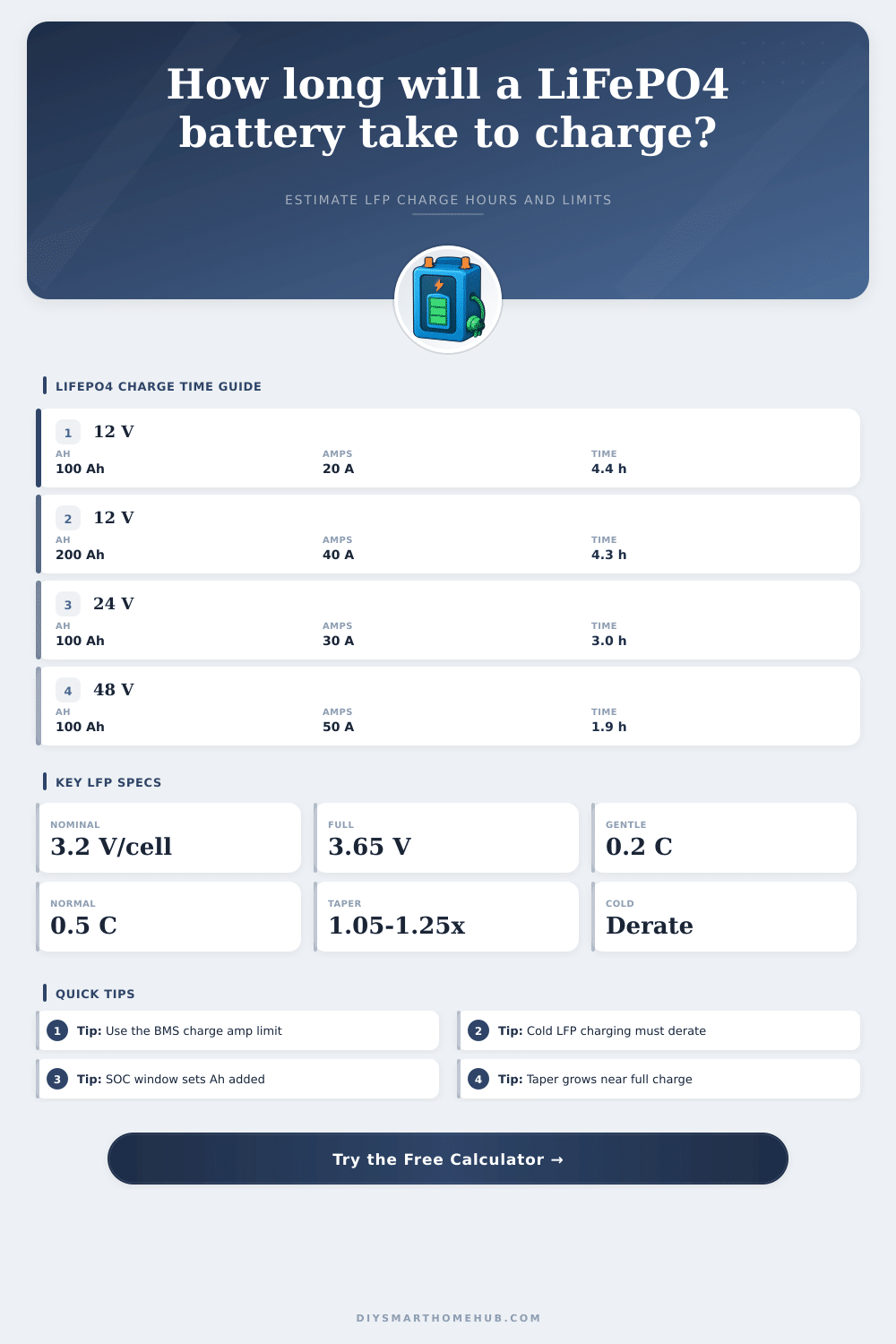
| 12 V RV 100 Ah | 12.8 V, 100 Ah | 20 A | About 4 to 5 hours from 20% to full |
| Van 280 Ah | 12.8 V, 280 Ah | 60 A | About 4 to 6 hours from mid SOC |
| 24 V Solar Bank | 25.6 V, 200 Ah | 50 A | About 3 to 4 hours for a 20% to 90% window |
| 48 V Rack Battery | 51.2 V, 100 Ah | 50 A | About 2 hours for a 30% to 95% window |
After a day of being off-grid, you pull up to a campground and hook up your shore power. Now what? How do you know when to disconnect? It’s not as easy as taking your charger current and dividing it by your battery capacity.
Lead-acid batteries don’t like that; lithium iron phosphate batteries are more forgiving, but not by much. There are clear rules for both. The calculator above figure out the math for your specific system configuration. No more guesswork with conversions and coefficients.
How to Charge Your RV Battery Safely
People make the largest error by mixing up the rating on the charger with reality of the battery. You might buy a sixty-amp charger for a hundred-amp-hour bank, thinking you’ll get a full recharge in an hour and forty minutes. Great! That means it’ll take an hour and forty minutes to fully charge the battery, right? Well…maybe not.
Remember: the effective current is always the lowest number in the chain. A thirty amp current is the most your Battery Management System will allow, so that excess hardware goes unused. The maximum C-rate set by your battery manufacturer are there to protect from heating damage. Your BMS enforces a hard cutoff during cell balancing. The charger provides whatever it can deliver up to those limits. Anything in the chain that’s going to bottleneck that flow lengthens your charge time accordingly. It’s not a flaw; its protection.”
But temperature is a whole different ballgame. Lithium batteries should of not be charged below freezing. Below 0 Celsius, the lithium ions cannot intercalate into the anode fast enough. This causes them to permanently plate on the anode and ruin cell. Most moddern BMS units will block charging when the internal temperature sensor reads near zero Celsius. Winter means patience or heat if you’re doing a winter shed bank.
The tool takes all that into account. When it gets cold, it derate current. It’s reflecting what chemistry is doing at a molecular level. The slow-down occurs because the chemistry just doesn’t want to move as fast anymore. And you can’t make chemistry speed up any faster than it wants to go. Doing so will shorten its life even quicker then any deep discharge.
Finally there’s that last ten percent. As lead-acid batteries charge, they gets a big bump in voltage and then quickly fall off. Chargers can easily detect when they’re finished. With lithium iron phosphate, the voltage curve is flat. It’s basically a shelf all the way until it gets almost full. Near the top, the charger switches over from constant current to constant voltage. After the switch, the amps trickle downward.
Charging from twenty percent to ninety percent is fast, at near full speed. But topping off from ninety-five percent to one hundred percent can be as long as the first half. Stop at ninety percent if you’re in a hurry. You’ll lose very little usability but gain back hours of charging time. Yes, the taper effect exists and matters.
Lithium has efficiency too. Not as much as one might think, but there’s a bit of efficiency lost. The conversion from AC to DC creates some heat. There’s also heat produced inside the cell due to its own resistance. Over time and a lot of charging, a little bit of that adds up. Running heavy loads while charging exacerbates this. If you’re charging while running your fridge, the fridge pulls fifty amps through your inverter. This means the charger have an additional fifty-amp draw to overcome. Now your charger is only supplying forty amps which means you’ll never get fully charged. Knowing this allows you to manage your loads when recharging.
On the page, there is also the handy reference tables of usual voltage targets based off the different series configuration. They can be used to check your voltage settings on your converter or solar controller. For example, you need more of a “boost” above the nominal rating if it’s a 12-volt bank. If it’s a 48-volt rack system, then you want exact high-voltage regulation. An incorrect number here results in undercharging the pack over time. This causes an imbalance between cells and leads to lower capacity.
Charging can be thought of like a bucket with a hole in it. Your battery is the bucket. Your load is the hole. Your charger is the tap, and your BMS is the guy shutting off the tap so you don’t overflow. If you can manage all three variables, you are in control. What you measure is what you get. But how do you measure? Measure properly by measuring the entire system; not just the largest number printed on the box.