💡 LED Strip Power Supply Calculator
Calculate the exact wattage & amperage needed for your LED strip installation
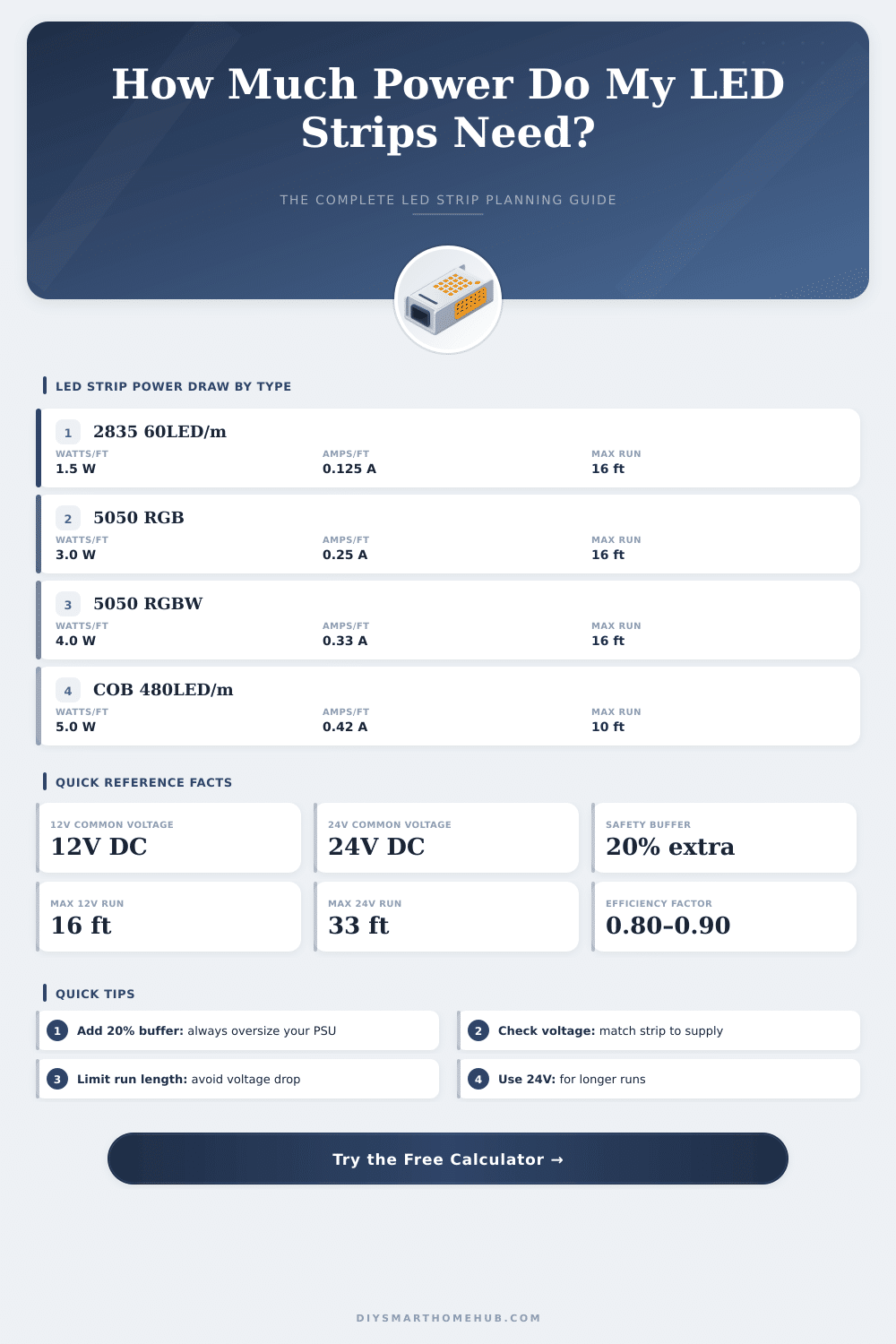
| Strip Type | Voltage | W/ft | W/m | A/ft | Max Run (12V) | Max Run (24V) |
|---|---|---|---|---|---|---|
| 2835 SMD 60 LED/m | 12V/24V | 1.5 | 4.8 | 0.125 | 16 ft (5m) | 33 ft (10m) |
| 2835 SMD 120 LED/m | 12V/24V | 2.9 | 9.6 | 0.24 | 16 ft (5m) | 33 ft (10m) |
| 5050 SMD RGB 60 LED/m | 12V/24V | 3.0 | 10.0 | 0.25 | 16 ft (5m) | 33 ft (10m) |
| 5050 SMD RGBW 60 LED/m | 12V/24V | 4.0 | 13.3 | 0.33 | 16 ft (5m) | 33 ft (10m) |
| 5050 Single Color | 12V/24V | 3.6 | 12.0 | 0.30 | 16 ft (5m) | 33 ft (10m) |
| COB 480 LED/m | 12V/24V | 4.9 | 16.0 | 0.41 | 10 ft (3m) | 20 ft (6m) |
| 2216 SMD 120 LED/m | 12V/24V | 2.0 | 6.5 | 0.17 | 16 ft (5m) | 33 ft (10m) |
| WS2812B Addressable | 5V | 2.2 | 7.2 | 0.44 | 16 ft (5m) | N/A |
| PSU Rating | Max Load (80%) | 12V — Max ft (2835 60) | 12V — Max ft (5050 RGB) | 24V — Max ft (2835 60) |
|---|---|---|---|---|
| 30W | 24W | 16 ft | 8 ft | 16 ft |
| 60W | 48W | 32 ft | 16 ft | 32 ft |
| 100W | 80W | 53 ft | 26 ft | 53 ft |
| 150W | 120W | 80 ft | 40 ft | 80 ft |
| 200W | 160W | 106 ft | 53 ft | 106 ft |
| 350W | 280W | 186 ft | 93 ft | 186 ft |
| 600W | 480W | 320 ft | 160 ft | 320 ft |
| Wire Gauge | Max Current | Voltage Drop at 16ft | Voltage Drop at 33ft | Recommendation |
|---|---|---|---|---|
| 28 AWG | 0.5A | 0.9V | 1.8V | Very short runs only |
| 24 AWG | 2A | 0.4V | 0.8V | Low-power strips <30W |
| 22 AWG | 3A | 0.25V | 0.5V | Standard strips up to 50W |
| 20 AWG | 5A | 0.16V | 0.32V | Medium runs 50–100W |
| 18 AWG | 8A | 0.10V | 0.20V | Long runs >100W |
| 16 AWG | 13A | 0.06V | 0.12V | High-power installations |
| Project | Strip Length | Strip Type | Total Watts | PSU Needed (20% buffer) | Amps Required |
|---|---|---|---|---|---|
| Under-Cabinet Kitchen | 16 ft | 2835 60 LED/m | 24W | 30W PSU | 2A @ 12V |
| TV Backlight | 10 ft | 5050 RGB | 30W | 40W PSU | 2.5A @ 12V |
| Bedroom Cove | 33 ft | 2835 120 LED/m | 96W | 115W PSU | 4A @ 24V |
| Living Room Accent | 49 ft | 5050 RGBW | 196W | 235W PSU | 9.8A @ 24V |
| Garage Workshop | 82 ft | COB 480 | 402W | 480W PSU | 20A @ 24V |
| Stair Lighting | 26 ft | 2216 120 LED/m | 52W | 63W PSU | 2.6A @ 24V |
LED strip lights work on a totally different principle compared to your usual tubes. They are powered by low voltage DC flow, so you need a Power Supply that receives the 120V or 240V AC from your wall outlet and converts it to the right DC voltage. Most LED strips are designed for 12V or 24V DC, that is the best level for their use.
An easy solution is to use a 12V plug adapter. Here you find many possible options for instance a 24-watt 12V source, that is UL-certified and takes care of the change from 110. 240V AC to stable 12V DC output. They work well for LED strips and other devices with low voltage.
How to Choose a Power Supply for LED Strips
Many of them also include protection against overheating and come with longer cables, which really simplifies the setup.
Here the spot about the power… It matters more than one hopes. Every LED Strip has its own power rating, and the Power Supply that you choose must cover that need.
A 12V source with 5 amps maximum fits in around 60 watts. The best method that I found is to add roughly around 20% extra room for safety. So if your strips use about 48 watts, a 60-watt source ends up being the wiser chioce.
Some Power Supply units go beyond simply changing voltage. Some models even read signals from a dimmer and adjust the brightness up or down. The IDLV-series does that great; it gives steady voltage with PWM dimming, that goes from 0 to 100%, ideal for strips.
On the other hand, non-dimmable sources work also well, especially when you combine single color or multicolor strips with a separate controller.
For wet or damp places, waterproof models are available. Mean Well offers IP65- and IP67-rated sources specially for such cases. In demanding setups, a 24V 350-watt Power Supply placed in a weather-resistant box can care for longer lines or several strips combined.
Voltage drop steals from you with longer strips. The cables in the strip itself lose voltage over distance, something that the specs commonly point out as maximum run length. Star wiring, that goes directly to the Power Supply, helps too settle that, keeping every branch under around 100 watts for safety.
Good seals and a reliable Power Supply stays good practice, even for just one strip.
In campers and tents, many folks connect 12V LED strips directly to the 12V DC system of the vehicle and totally skip the AC-to-DC converter. Like this the lights work without need of extra connections or starting of the generator. One thing to watch, the voltage can spike up to about 14V, when the alternator starts, which can wear LEDs more quickly.
A step-down converter keeps thatvoltage at 12V.
For small portable setups, lithium batteries or USB power can feed some strips without complex wiring. An AC wall adapter plugged directly in the outlet works also, if you want something fast and without issues.