LED Power Consumption Calculator
Estimate connected watts, average daily kWh, monthly kWh, annual kWh, standby draw, and the difference between LED fixtures and older lamp ratings.
Full calculation breakdown
| LED product | Typical input power | Common lumen range | Standby note |
|---|---|---|---|
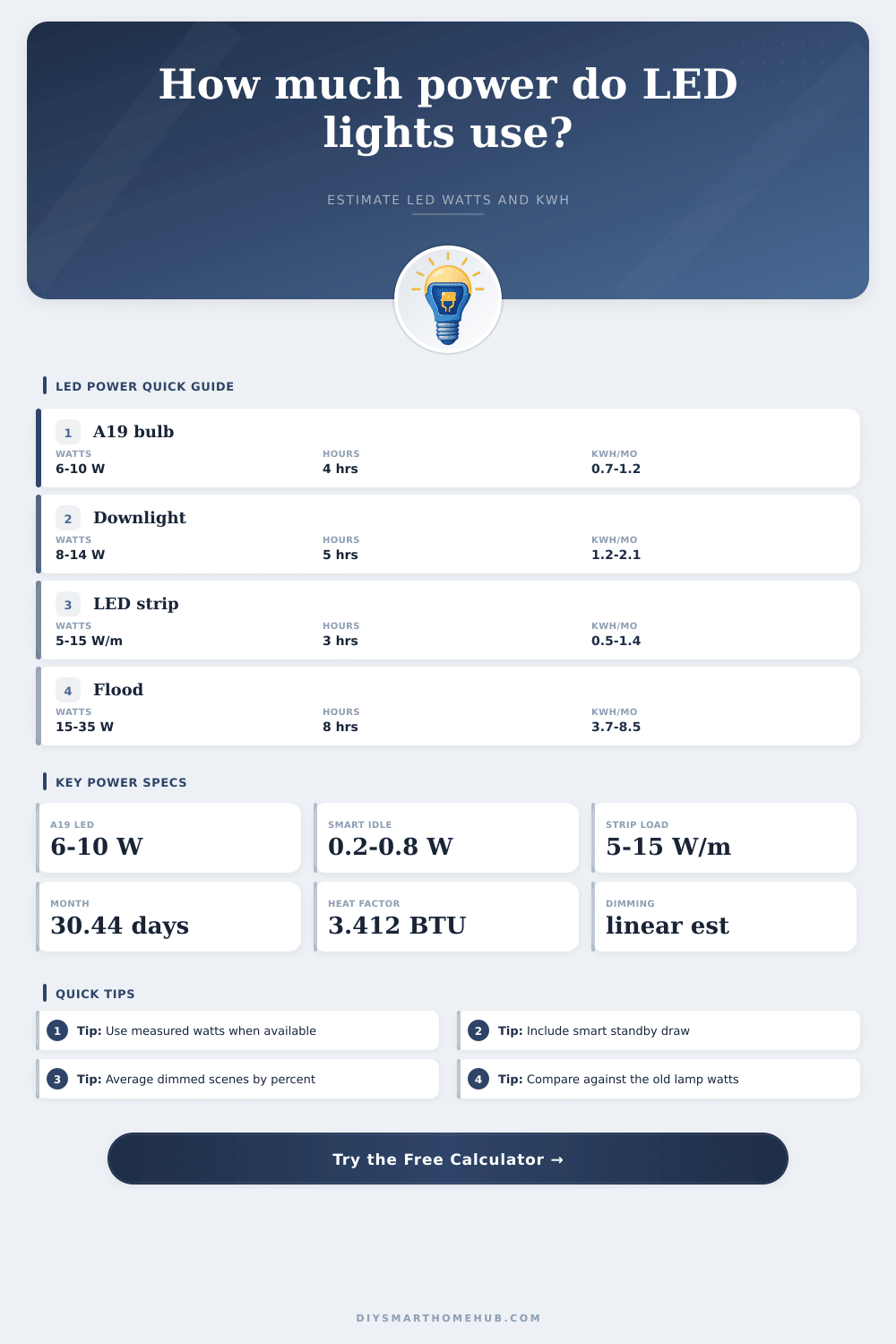
| A19 smart bulb | 6 to 10 W | 450 to 1,100 lm | 0.2 to 0.8 W when reachable |
| Recessed LED downlight | 8 to 14 W | 650 to 1,200 lm | Usually 0 W when switched off |
| 24 V LED strip | 5 to 15 W per meter | 400 to 1,500 lm per meter | Controller may idle at 0.3 to 1.5 W |
| Outdoor LED floodlight | 15 to 35 W | 1,500 to 4,000 lm | Motion sensor electronics can add standby |
| LED shop or panel fixture | 35 to 55 W | 3,500 to 6,500 lm | Typically 0 W when switched off |
| LED grow bar | 20 to 60 W | Rated more often by PPF than lumens | Timer or smart plug may add standby |
| Lighting zone | Typical daily runtime | Likely dimming average | Power note |
|---|---|---|---|
| Living room smart scene | 3 to 5 hours | 50% to 80% | Multiple low-watt bulbs plus standby |
| Kitchen task downlights | 2 to 5 hours | 80% to 100% | Fixture count drives connected load |
| Porch or entry dusk lighting | 8 to 12 hours | 60% to 100% | Runtime matters more than wattage |
| Night path lighting | 6 to 10 hours | 10% to 30% | Dimmed loads can be very small |
| Garage work lighting | 1 to 4 hours | 100% | High lumen fixtures, fewer hours |
| Seedling grow bars | 12 to 16 hours | 100% | Long runtime dominates annual kWh |
| Device electronics | Typical standby watts | When it applies | Calculator input |
|---|---|---|---|
| Non-smart switched LED | 0 W | Fixture is fully disconnected by wall switch | Enter 0 |
| WiFi or Matter smart bulb | 0.2 to 0.8 W | Bulb remains powered for network control | Enter per bulb |
| LED strip controller | 0.3 to 1.5 W | Controller listens for app or remote commands | Divide by strip zones if needed |
| Motion floodlight sensor | 0.5 to 2 W | Sensor and control circuit stay awake | Enter per fixture |
| Smart plug or relay | 0.3 to 1.2 W | Used to control a non-smart lamp string | Add to total or per controlled zone |
| Old lamp rating | Similar LED input | Typical reduction | Use in calculator |
|---|---|---|---|
| 40 W incandescent | 4 to 6 W LED | 85% to 90% | Baseline 40 W |
| 60 W incandescent | 7 to 10 W LED | 83% to 88% | Baseline 60 W |
| 75 W incandescent | 10 to 13 W LED | 82% to 87% | Baseline 75 W |
| 50 W halogen MR16 | 6 to 8 W LED | 84% to 88% | Baseline 50 W |
| 100 W incandescent | 14 to 18 W LED | 82% to 86% | Baseline 100 W |
While LED lights are energy efficient, the energy savings that is provided by using LED lights depend on the way in which the individual use those LED lights. An LED fixture may be very efficient, but if the LED light is always in standby mode or if the LED lights are often running at full brightness for long period of time, an LED light can still use a significant amount of electricity. In order to understand in what ways the LED lights may save money on electricity costs for an individual, it is important for that individual to understand all component of the energy that those LED lights may use.
The calculator that is provided allows an individual to input specific information regarding the LED lights that the individual is to be used. For instance, the individual must input the number of LED light fixture, the wattage of each of the fixtures, the brightness level of each of the lights, and the standby power of each of the LED lights. While an individual may be aware of the brightness and running hours of the LED lights, they may often forget to calculate the standby power draw of those lights.
How LED Lights Use Energy and Save Money
Standby power draw is especially true of smart LED bulb, as each of those bulbs continuously draws electricity to maintain its smart features, even while it is off. The standby power is often a constant draw of electricity, but can become a large amount over the course of a year. The brightness percentage of the LED lights is another variable that can alter the energy consumption of the LED lights.
For instance, an individual that dims the LED lights to sixty percent of the brightness of the light fixtures is reducing the amount of electricity that the LED lights emit by sixty percent. This percentage is used in the calculation of the wattage that the LED lights will use; the percentage ensures that the estimation of the energy use of the LED lights is accurate. Should the individual choose to use the LED lights for tasks that require the lights to be at 100% brightness, the individual will have to use the higher wattage of the LED lights to represent the energy draw of the lights when used for such tasks.
Another function of the LED lights is the standby function. As discussed above, any non-smart LED light fixtures will use zero electricity if they are turned off using a physical switch at the fixture. However, any Wi-Fi LED bulb will draw electricity in order to remain on and ready to recieve a voice command to turn the lights on.
Thus, those LED lights will use a steady amount of electricity each hour, regardless of whether the lights are on or off, and such electricity is known as standby power draw. When comparing the wattage of LED lights to the wattage of older lamps, there are often great difference. For instance, an older lamp may draw 60 watts of power, but the LED light may only use 8 or 9 watts to provide the same amount of light.
The savings that an individual can be provided by using LED lights instead of older lamps can be calculated based on the number of lamps and the number of hours that each of those lamps is used. The wattage of older lamps is still visible on the calculator to allow individuals to determine whether the installation of LED lights is worth the cost of those bulbs. In addition to the number of hours that the LED lights are used, the daily and weekly patterns in which those lights are used will also impact the total electricity that the LED lights use.
For instance, an individual may find that their porch light is used each evening from sunset until bedtime, but their hallway light is only used occasionally when they are walking through the hallway at night. Such differences in lighting hours can be accounted for in the calculation of the electricity consumption by the LED lights. This information may be of use in determining whether motion sensors should be placed in those lights.
The amount of heat that the LED lights emit is another variable that may impact the amount of electricity that is used by the lights. For instance, older lamps can emit a great deal of heat, but LED lights emit the majority of their energy as light. Thus, an individual may save additional electricity costs by reducing the amount of work that an air conditioner must be performed by in order to cool a room that is lit with LED lights rather than older lamps.
Such information can be provided by the calculator, which converts the active wattage of the LED lights to BTUs per hour of heat energy that is emitted by the light fixtures. Although the calculations are based upon the specifications of the LED lights, the actual lights that are purchased may not always reflect those number. Instead, the information that is used in the calculation is the actual input wattage for each LED light fixture.
Using the wattage information that is printed directly on the LED light will ensure that the LED light is calculated to use the correct amount of energy. In addition to the factors discussed above, the number of hours that each of the LED lights is used each day may change with the change of the seasons. For instance, during the winter months, each individual may use the LED lights in their living areas for longer periods of time, but in the summer months, there is more natural light after sunset, so the LED lights may be used for fewer hours.
However, the standby power draw of the lights will remain the same throughout the year. Such information may be of use for those managing the LED lights to understand how there electricity bills change from season to season. Based off the information provided by the calculator, an individual can make decisions regarding the use of the LED lights.
For instance, if the standby power draw is high for each of the LED lights, the individual may wish to place a switch to turn the lights off when not in use. However, if the energy savings from using LED lights to older lamps is low, this may be because the LED lights are being used at a reduced brightness. Thus, the calculator can help an individual to gain a better understanding of the actual electricity use of the LED lights.
The value of the LED light calculation is that it turns general information about LED lights to specific numbers. For instance, the LED lights can be used to determine exactly from where the electricity for the LED lights is coming. Furthermore, if an individual determines the amount of electricity that is used by each portion of the LED lights, it becomes possible for that individual to make decisions about what changes to LED lights will provide the greatest savings in electricity use.