🌡️ Joules to Kelvin Converter
Convert thermal energy (joules) to temperature (kelvin) using the Boltzmann constant. Supports single particles, moles & systems.
| Temperature | Kelvin (K) | k𝐵T (Joules) | (3/2)k𝐵T Kinetic Energy |
|---|---|---|---|
| Liquid Helium | 4.2 K | 5.80×10⁻²³ J | 8.70×10⁻²³ J |
| Liquid Nitrogen | 77 K | 1.06×10⁻²¹ J | 1.60×10⁻²¹ J |
| Dry Ice (CO₂) | 194.65 K | 2.69×10⁻²¹ J | 4.03×10⁻²¹ J |
| Room Temperature | 298 K | 4.11×10⁻²¹ J | 6.17×10⁻²¹ J |
| Human Body | 310 K | 4.28×10⁻²¹ J | 6.42×10⁻²¹ J |
| Water Boiling | 373.15 K | 5.15×10⁻²¹ J | 7.72×10⁻²¹ J |
| Iron Melting | 1811 K | 2.50×10⁻²° J | 3.75×10⁻²° J |
| Sun Surface | 5778 K | 7.98×10⁻²° J | 1.20×10⁻¹⁹ J |
| Formula Name | Equation | Use Case | Variables |
|---|---|---|---|
| Simple Inversion | T = E / (N × k𝐵) | N particles, any energy | E=energy, N=particles, k𝐵=Boltzmann |
| Equipartition | T = 2E / (f × N × k𝐵) | Statistical mechanics | f=degrees of freedom |
| Kinetic Energy | T = 2E / (3 × N × k𝐵) | Monatomic ideal gas | E=kinetic energy only |
| Molar (per mole) | T = E / (n × R) | Chemistry / per mole | n=moles, R=8.314 J/mol·K |
| Direct k𝐵T | T = E / k𝐵 | Single particle energy | E must equal k𝐵T exactly |
| Kelvin (K) | Celsius (°C) | Fahrenheit (°F) | Rankine (°R) |
|---|---|---|---|
| 0 K | –273.15°C | –459.67°F | 0 °R |
| 77 K | –196.15°C | –321.07°F | 138.6 °R |
| 273.15 K | 0°C | 32°F | 491.67 °R |
| 298.15 K | 25°C | 77°F | 536.67 °R |
| 373.15 K | 100°C | 212°F | 671.67 °R |
| 1000 K | 726.85°C | 1340.33°F | 1800 °R |
| 5778 K | 5504.85°C | 9940.73°F | 10400.4 °R |
| Temperature (K) | RT (J/mol) | (3/2)RT (J/mol) | (5/2)RT (J/mol) |
|---|---|---|---|
| 77 K | 640.2 J/mol | 960.3 J/mol | 1600.5 J/mol |
| 200 K | 1662.8 J/mol | 2494.2 J/mol | 4157.0 J/mol |
| 298.15 K | 2478.8 J/mol | 3718.2 J/mol | 6197.0 J/mol |
| 373.15 K | 3102.7 J/mol | 4654.0 J/mol | 7756.7 J/mol |
| 500 K | 4157.0 J/mol | 6235.5 J/mol | 10392.5 J/mol |
| 1000 K | 8314.0 J/mol | 12471.0 J/mol | 20785.0 J/mol |
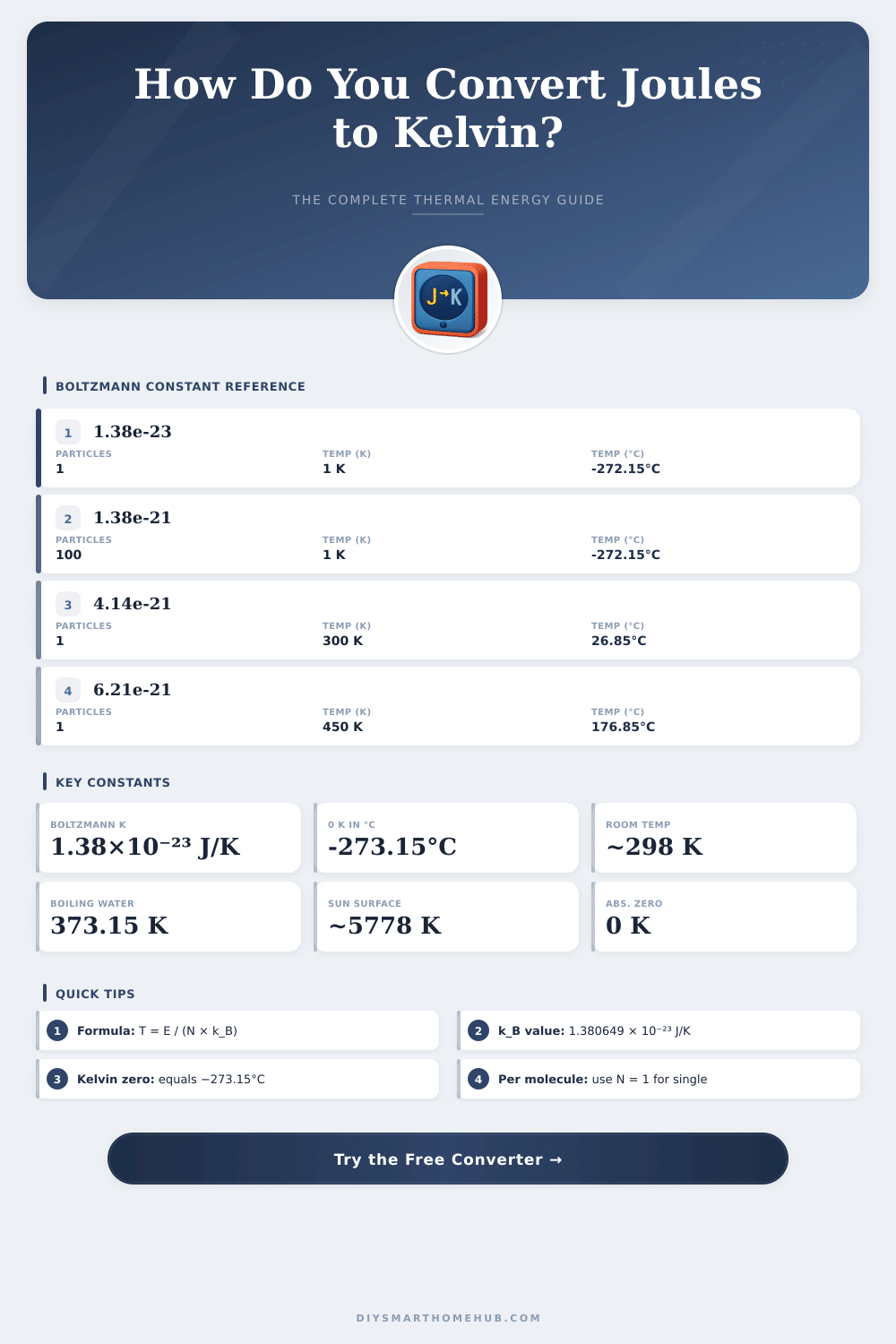
4.14e-21 for 4.14×10⁻²¹ J). The Boltzmann constant is 1.380649×10⁻²³ J/K — so room temperature energy per particle (~300 K) is approximately 4.14×10⁻²¹ J for a monatomic gas (3 degrees of freedom, using equipartition).
The change between džuloj and kelvinoj commonly appears in physical lessons. Here the main spot: džuloj and kelvinoj are not same kinds of size. Džulo measures energy, while kelvino shows temperature.
Because of that they are different physical units, so energy in džuloj can not transfer directly to kelvinoj.
Joules, Kelvins and Heat Capacity
That maybe seems unclear at first. Why so many folks use a tool of džuloj to kelvinoj, if direct change is not possible? The answer relates to a thing called varmkapablo.
Varmkapablo links džulojn with kelvinoj. It shows, how much energy is needed to raise the heat of material by one grade. One can show this relation by means of a basic formula.
Varmkapablo matches džulojn shared by kelvino. Like this, if you know the varmkapablon of some stuff and the added energy, you find the change of tmeperature. Even so, without knowing the material and its weight, there is no way to go directly from džuloj to kelvinoj.
For this there is a practical formula. The change of temperature matches the energy in džuloj divided by the product of specific varmkapablo and mass. Here Q means the energy in džuloj, C the specific varmkapablon, and m the weight of the object.
That result shows temperature change in kelvinoj. So it is not a pure direct change, it depends on the kind of substance, that you process, and on its amount.
Some online programs and pages offer tools of džuloj to kelvinoj or vice versa. They use many factors too ease the math. There are also online calculators, that care about relevant changes, for instance from džuloj each kelvino to kilodžuloj each kelvino.
For that case, the quick change is that one džulo each kelvino matches 0.001 kilodžuloj each kelvino.
If someone puts kelvinojn and džulojn in a simple tool without naming varmkapablon, there will probably be a mistake. The tool maybe will show, that it does not find a change between kelvino and džulo, because they are mismatched kinds. That makes sense, because one is a unit of temperature and the other of energy.
Many scientific formulas use kelvin-units. Working with energy and heat at the same time, the equation with varmkapablo forms the main bridge. To move energy in džuloj to temperature change in kelvinoj, you need to know the type of material and its weight.
Without those facts, thevalues simply do not connect.