Inverter Load Calculator
Model the connected backup load, real simultaneous usage, compressor surge, DC battery current, and runtime bridge for routers, cameras, refrigerators, pumps, office gear, and essential circuits.
📌Quick Load Presets
⚙Backup Load Inputs
Backup Load Results
Enter your load details to see inverter class, surge support, battery bank size, and DC current demand.
📊Selected Inverter Family Snapshot
Balanced outage coverage for mixed electronics and appliance circuits.
High conversion efficiency keeps runtime and DC current more manageable.
Always-on overhead when the inverter is energized waiting for outages.
Preferred battery voltage window for low-current, low-noise operation.
📑Common Backup Loads
Use measured values when possible. Compressor and pump starts often exceed rough appliance sticker estimates.
| Device Group | Typical Run Load | Typical Startup | Planning Note |
|---|---|---|---|
| Fiber ONT, modem, router, mesh | 40 to 110 W | 80 to 160 W | Electronic loads usually need little surge but prefer pure sine output. |
| PoE switch, NVR, cameras | 140 to 320 W | 200 to 450 W | Consider night IR load and record all PoE injector nameplates. |
| Full-size refrigerator | 150 to 300 W | 900 to 1600 W | Startup spikes dominate inverter sizing more than steady runtime watts. |
| Sump pump 1/3 hp to 1/2 hp | 800 to 1300 W | 1800 to 3200 W | Plan generous surge reserve because storm duty cycles can repeat quickly. |
| Pellet stove or furnace blower | 250 to 600 W | 700 to 1400 W | Fan motor starts are smaller than pumps but still matter. |
| Desktop, monitor, NAS, network rack | 220 to 700 W | 260 to 900 W | UPS-style inverter families often fit these stable electronic loads well. |
🔌Battery Bus and DC Current Guide
| Continuous Output | 12V DC Current | 24V DC Current | 48V DC Current |
|---|---|---|---|
| 1000 W | 93 A | 46 A | 23 A |
| 2000 W | 185 A | 93 A | 46 A |
| 3000 W | 278 A | 139 A | 69 A |
| 5000 W | 463 A | 231 A | 116 A |
| 8000 W | 741 A | 370 A | 185 A |
💻Inverter Family Comparison
| Family | Efficiency | Surge Style | Best Match |
|---|---|---|---|
| Compact Pure Sine | 91 to 93% | About 1.7x | Routers, TVs, chargers, and small appliance circuits. |
| Hybrid Battery Inverter | 94 to 96% | About 2.0x | Mixed home backup loads with smart panels and LiFePO4 banks. |
| Rack UPS Inverter | 90 to 94% | About 1.5x | Stable IT gear, office electronics, and network cabinets. |
| Motor-Heavy Backup | 89 to 92% | About 2.5x | Pumps, refrigerators, freezers, and blower starts. |
| Smart Panel Inverter | 95 to 97% | About 2.0x | Essential circuit subpanels and longer outages with larger batteries. |
| Telecom 48V Inverter | 93 to 95% | About 1.4x | Always-on communications, PoE, and rack systems with little motor load. |
📋Preset Scenario Quick Check
| Scenario | Connected Load | Runtime Target | Typical Bus |
|---|---|---|---|
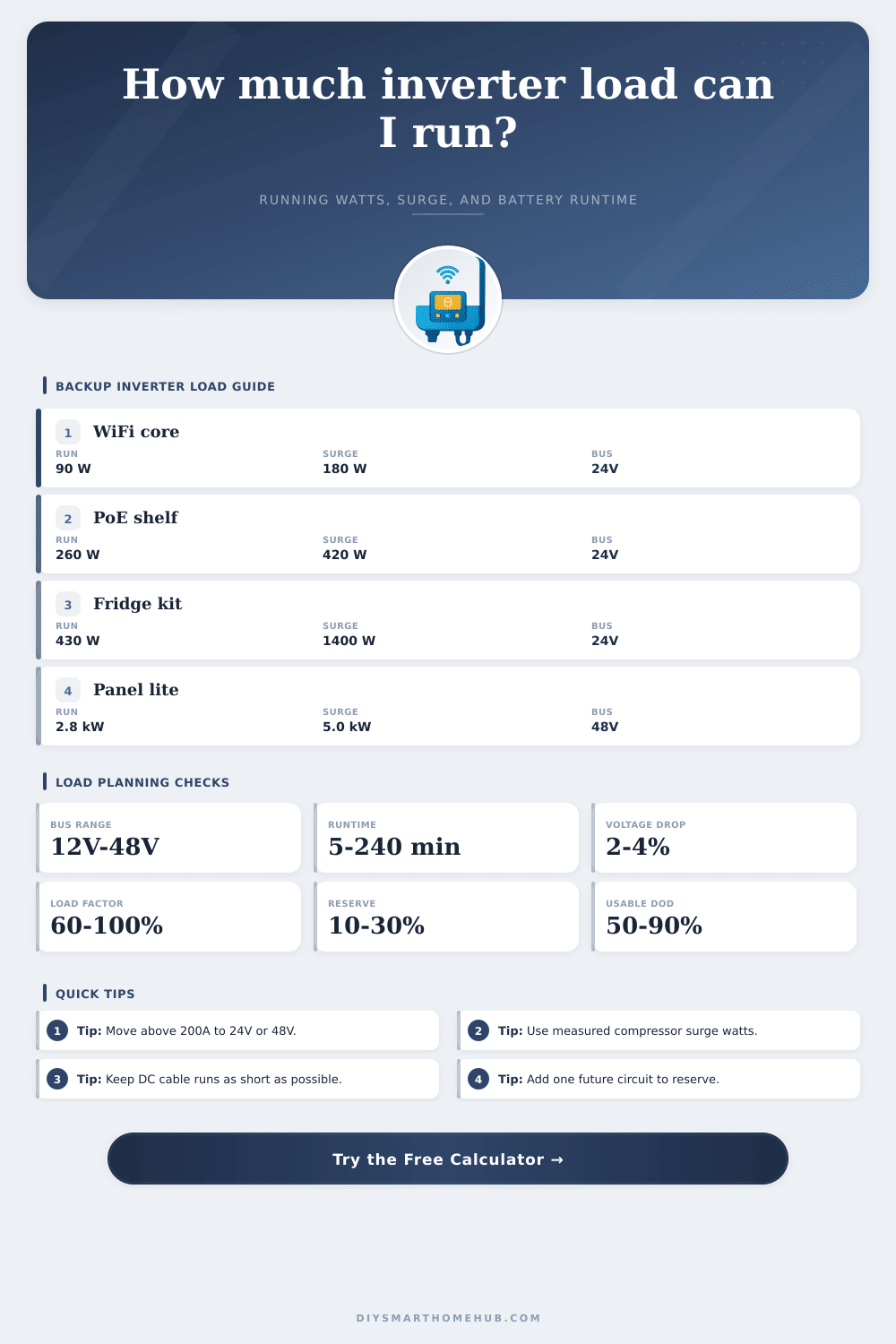
| WiFi Core Shelf | 120 W | 180 min | 24V DC |
| PoE Cameras + NVR | 340 W | 120 min | 24V DC |
| Fridge + Router | 520 W | 90 min | 24V DC |
| Office + NAS Rack | 840 W | 60 min | 48V DC |
| Essential Load Panel | 3400 W | 90 min | 48V DC |
When your calculator result shows more than about 200A on the DC side, the bus voltage usually needs more attention than the AC inverter nameplate.
For refrigerators, pumps, and freezers, measure startup with a power meter if you can. Real surge data prevents under-sizing more than adding random wattage buffer does.
An inverter will allow your appliances to continue to recieve power in the event that the electrical grid fails. In order to ensure that the inverter can provide power to your appliances, however, it is necessary to size the inverter correctly. Many individuals attempt to calculate the wattage that an inverter will need to draw from the appliances by simply adding the numbers that are found on the appliances manufacturer stickers.
In most cases, however, the result of such an addition will not reflect the correct size that the inverter should be. Instead, you must calculate the power requirement of the appliances in order to determine the power that each of the appliances will draw. For instance, appliances may draw different amounts of power when they are performing one task compared to another; a refrigerator, for instance, will draw more power when its compressor starts up compared to when it is performing its typical running tasks.
How to Size Your Inverter
In order to correctly size the inverter for an electrical system, it is necessary for individuals to understand the concept of diversified running load. Diversified running load is the total amount of power that will be drawn by the appliances at any given moment. In most instances, an inverter does not have to provide power to each appliance at maximum power simultaneously; the power required by each appliance will vary over time.
As a result, you can calculate the diversified running load by determining the total wattage of each appliance and then multiplying the number by a factor between 0.7 and 0.85; the factor represents the fact that only 70 to 85% of the total power of the appliances will be drawn at any one time. Additionally, it is also often recommended to add 20% to this calculation to account for the potential addition of additional appliance to the system. In addition to calculating the diversified running load of the appliances, it is also necessary to ensure that the inverter is sized to handle the surge power that motors and compressors typically draw in many appliances.
Surge power is the amount of power that is required by these appliances at the time that they start up. As a result, each of these motors will draw between two and three times there running wattage at the time that they start up; if the inverter is not able to supply that much power to the appliance, the inverter will fail or shut down. As a result of the recommended use of a plug-in watt meter to measure the starting wattage of appliances like refrigerators or sump pumps; the surge power that an appliance draws will often be higher than the wattage rating that is displayed on the appliances manufacturer stickers.
Providing for the surge power of the appliances will prevent the inverter from shutting down. Beyond calculating the power that will be drawn by the appliances, another of the factors that must be considered is the battery bus voltage. Battery bus voltage is a mathematical value that can be used to determine the amount of current that will flow through the system.
For instance, if an individual is using a 12-volt battery system to supply power to appliances that require 3,000 watts of power, the 12 volt battery system will need to supply 250 amps of DC current. The higher amount of DC current that a 12 volt system requires, however, requires the use of very thick cables and fuses; high DC current can also result in voltage sag within the system. In contrast, however, if an individual used a 48 volt battery system instead, the 48 volt battery system will only need to supply 60 amps of DC current.
48 volt systems, therefore, allow for the use of thinner wires, which is less likely to overheat during the operation of the system. In determining the time that the inverter will run before the batteries become empty of the stored electricity, the runtime of the system, another factor must be considered. Runtime is related to the capacity of the batteries that will be used in the inverter and the number of appliances that are to be supplied with power.
One type of battery that can be utilized in an inverter system are LiFePO4 batteries. LiFePO4 batteries can be discharged to 90% of their power capacity without damaging the battery. AGM batteries, in contrast, should only be discharged to 50% of their capacity otherwise their life will be significantly reduced.
Additionally, the idle draw of the inverter must be accounted for; inverting systems will typically draw between 30 and 40 watts of power even when the inverter isnt supplying power to any appliance. Beyond each of these factors that relate to the sizing of the inverter, additional factors must also be considered. For instance, the environment in which the inverter will be used can impact the performance of the inverter.
For instance, if the inverter will be located within a garage or similar location that is often hot, the temperatures may reduce the performance of the inverter by 5 to 10% of its rated output. Additionally, cold temperatures can impact the performance of the batteries that are used in the inverter. Additionally, the inverter will need to be properly ventilated to allow for the operation of its cooling fans; battery cables that are too thin or too long may lead to a loss of voltage.
By taking each of these factors into consideration and ensuring that each is properly accounted for in the power calculations that are made prior to installation of the inverter system, youll be ensured of the ability of the appliances to function properly during the power outages.