🏠 R-Value Insulation Calculator
Calculate insulation thickness, coverage area, and total R-value for any space — imperial or metric
per inch
per inch
per inch
per inch
per inch
per inch
per inch
per inch
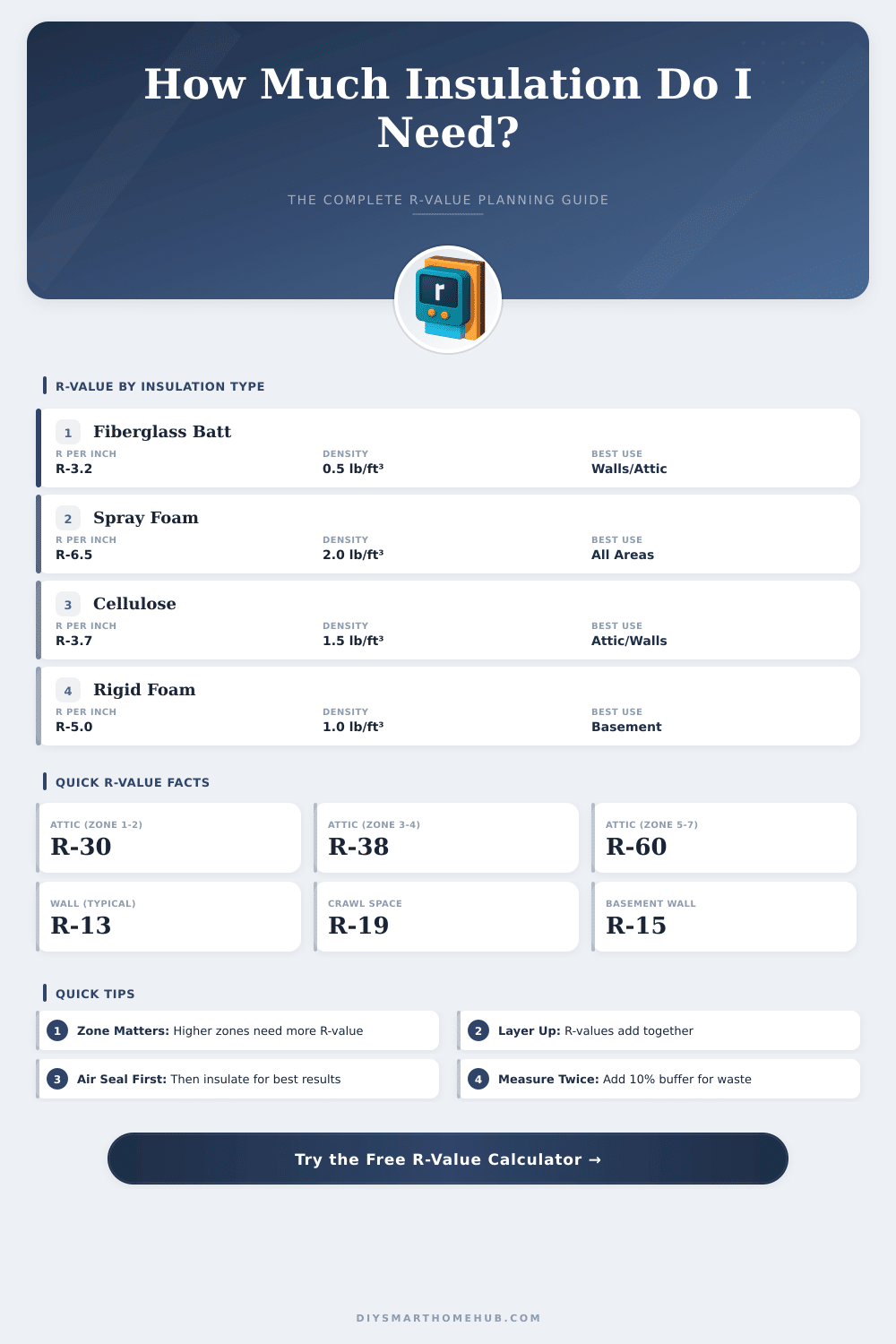
| Climate Zone | Location Examples | Attic R-Value | Wall R-Value | Floor R-Value |
|---|---|---|---|---|
| Zone 1 (Hot) | Hawaii, S. Florida | R-30 to R-49 | R-13 | R-13 |
| Zone 2 (Hot-Humid) | Texas, Louisiana | R-30 to R-60 | R-13 to R-15 | R-13 to R-19 |
| Zone 3 (Mixed-Humid) | Georgia, N. California | R-30 to R-60 | R-13 to R-21 | R-19 to R-25 |
| Zone 4 (Mixed) | Maryland, Oregon | R-38 to R-60 | R-13 to R-21 | R-25 to R-30 |
| Zone 5 (Cold) | Illinois, Michigan | R-49 to R-60 | R-13 to R-21 | R-25 to R-30 |
| Zone 6 (Very Cold) | Minnesota, Montana | R-49 to R-60 | R-15 to R-21 | R-25 to R-30 |
| Zone 7 (Subarctic) | N. Minnesota, Alaska | R-60+ | R-21+ | R-30+ |
| Thickness (in) | Fiberglass Batt | Cellulose Blown | Spray Foam Closed | Rigid EPS |
|---|---|---|---|---|
| 2 inches | R-6.4 | R-7.4 | R-13.0 | R-7.6 |
| 3.5 inches | R-11.2 | R-12.9 | R-22.7 | R-13.3 |
| 5.5 inches | R-17.6 | R-20.3 | R-35.7 | R-20.9 |
| 7.25 inches | R-23.2 | R-26.8 | R-47.1 | R-27.5 |
| 9.5 inches | R-30.4 | R-35.1 | R-61.7 | R-36.1 |
| 12 inches | R-38.4 | R-44.4 | R-78.0 | R-45.6 |
| 14 inches | R-44.8 | R-51.8 | R-91.0 | R-53.2 |
| Insulation Type | Bag Weight | Coverage at 4" | Coverage at 6" | Coverage at 10" |
|---|---|---|---|---|
| Fiberglass Blown | 25 lb bag | ~40 sq ft | ~27 sq ft | ~16 sq ft |
| Cellulose Blown | 25 lb bag | ~30 sq ft | ~20 sq ft | ~12 sq ft |
| Mineral Wool Batt | 60 sq ft/pk | 3.5" thick | N/A (layer) | N/A (layer) |
| Fiberglass Batt R-13 | 40 sq ft/pk | 3.5" thick | N/A (layer) | N/A (layer) |
| Rigid EPS (2" panel) | 4x8 ft sheet | 32 sq ft | Layer 3 sheets | Layer 5 sheets |
| Project / Location | Typical Area | Target R-Value | Best Material |
|---|---|---|---|
| Small Bedroom | 168 sq ft | R-38 (Zone 5) | Fiberglass Batt |
| Living Room | 360 sq ft | R-38 to R-49 | Blown Cellulose |
| Standard Attic | 800 sq ft | R-49 to R-60 | Blown Fiberglass |
| Large Attic | 1,500 sq ft | R-49 to R-60 | Blown Cellulose |
| Basement Wall | 400 sq ft | R-15 to R-21 | Rigid Foam EPS |
| Crawl Space Floor | 750 sq ft | R-25 to R-30 | Spray Foam Closed |
| Garage (detached) | 440 sq ft | R-13 to R-21 | Fiberglass Batt |
If you already have R-19 insulation and want to reach R-49, you only need to add an additional R-30 layer. Measure existing insulation depth before ordering new material to avoid over-buying.
Attic joists, HVAC equipment, and irregular shapes reduce usable area. Add at least 10% overage to your calculated coverage area. For blown-in insulation, add 15% to account for settling over time.
R-value simply points how well material blocks the heat across it whole. When the number is higher the insulation works more well. It measures the resistance against heat flow (the bigger the value), the hardly the heat moves over there, where it should not go.
Think of it as a score for how good something is at keeping heat where it needs to be.
What Is R-Value and Why It Matters
This measure counts for every material that is between two areas with different temperature. Dividing the difference of temperature by the thermal resistance, one gets a sense about how much heat escapes. The main idea is to reduce the ease by which heat passes through the material.
When one stacks several layers of insulation, their R-values simply add up. It is that easily.
There is legal duty for makers, installers, builders and stores to share info about R-values, based on standard test methods. That openness helps the folks choose more wisely when they buy insulation. One spot that not always one mentions is that R-values adjust according to the direction in which the heat flows through the product.
You probably will meet also U-value, that is the opposite of R-value. Here it easily confuses, for U-values, a smaller number is the better, and they commonly are fractions that hardly compare. R-values are nicely simple, because one only needs to search the bigger number.
So one sees R-values commonly in ads.
During camping, the R-value matters for sleeping pads. It decides the limit under which the heat of your body warms the pad more quickly than the soil steals it away. Pads between one and two and half R-values keep you comfortable until almost cool temperatures.
If one jumps to range of two and half until five, one has protection until almost zero degrees Fahrenheit. The most sleeping pads reach around seven, which allows you to sleep directly on snow, if needed. For cold trips, many use closed-cell foam pads under self-inflating ones.
One spot: blankets compact under weight, so they do not reach the same R-value as good pads.
Things get tricky when one talks about travel vehicles and R-values. Honestly, the most wholesale-produced models in budget and middle range simply do not have enough insulation for real use. Single windows?
They almost do not help for insulation. Even when makers praise their R-values, those numbers do not count windows, rubber seals around sliding doors and plastic windows up. Here the surprise, R-values for travel vehicles not even are officially measured, tested or certified according to any real standard.
One finds ads about R-38 on roofs and floors with R-7 on walls, but those claims commonly seem doubtful. Air gaps by themselves, when they only sit their, do notcount as real R-value, because they are not closed.