HVAC Energy Consumption Calculator
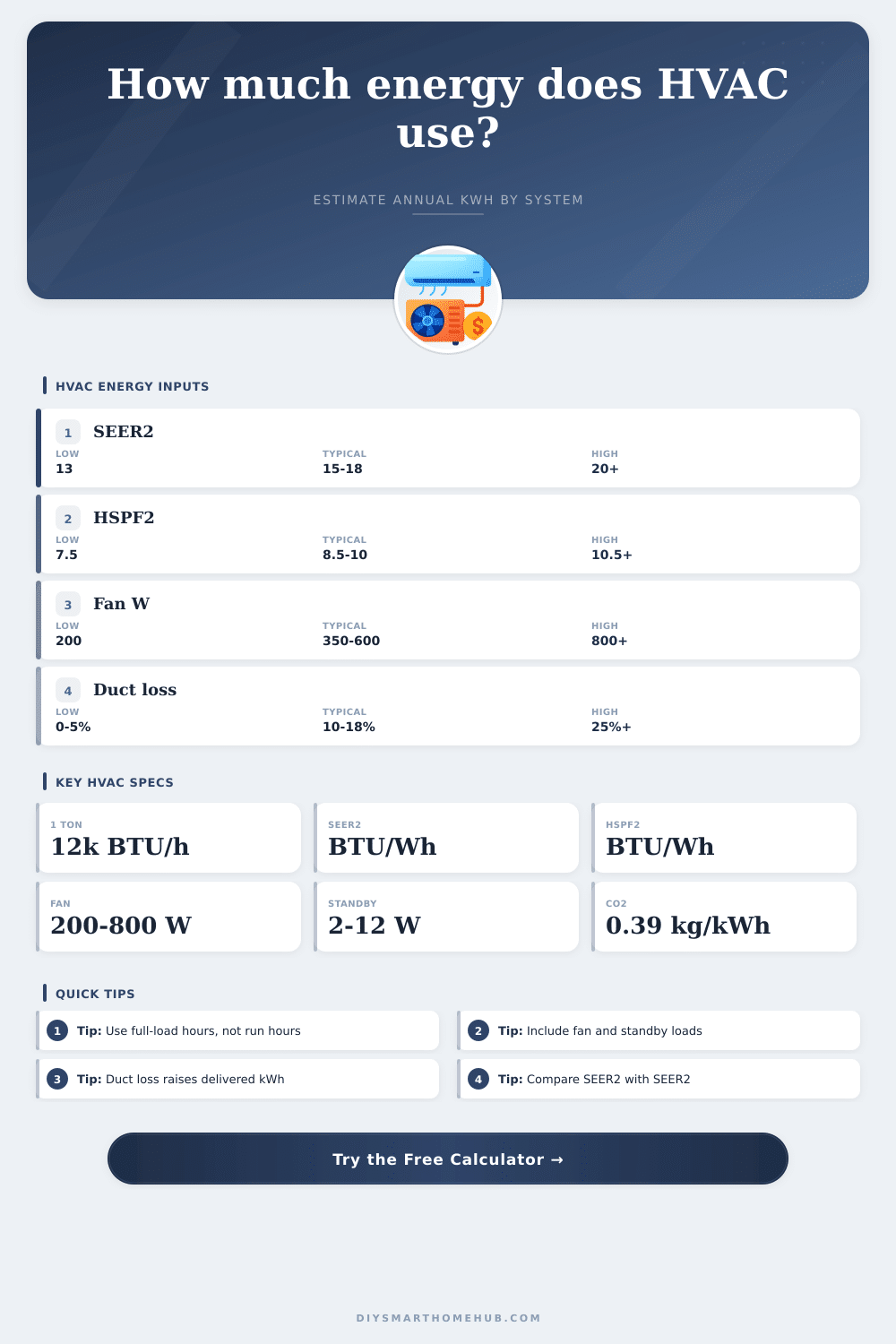
Estimate annual HVAC electricity use from equipment size, SEER2, HSPF2, equivalent full-load hours, fan watts, standby load, duct loss, and conditioned area.
⚙Real HVAC Energy Presets
🧮HVAC Consumption Inputs
HVAC Energy Consumption Results
Formula Breakdown
⚙Formula Spec Grid
📊HVAC Efficiency Reference
| Rating or load | Common value | Formula relationship | Consumption effect |
|---|---|---|---|
| One refrigeration ton | 12,000 BTU/h | Capacity tons x 12,000 | Defines delivered heating or cooling load |
| SEER2 cooling rating | 14.3 to 17 typical | Cooling kWh = BTU / SEER2 / 1000 | Higher SEER2 lowers seasonal cooling kWh |
| EER full-load rating | 10 to 13 typical | Input W = BTU/h / EER | Best for design-day or steady full-load checks |
| HSPF2 heat pump rating | 7.5 to 10.5 typical | Heating kWh = BTU / HSPF2 / 1000 | Higher HSPF2 lowers seasonal heating kWh |
| Duct distribution loss | 5% to 25% | Delivered load / (1 - loss) | Loss raises the equipment energy needed |
⏱Equivalent Full-Load Hour Reference
| Runtime profile | Cooling EFLH | Heating EFLH | Best matched scenario |
|---|---|---|---|
| Mild coastal home | 300 to 550 | 250 to 650 | Low seasonal loads and long shoulder seasons |
| Mixed climate house | 700 to 1100 | 500 to 1000 | Balanced heating and cooling consumption |
| Hot humid cooling-heavy | 1300 to 2200 | 100 to 450 | Air conditioning dominates annual kWh |
| Hot dry cooling-heavy | 1200 to 1900 | 150 to 550 | High sensible cooling with low heating load |
| Cold heating-heavy | 300 to 700 | 1200 to 2400 | Heat pump HSPF2 drives annual kWh |
🌬Fan, Standby, and Distribution Reference
| Component | Typical range | Calculator formula | When it matters most |
|---|---|---|---|
| ECM indoor blower | 150 to 500 W | Watts x hours/day x 365 / 1000 | Continuous fan settings and long runtime homes |
| PSC indoor blower | 400 to 900 W | Watts x hours/day x 365 / 1000 | Older forced-air systems with high fan hours |
| Ductless indoor unit fan | 20 to 80 W | Watts x hours/day x 365 / 1000 | Room mini splits with long low-speed operation |
| Thermostat and controls | 2 to 12 W | Watts x 8760 / 1000 | Always-on smart controls and crankcase heaters |
| Attic or crawlspace ducts | 10% to 30% loss | Load divided by 1 minus loss | Ducts outside conditioned space |
⌂Common HVAC Consumption Scenarios
| Scenario | Typical inputs | Primary output | Secondary output |
|---|---|---|---|
| Bedroom ductless mini split | 0.75 ton, SEER2 21, no ducts | Annual kWh | Fan and standby share |
| Apartment heat pump | 1.5 ton, mild climate, low fan watts | kWh per sq ft | Average daily kWh |
| Small central AC home | 2.5 ton, SEER2 14.3, 12% ducts | Cooling kWh | Distribution loss impact |
| Whole-house heat pump | 3.5 ton, HSPF2 8.8, mixed climate | Total HVAC kWh | Heating versus cooling split |
| Leaky attic duct system | 3 ton, 25% ducts, high fan watts | Annual kWh | Fan plus distribution load |
| Cold climate heat pump | 4 ton, HSPF2 10, 1800 heating EFLH | Heating kWh | CO2 reference output |
💡Calculation Tips
An HVAC system is an machine that provides heating and cooling to the home. All HVAC system use electricity to perform there functions. Since HVAC systems use a considerable amount of electricity, many individual end up with high utility bills.
High utility bills is common among homes that have HVAC systems in operation. This is because HVAC systems are complex machine with many moving parts. The capacity of HVAC systems refer to the amount of heat that they can move within the home.
Why Your HVAC Uses So Much Electricity
Efficiency relates to the amount of electricity that the HVAC system use to move that amount of heat. HVAC systems have a rating called the SEER2 and the HSPF2 rating. Both of these measure the efficiency of HVAC systems.
The higher the SEER2 or HSPF2 rating of an HVAC system, the more efficient the system is. The more efficient the HVAC system is, the less electricity the system will use to move the heat within the home. Therefore, HVAC systems with high efficiency ratings will cost less to operate than HVAC systems with low efficiency ratings.
HVAC systems use a measurement called equivalent full load hours to show how much electricity they use. HVAC systems do not run at the same speed 24 hours a day. Therefore, HVAC systems cycle on and off or change the speed at which they perform there function based off the level of humidity and the temperature of the home.
The equivalent full load hours represent the amount of energy that an HVAC system will need to maintain the desired temperature in the home. Using a calculator allows individuals to determine the equivalent full load hours that an HVAC system will use. Using such a calculator will prevent individuals from having to manually track the cycles that the HVAC system performs in a given year.
The compressor is the machine within the HVAC system that uses the most electricity. However, the indoor blower motor also use a considerable amount of electricity. The indoor blower motor is the fan that pushes the air through the vents that are located within the home.
The indoor blower motor within older HVAC systems can be inefficient and use alot of electricity. If individuals set the fan setting on the HVAC system to the on setting instead of the auto setting, the indoor blower motor will run constant. If the indoor motor runs constantly, the HVAC system will use a lot of electricity.
Another problem with HVAC systems is that the ductwork can make the system lose energy. If people do not seal the ducts properly, the HVAC system can lose energy to improperly sealed ducts. If the ducts are located in a hot part of the house, such as the attic, or a damp area, such as the crawlspace, the HVAC system can lose energy through the ductwork.
If the HVAC system loses energy to the ducts, it must work harder to reach the desired temperature. The HVAC system must work harder, therefore, increasing the electricity bill for the homeowners. Even if the HVAC system has a high efficiency rating, if the ductwork leaks energy, it will perform poorly.
The energy created by the high efficiency HVAC system will escape the ducts. Another problem with HVAC systems that is often overlooked is the standby load. Standby load is the amount of energy that the system use while in standby mode.
The smart thermostat, the WiFi modules, and the crankcase heaters all use a small amount of electricity while running in standby mode. These components create the standby load for the HVAC system. Although each component uses a small amount of electricity, the total standby load of the HVAC system will increase the total amount of electricity that the system will use each year.
Energy intensity is another measurement for HVAC systems. Energy intensity is the amount of electricity that a home uses per square foot. Using this measurement, individuals can compare the efficiency of there home to the baseline efficiency of homes of the