HEPA Filter Pressure Drop Calculator
Estimate clean and loaded static pressure across a HEPA stage from airflow, filter face area, depth, housing losses, and prefilter strategy before you commit to a filter cabinet or recirculation loop.
📌Quick HEPA presets
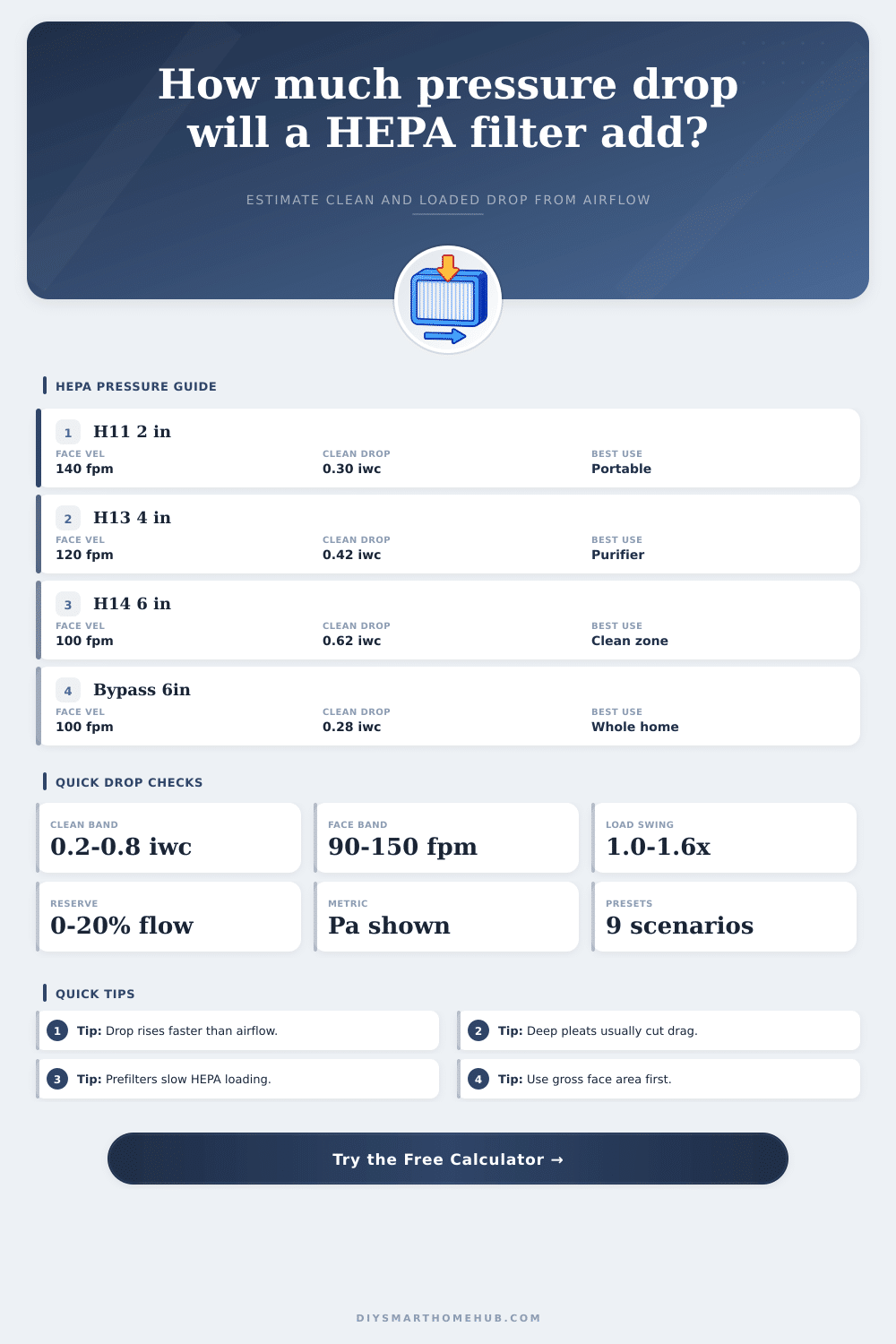
This calculator keeps the existing pressure model but reframes it for HEPA work: focus on clean and loaded drop, face velocity, and how much airflow the filter can carry before static budget becomes the hard limit.
📏Project inputs
💡Live planning notes
📈HEPA pressure and airflow results
📊HEPA pressure reference grid
📋Common HEPA face sizes
| Filter size | Gross area | MERV 8 quiet | MERV 13 1 inch | MERV 13 4 inch | Typical use |
|---|
🏷HEPA or prefilter family comparison
| HEPA or prefilter family | Free area | Quiet fpm | Max fpm | Ref drop | Best fit |
|---|
🏠HEPA scenario table
| Scenario | Room volume | ACH target | Room CFM | Filter-safe CFM | Read |
|---|
🛠Practical HEPA tips
If the target airflow is above the quiet band but still below the hard limit, expect more hiss at the return grille. Increasing face area is the cleanest fix.
When loaded pressure drop is already close to the budget on day one, the filter will become the system bottleneck before the next service interval arrives.
The pressure drop are a measurement of the resistance that the air encounters as it moves through the filter. Pressure drop is typicaly measured in inches of water column or in pascals. When a filter is clean, the pressure drop will be relatively low.
However, as particle begin to accumulate within the filter, the pressure drop will increase due to the fact that the particles have the effect of narrowing the paths that the air must take to pass through the filter. As the particles fills those paths, the resistance that the air encounters increases, thus contributing to an increase in the pressure drop of the system. The pressure drop will not necessarily increase at a steady rate as the air filter through the particles within the filter.
Why air filters make air hard to move
For example, if an individual doubles the amount of airflow that passes through the filter, the pressure drop may quadruple. Many individuals doesnt account for this potential increase in pressure drop when setting up there air filtration systems. As a result, the filter may become a bottleneck for the system, regardless of the strength of the fan that the system utilizes to move the air through.
HEPA filters, such as H13 or H14 HEPA filters, are among the most efficient at capturing 99.95% of particles that are 0.3 microns in size. Because of the small size of the particles that these filters must remove from the air, the filters have to be deeper in their design and have lower face velocities in order to capture those particles efficient. Face velocity is the rate at which air crosses the front of the filter, and it is measured in feet per minute.
In residential settings, people often preferred a velocity that is below 150 feet per minute. At these rates, the noise created by the system is lower, and the blower does not have to utilize as much power to push the air through the system. However, if an individual increases the face velocity to 200 feet per minute or higher, the noise levels will increase, the efficiency of the system may decrease, and the pressure drop will increase at an accelerated rate.
Deep pleats can be utilized to increase the amount of filter media within the cabinet without increasing the size of the cabinet. Deep pleats can help control the face velocity of the system. However, deep pleat filters load with dust more quickly within environments like a workshop.
Different environments contains different amounts and types of dust. For instance, a home that owns pets will have more lint and dander than a clean environment like a server closet. Thus, the increase in lint and dander will lead to a faster increase in the pressure drop of the filter.
In order to account for these different types of dust within the air, many professionals will include a buffer of 10% to 20% within their design estimates for the air filtration system. Additionally, many individuals will use a prefilter to the HEPA filter to control the amount of debris that enter the HEPA filter and reduces the likelihood of clogging the HEPA filters. Depending upon the use of the air filtration system, the requirements for air changes per hour will differ.
For instance, bedrooms require between 4 and 6 air changes per hour. Because bedrooms will be in operation for long periods of time, smaller filters can be used. In contrast, workshops will require 8 or more air changes per hour.
Therefore, robust fans will be required in these areas to overcome the static pressure created by the amount of dust that is present in these areas. In addition to HEPA filters, one must also consider the static pressure budget of the blower. For instance, blowers may have a spare capacity of 0.3 inches of water column.
The filter should be designed in a way that does not utilize all of that static pressure budget. An H11 HEPA filter may have a low initial pressure drop, but the H14 HEPA filter with deep media and low face velocities may be a better choice for those looking to provide efficient airflow through the system over an extended period of time. Many people make the mistake of only considering the initial static pressure drop that is created by the clean filter.
The manufacturer will list the static pressure drop for the clean filter, but that same filter will have a higher static pressure drop once it has been loaded with dust. For example, a filter rated for 500 cubic feet per minute when it is clean may only allow for 300 cubic feet per minute of airflow once it is loaded with dust. As a result, there may be a decrease in the air changes per hour.
In addition to all of the variables related to the filter itself, there are also housing losses that will contribute to the total static pressure drop of the system. For instance, any sharp turns in the air ducts or thin frames for the filters will contribute to the static pressure budget. These losses can contribute to a 10% to 20% drop in the static pressure budget for the system.
Thus, custom air filtration cabinets should seek to minimize these losses. To design an effective air filtration system, the individual will have to determine the target face velocity for the filter. The loaded pressure drop of the filter should be checked against the total static pressure budget of the blower.
The size of the filter can then be increased until the airflow meet the requirements of the area to be filtered. Using deep pleats and using prefilters will help to maintain the airflow and the cleanliness of the air.