Heating and Cooling Load Calculator
Estimate room or zone HVAC load with area, volume, insulation, windows, design delta-T, sensible cooling, latent cooling, BTU/h, and tonnage formulas.
⚙Load Scenario Presets
🌡Heating and Cooling Inputs
Design Load Results
Loads include envelope conduction, window gains, infiltration, estimated internal gains, latent cooling, and a 10 percent design margin.
Full Formula Breakdown
This is a planning load calculator, not a certified Manual J report. Use the results to compare equipment sizes and identify which inputs dominate the load.
📊HVAC Spec Comparison Grid
📐Envelope Assumption Reference
| Envelope Profile | Wall U-Factor | Ceiling U-Factor | Air Changes Used |
|---|---|---|---|
| Excellent tight envelope | 0.045 BTU/h ft² F | 0.026 BTU/h ft² F | 0.18 ACH planning value |
| Good upgraded house | 0.065 BTU/h ft² F | 0.035 BTU/h ft² F | 0.32 ACH planning value |
| Average mixed-age house | 0.090 BTU/h ft² F | 0.050 BTU/h ft² F | 0.55 ACH planning value |
| Poor leaky envelope | 0.140 BTU/h ft² F | 0.080 BTU/h ft² F | 0.90 ACH planning value |
☀Window and Solar Load Reference
| Window Profile | U-Factor Used | Solar Gain Used | Best Match |
|---|---|---|---|
| Low-E shaded glass | 0.30 BTU/h ft² F | 25 BTU/h per ft² | Overhangs, blinds, trees, north exposure |
| Low-E mixed exposure | 0.32 BTU/h ft² F | 55 BTU/h per ft² | Typical modern double-pane windows |
| Clear double-pane glass | 0.48 BTU/h ft² F | 110 BTU/h per ft² | Older double-pane without strong solar control |
| Hot west-facing glass | 0.50 BTU/h ft² F | 190 BTU/h per ft² | Afternoon sun on large glass area |
| Older single-pane glass | 1.05 BTU/h ft² F | 160 BTU/h per ft² | Single-pane or storm-window assemblies |
🧮Heating and Cooling Formula Reference
| Load Component | Formula Used | Inputs Needed | Result Type |
|---|---|---|---|
| Envelope conduction | U-factor × area × delta-T | Surface area, insulation, design temperatures | Heating and sensible cooling BTU/h |
| Air infiltration sensible | 1.08 × CFM × delta-T | Volume, ACH, indoor/outdoor temperature gap | Heating and sensible cooling BTU/h |
| Latent cooling | 0.68 × CFM × grains difference | Infiltration airflow and outdoor humidity severity | Cooling moisture BTU/h |
| Cooling tonnage | Total cooling BTU/h / 12,000 | Sensible load, latent load, design margin | Required nominal cooling tons |
🏠Common HVAC Capacity Cross-Check
| Scenario | Typical Area | Heating Load Check | Cooling Size Check |
|---|---|---|---|
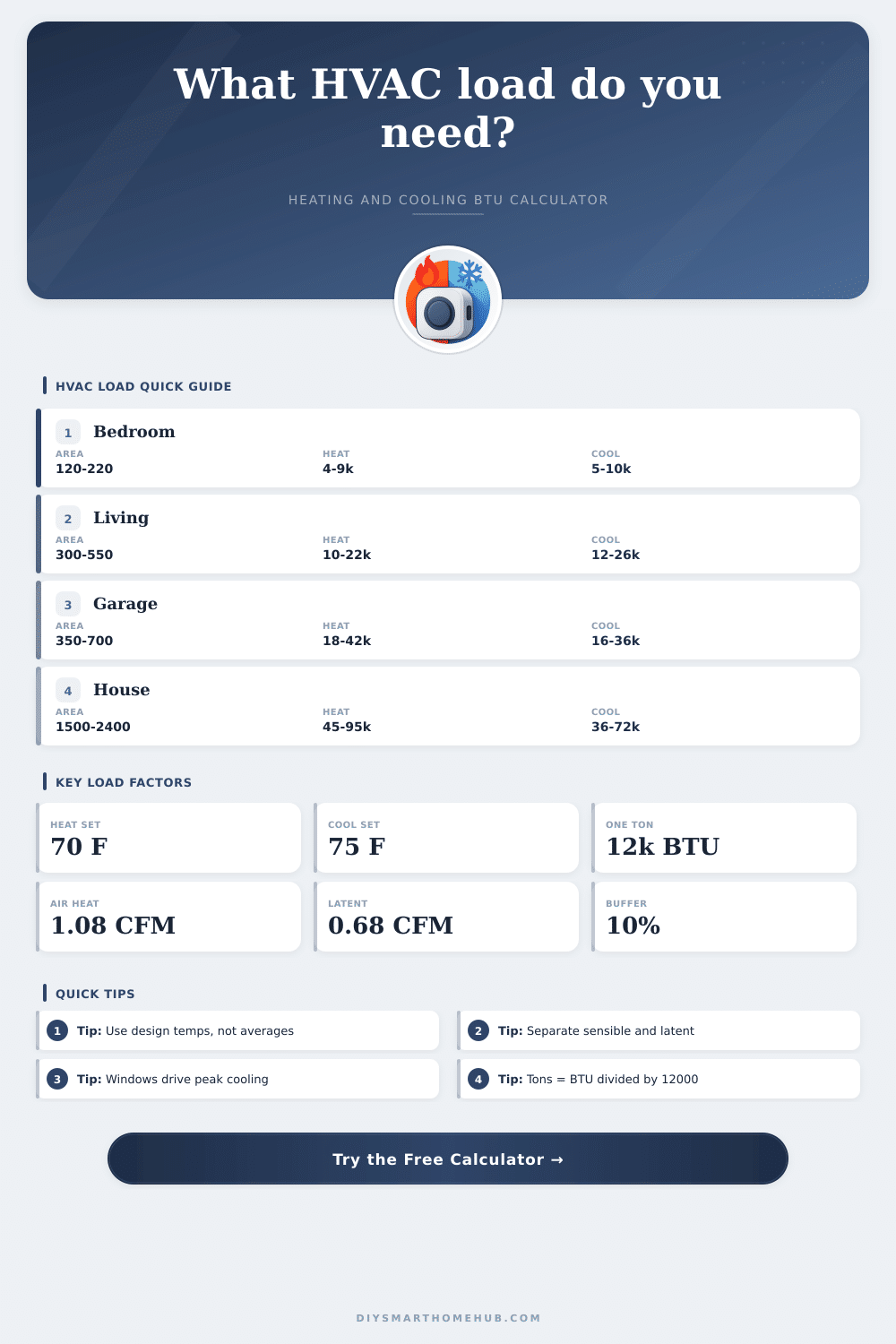
| Tight bedroom or office | 120-220 ft² / 11-20 m² | 4,000-10,000 BTU/h | 0.5-0.75 ton often reviewed |
| Average living room zone | 300-550 ft² / 28-51 m² | 10,000-25,000 BTU/h | 1.0-1.5 tons often reviewed |
| Sunny open plan space | 600-1,000 ft² / 56-93 m² | 20,000-45,000 BTU/h | 2.0-3.0 tons often reviewed |
| Garage or workshop zone | 350-700 ft² / 33-65 m² | 18,000-45,000 BTU/h | 1.5-3.0 tons if cooling is needed |
| Whole-house compact system | 1,500-2,400 ft² / 139-223 m² | 45,000-100,000 BTU/h | 3.0-5.0 tons depending on climate |
ℹLoad Calculation Tips
To determine the correct size for an heating and cooling system for a building, it is first necessary to determine how much heat move in and out of the building. Many person may believe that the square footage of the building is one factor in determining the size of the heating and cooling system that is necessary for that building. However, it is actualy necessary to determine factors related to the building shell for the building, the window that are used for the building, the air leakage of the building, and the humidity levels of the air outside the building.
Without considering each of these factors, the heating and cooling system may turn on and off too frequent during periods of mild weather, or may fail to provide heat or cooling to the building during periods of extreme weather. Thus, the use of calculations must consider each of these factors to determine the correct size for the heating and cooling system. To calculate the load that the heating and cooling system must move in and out of the building, the outdoor design temperatures for the location of the building is used as the starting point for the calculations.
How to Calculate Heating and Cooling Loads
Outdoor design temperatures are not the average temperature for the location, but the temperatures that are extreme and which occur during extreme weather conditions outside of the building. After outdoor design temperatures are established for the climate in which the building will be constructed, a calculator is used to determine the square footage of the building, the height of the ceilings within the building, the insulation levels within the building, and the area of the windows for the building. These variable in the calculator lead to the determination of several different load measurement for the building, including the heating BTU per hour, the sensible cooling load, the latent cooling load, and the total cooling tonnage for the building.
The heating load for a building is established through calculations of the conduction of heat through the building, as well as the air leakage of the building. Conduction occur due to the fact that the indoor temperature is often higher than the outdoor temperature, causing heat to move from the indoors to the exterior wall, ceilings, and floors of the building. The heating load can be determined through the calculation of how well the building is insulated, as well as how much outside air is allowed to enter the building through its doors, windows, and other openings in its shell.
More outside air means more intake of warm air into the building, increasing the heating load requirement for the building. Additionally, a small amount of extra heat can be provided to the building to ensure that the indoor temperature remain within the parameter that are set for the building. The cooling load for a building is established through the calculation of both the sensible cooling load for the building, as well as the latent cooling cooling load for the building.
The sensible cooling load is the amount of load created by the cooling of the air within the building. The latent cooling load for the building is the amount of load created by the removal of moisture from the air within the building. The latent cooling load is often more important in buildings in humid climate.
Therefore, by separating these two load with the calculator, the builder or technician can ensure that any HVAC system provided to the building will have sufficient capability to cool the building to the desired temperature. An additional variable that can be considered in the HVAC load calculation is the impact that the windows has on the heating and cooling loads. Winter month often show heating loads increasing due to the windows of the building losing heat more rapid than the walls of the building.
Summer month, however, often show that the windows of the building allow heat from the sun into the building. Calculations often allow for the selection of different profile for the windows, such as how much sunlight enters the building through those windows. Thus, the HVAC load calculator allows for the consideration of solar energy and heat from the sun.
The results that an HVAC load calculator can determine include the sensible heat ratio for the building. The sensible heat ratio is a representation of the relationship of the sensible cooling load to the latent cooling load for the building. If the sensible heat ratio is low, it means that the HVAC system will have to work to remove moisture from the air at a higher rate.
Higher sensible heat ratio indicate that the climate in which the building will be constructed is dry, and, therefore, a reduction in the cooling load requirements of the HVAC system. In addition to all of the factor that are collected through the HVAC load calculator, there are some additional variable related to the building that may impact its heating and cooling loads. For instance, all of the furnitures within the building, the appliance in the building, and the number of individual that live within the building will increase the heating and cooling loads.
Additionally, some construction detail of the building, such as recessed lights or construction detail that allow for the movement of heat through the building will also increase the heating and cooling loads of the building. Thus, while the load calculator will provide an estimate of the heating and cooling load of the building, it is also necessary to physically inspect the building to ensure that there are no additional variable that may impact the HVAC system requirements. The purpose of calculating the heating and cooling load for a building is to allow the HVAC technician to understand how heat and moisture move in and out of the building.
By understanding in what way and at what rate heat and moisture move in and out of the structure, it is possible to determine whether adjustment to the insulation of the building, the air sealing of the building, or the windows of the building are needed. By understanding how heat and moisture move in and out of the building, it is also possible to select the type of HVAC system that is required for the building. Thus, understanding how heat and moisture move in and out of a building ensures that an individual can select the correct HVAC system for that structure, leading to comfort for the individual within the building.