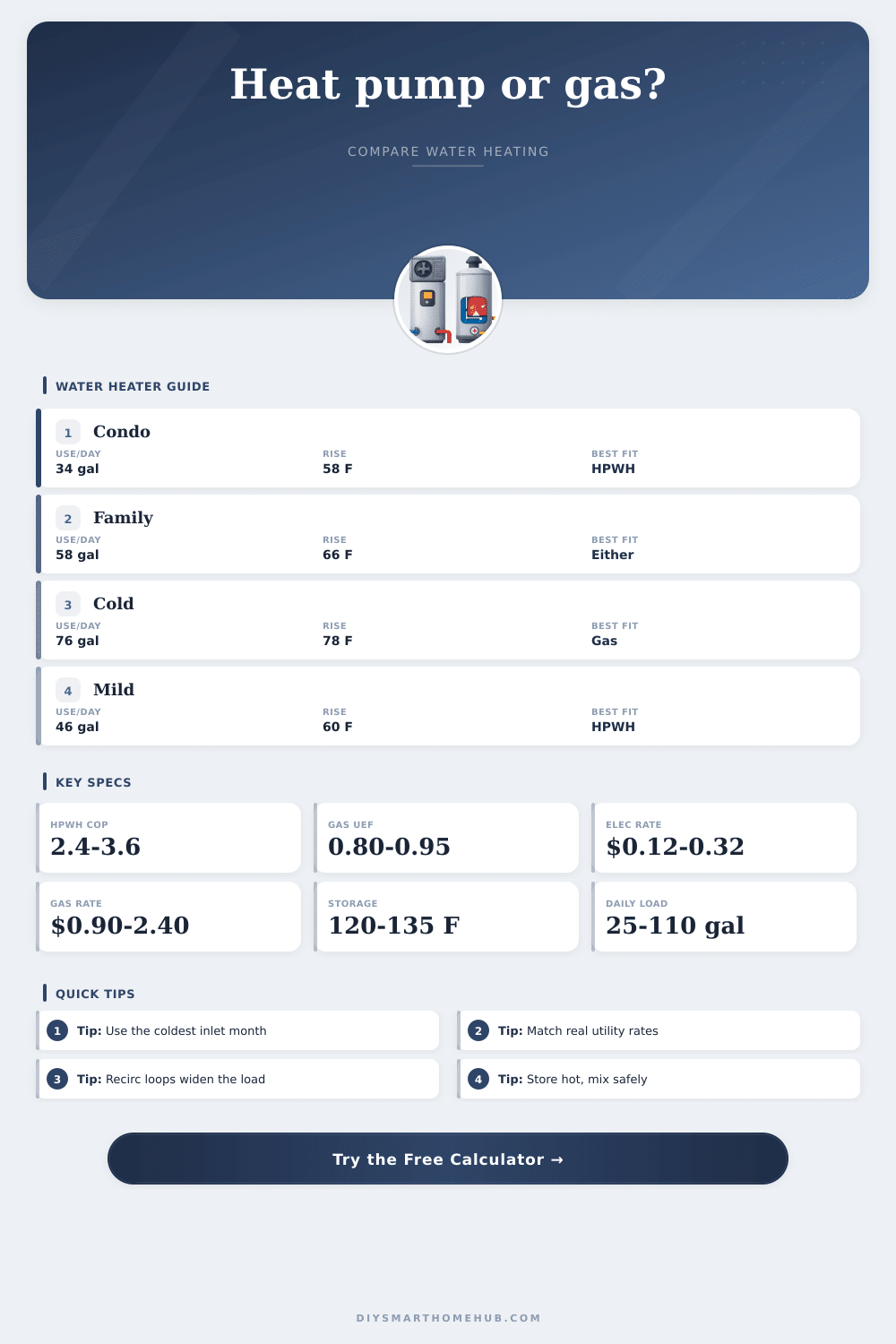
Heat Pump Water Heater vs Gas Calculator
Compare daily load, yearly operating spend, and the break-even gas rate for a hybrid heat pump water heater versus a gas unit using your own temperature rise and utility inputs.
Preset ready: Warm Coast Condo with moderate draw, warm inlet water, and a strong hybrid efficiency case.
| Home type | Use/day | Typical rise | Comment |
|---|---|---|---|
| Studio or condo | 25-40 gal | 50-60 F | Often strong for HPWH |
| Small family | 45-65 gal | 58-68 F | Close comparison zone |
| Busy household | 70-95 gal | 65-75 F | Storage and recovery matter |
| Heavy laundry home | 95-120 gal | 70-80 F | Gas can close the gap |
| Inlet water | Approx F | Approx C | Effect |
|---|---|---|---|
| Warm gulf or island | 65-72 | 18-22 | Smaller annual load |
| Mild mixed climate | 56-64 | 13-18 | Balanced comparison |
| Cold inland climate | 47-55 | 8-13 | Heat demand jumps |
| Deep winter well water | 40-46 | 4-8 | Gas often gains ground |
| HPWH COP | Room feel | Expected output | Planning note |
|---|---|---|---|
| 3.4-3.8 | Warm room | Very low kWh | Best operating case |
| 2.9-3.3 | Basement | Typical savings | Good all-around choice |
| 2.5-2.8 | Cool utility | Moderate savings | Check winter performance |
| 2.0-2.4 | Cold garage | Compressed margin | Gas may stay competitive |
| Gas UEF | Heater type | Standby feel | Break-even effect |
|---|---|---|---|
| 0.80-0.84 | Basic tank | Higher flue loss | Helps HPWH |
| 0.85-0.90 | Strong tank | Moderate standby | Mid-range matchup |
| 0.91-0.94 | Condensing tank | Lower standby | Gas narrows the gap |
| 0.95+ | Premium condensing | Very efficient | Gas can win at low rates |
These rows are meant to help you pressure-test your assumptions before you trust the annual comparison. Use the warmest and coldest realistic settings to see how stable your outcome is.
The difference between 62 F inlet water and 45 F inlet water changes the thermal load fast. A winter scenario is the safest way to see whether a heat pump unit still leads in your home.
Break-even math only helps when the rates match the real bill. Include delivery charges in the per-therm gas rate and the blended electric rate if your utility adds riders or seasonal fees.
Heat pump water heaters are also commonly called hybrid electric water heaters. These units have same ultra-efficient performance. They look like average water heaters, but absorb heat from the surrounding air.
Like this they use fewer energy to warm water. Stand-alone air-source heat pump water heater takes heat from the air around and transfers it to heat water in a storage tank at a higher temperature. It operates like a refrigerator in reverse.
How Heat Pump Water Heaters Work and What They Cost
Because this method, it reaches up to 4x the efficiency of a standard water heater. This technology produces zero emissions onsite and makes fewer greenhouse gases.
You buy stand-alone heat pump water heating system as one whole. In these systems are including water storage tank together with back-up resistance heating elements. The electric elements can change the heat pump to do it average electric water heaters.
They also work together with the pump in hybrid mode. In that way the heat pump runs only until some amount of warm water is used. Most heat pump water heaters are hybrids with traditional mode.
You can set it so that it work as usual electric water heater and do not take heat from the room. That is less efficient, but more comfy while very cold weather.
The precise upfront cost of heat pump water heater depend on several factors. Between them are the unit you buy, the time for install and the incentives you qualify for. Size and brand affects the price.
Heat pump water heaters cost between $1,200 for 50-gallon tanks to $2,500 for 80-gallon tanks made by the highest-end makers. You can look across various models to find the perfect energy-saving solution for your home. Some models have features as WiFi-connection, leak detection and glass-lined tanks.
There are different kinds of pumps available. Between them is air/water with storage tank, air/water with storage tank and internal heat exchanger or ground loop reversible house pump with a desuperheater and storage tank. It is important to mention, that the heat pump requires enough volume of free air in temperatures above freezing.
If too cold, the device will not work well. For instance, some units do not work under 45 degrees. In some climates the heat pump give not only warm water for wash, but also cool air for helpful natural cooling.
This also provides dehumidification during the whole year.