Heat Pump Size Calculator
Estimate heating and cooling design loads, nominal tonnage, airflow, and backup heat using your home shape, floor area, climate severity, insulation level, window exposure, and duct placement.
📌Preset Homes
Loaded preset: Tight Townhome sized from total conditioned area, a mixed climate profile, cold-climate inverter equipment, and a low-leakage envelope.
⚙Home and Climate Inputs
📊Recommended Size
📦Equipment Profiles
📖Reference Tables
| Climate | Winter | Summer | Driver |
|---|
| Envelope | Heat | Cool | ACH |
|---|---|---|---|
| Poor shell | 1.25x | 1.15x | 0.65 |
| Average shell | 1.00x | 1.00x | 0.45 |
| Good shell | 0.86x | 0.92x | 0.32 |
| High-perf | 0.72x | 0.82x | 0.20 |
📋Common Project Checks
| Home | Area | Size | Airflow |
|---|
| Rule | Target | Meaning | Use |
|---|---|---|---|
| Airflow | 350-425 CFM/ton | Blower match | Check coil setup |
| Heat retention | 72-95% | Low-temp output | Winter sizing |
| Window ratio | 12-18% | Solar swing | Cooling check |
| Ceiling height | 8-10 ft | Volume effect | Infiltration load |
💡Sizing Notes
Heating-dominant homes
If the raw heating tonnage is higher than cooling tonnage, a cold-climate inverter can reduce auxiliary heat without oversizing summer airflow as much as strip heat alone.
When a Manual J still matters
Use this calculator to frame the equipment class and tonnage band, then confirm final selection with room-by-room load and duct design before equipment is ordered.
Figuring out the right size of a heat pump is the most difficult step. Big unit does not work, likewise as little. Well chosen system guarantees comfort and low energy use.
If the device is too little, it hardly will heat or cool the house. That results in higher bills and extra repair costs. Systems that is too big cost 1,000 until 3,000 dollars more during setup.
How to Choose the Right Heat Pump Size
Annual costs for their use can grow in 10% until 25%. And too big and too little units must be replaced 3 until 5 years sooner than right size.
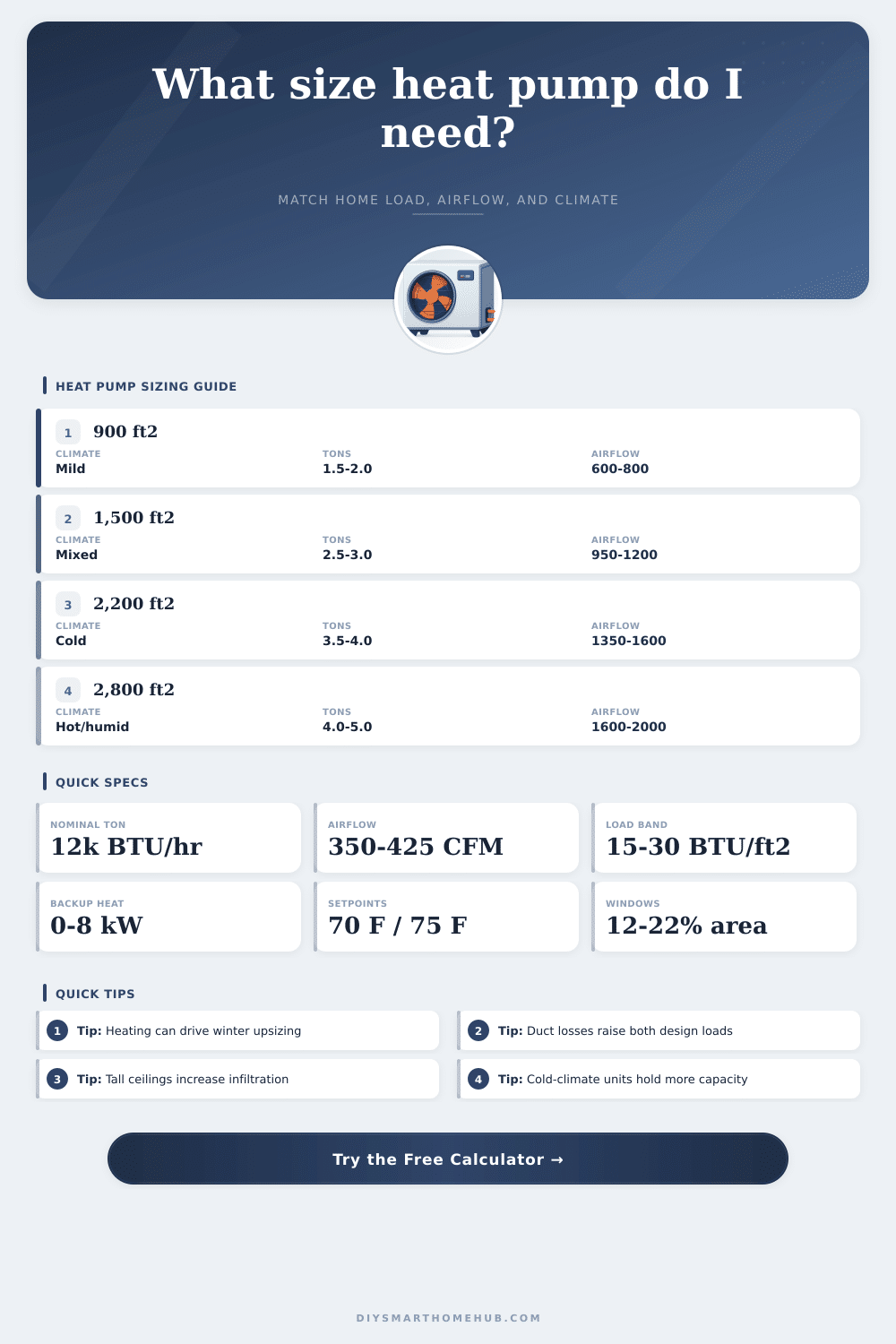
Capacity of heat pumps measure usually by means of tons or British thermal units (BTU). One ton matches 12,000 BTU. Also have smaller models, for instance 2.5-ton or 3.5-ton.
Little home devices have around 6,000 BTU in hour. The biggest reach 60,000 BTU in hour. For every 500 square feet you need one ton of air conditioning capacity.
For instance, 8-ton heat pump works for house of 4,500 square feet.
Size depends of several factors. Houses in harsh climates or big buildings require stronger unit. The plan, drafts and insulation plays role.
Practical rule says: 50 watts (0.05 kW) for 1 m² of floor. Other advice: 30 BTU in square foot of living space. Many reckon that real capacity of HVAC depends of every case and that those are only guides for normal situations.
For air conditioning, the volume matters more than the area.
For determine the right size, use a calculator for heat pumps either turn you to company about air conditioning. Expert person will check the house and will point the wanted system size. Professional calculations of load are inherent.
Enter the approximate surface needing heat or cold and click for receive result. You can also count according to energy use of current heating in cool winter. For pool share the volume in gallons by means of 2,500 to find required kW output.