Heat Pump Savings Calculator
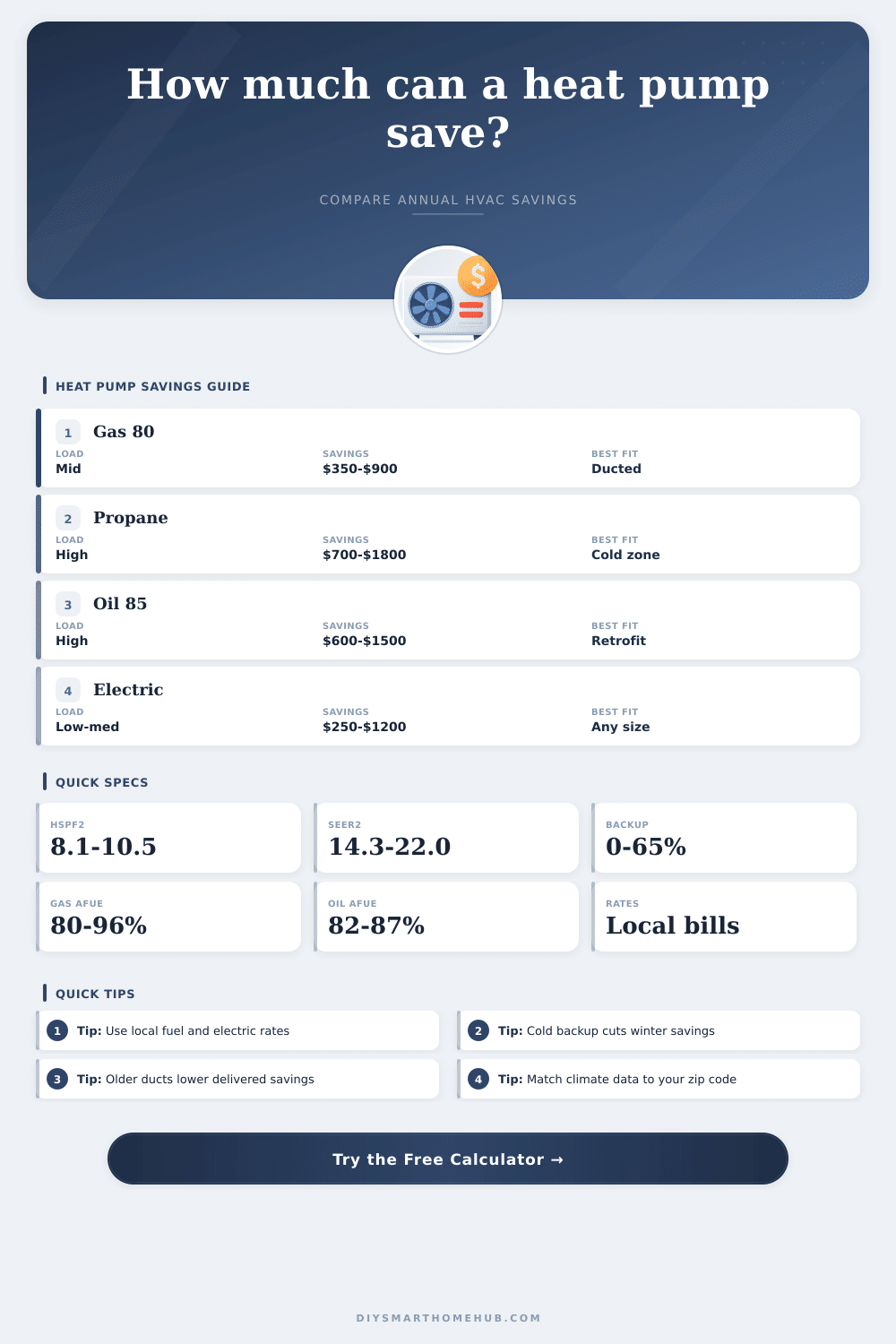
Compare annual utility savings when a new heat pump replaces gas, propane, oil, electric resistance, or an older heat pump. The model blends floor area, climate, duct losses, retained winter capacity, and cooling efficiency into one operating-cost view.
📌Preset Scenarios
Loaded preset: Mixed Gas Ranch with attic ducts, mixed-climate weather data, an 80 AFUE gas furnace baseline, and a 3-ton inverter ducted heat pump.
⚙Home, Weather, and Utility Inputs
⚡Estimated Savings Results
📊Equipment Snapshot
📑Reference Tables
| Current system | Heat eff. | Unit | Cooling |
|---|
| Heat pump | HSPF2 | SEER2 | 17 F cap |
|---|
🏠Scenario Benchmarks
| Scenario | Current | Heat pump | Annual savings |
|---|
Benchmarks use each preset's rates, weather, and selected baseline system so you can compare realistic savings ranges instead of generic averages.
💡Calculation Notes
Use delivered fuel rates
Heat pump savings swing quickly when gas, propane, or oil rates include delivery fees or seasonal surcharges. Enter the full bill rate, not only the commodity charge.
Check winter capacity margin
A heat pump can still save money when backup runs, but savings usually flatten when retained low-temperature capacity sits well below design load in colder climates.
Heat pumps are very energy efficient appliances. They deliver three to four times more heat than the electricity that they use. Like this you receive 300 to 400 percent more heat than from one unit of electricity.
Rather, a gas boiler turns around 90 percent of its fuel into usable warming. Also, a heat pump helps to lower electrical bills. If you substitute old heating equipment with the right heat pump, new study shows that this saves money for more than 90 percent of American families.
How Heat Pumps Save Energy and Money
That counts, if the pump well matches the needs of the house.
Savings adjust based on several things. Between them is the size of a home, the local weather and how energy efficient the building is. On average you can save more than 500 dollars yearly.
Pairing a heat pump with insulation or other weather-preventative resources, folks save even more. It is possible to also cool the house during the day when all are missing or overnight, to keep expenses low. Heat pumps for heating save 10 percent during the worst two weeks, more than 30 percent in the two worst months and over 50 percent during the other seven heating seasons.
High-performance models save a lot on cooling bills. Everywhere a heat pump lowers cooling costs, when it replaces old AC systems.
Homeowners have several ways pay for these installations. You can use discounts or instant rebates to lower the price. Available also are energy efficiency tax credits.
For example the updated and extended Residential Clean Energy credit gives a 30-percent tax reduction for equipment of clean energy. Heat pumps require less attention than systems with combustion. That lowers expenses for repairs and attention.
Switching to a heat pump helps to spread heat and cold more equally in the house. During old devices produce heat by means of burning, these new move it using electricity. Even in a campsite with coastal electrical net you can save on propane by means of a heat pump.
Heat pumpls are very energy efficient appliances. They deliver three to four times more heat than the electricity that they use. Like this you receive 300 to 400 percent more heat than from one unit of electricity.
Rather, a gas boiler turns around 90 percent of its fuel into usable warming. Also, a heat pump helps to lower electrical bills. If you substitute old heating equipment with the right heat pump, new study shows that this saves money for more than 90 percent of American families.
That counts, if the pump well matches the needs of the house.
Savings adjust based on several things. Between them is the size of a home, the local weather and how energy efficient the building is. On average you can save more than 500 dollars yearly.
Pairing a heat pump with insulation or other weather-preventative resources, folks save even more. It is possible to also cool the house during the day when all are missing or overnight, to keep expenses low. Heat pumps for heating save 10 percent during the worst two weeks, more than 30 percent in the two worst months and over 50 percent during the other seven hesting seasons.
High-performance models save a lot on cooling bills. Everywhere a heat pump lowers cooling costs, when it replaces old AC systems.
Homeowners have several ways pay for these installations. You can use discounts or instant rebates to lower the price. Available also are energy efficiency tax credits.
For example the updated and extended Residential Clean Energy credit gives a 30-percent tax reduction for equipment of clean energy. Heat pumps require less attention than systems with combustion. That lowers expenses for repairs and attention.
Switching to a heat pump helps to spread heat and cold more equally in the house. During old devices produce heat by means of burning, these new move it using electricity. Even in a campsite with coastal electrical net you can save on propame by means of a heat pump.