Heat Pump COP Calculator
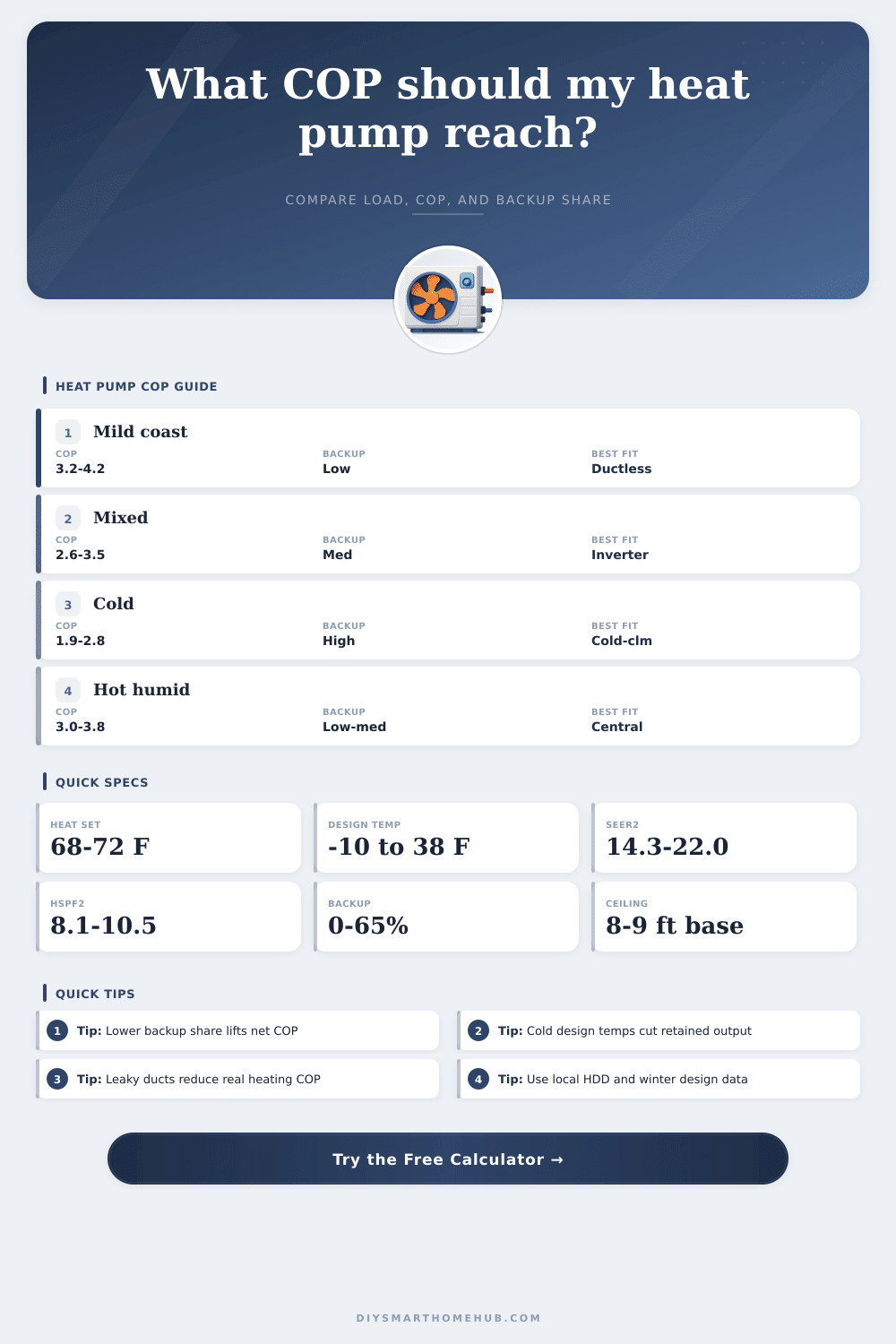
Estimate net heating COP from floor area, shell tightness, climate degree days, duct losses, and low-temperature capacity retention so you can compare compressor-only performance against backup-assisted operation.
📌Preset Scenarios
Loaded preset: Suburban Ranch with attic ducts, mixed-climate degree days, and a 3-ton inverter ducted system.
⚙Home and System Inputs
⚡COP Performance Results
📊System Snapshot
📑Reference Tables
| Climate | HDD65 | CDD65 | Designs |
|---|
| Envelope | UA/ft2-F | ACH | Use case |
|---|
🏠Scenario Benchmarks
| Scenario | Area | System | Heating COP |
|---|
💡Calculation Notes
Use real weather and setpoints
Degree-day estimates only work when HDD65, CDD65, and winter design temperature match the site. Overwrite climate defaults when local weather data differs from the preset.
Read backup as a sizing clue
A nonzero backup share does not mean strip heat runs every day. It means the chosen unit runs short often enough at design conditions that some seasonal heating shifts away from compressor-only operation.
The coefficient of performance, or POLICEMAN is mode measure how effectively operate heating or cooling system. You use that measure at heat pumps, air conditioners and other HVAC-gear. In simplest words, POLICEMAN is report it compares the amount of useful heating or cooling that the system delivers with the amount of energy that it consumes.
You can also describe it as relation between useful heat movement and the work input. That is important measure for the efficiency of air conditioning and heat pumps. It shows the useful heating or cooling provided relatively to the energy consumed at certain temperature.
What POLICEMAN Means for Heating and Cooling
higher POLICEMAN means better efficiency. That usually leads to less energy consumption and so to lower operating costs. If a heat pump have POLICEMAN more than 1, it moves more heat energy than the electrical energy that it uses.
Use a space heater are virtually use heat pumps with POLICEMAN of 1 the whole time. Because electricity serves for move heat instead of create it, such systems can deliver two three or occasionally even four times more heat comparatively with the electricity that they consume. Because of that heat pumps commonly reach POLICEMAN-values a lot above 1.
For instance if a heat pump have POLICEMAN of 3.5 one unit of electricity gives three and half units of heat. In that occasion the heat pump indeed employ 350% of the electricity that it draws.
POLICEMAN is not permanent number it adjusts according to various factors. Between them are the temperatures inside and outside and also how big part of the system skill is used. When the surrounding temperature falls the efficiency of heat pumps commonly sink very quickly.
POLICEMAN also is directly proportionate to the amount of “lift” required between the outdoor air temperature and the indoor air temperature during heating. Exists moreover other measure called the seasonal coefficient of performance or SCOP. During POLICEMAN give snapshot of efficiency in separate moment SCOP measures energy efficiency through the whole heating season.
SCOP considers the varying exterior temperatures and operating conditions during the season for give more comprehensive picture of the general performance.
Some systems can have lower POLICEMAN for warm water than for heating use. That simply belongs to the nature of the beast it is possible also that POLICEMAN be less than one. That can happen if the unit must do more common defrost cycles at lower temperatures.
Then fewer energy enters the house and more energy is spent for the defrost cycle.