Ground Mount Solar Calculator
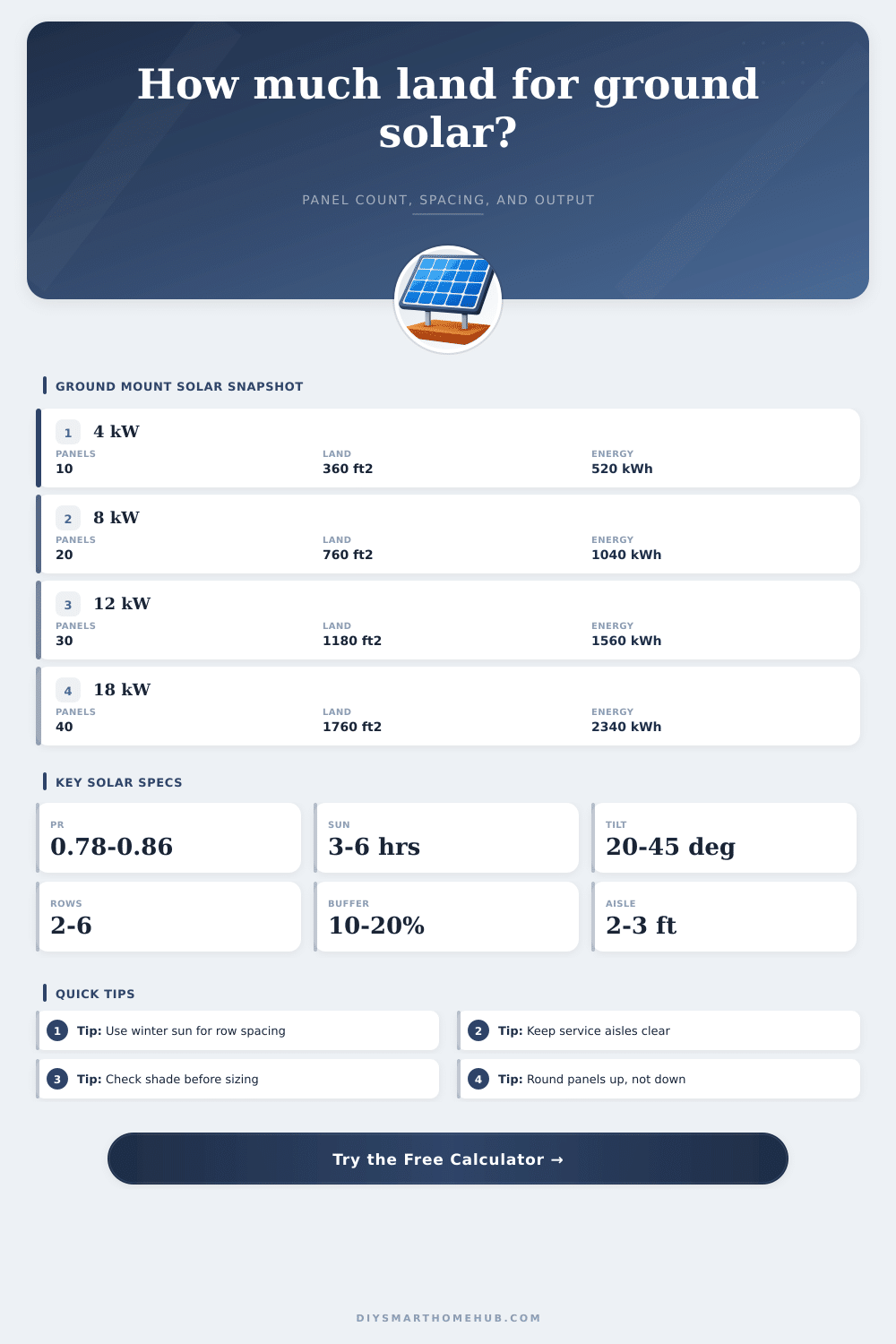
Estimate panel count, DC array size, winter row spacing, ground footprint, and monthly energy for a freestanding solar rack layout.
Fixed-Tilt Ground Rack
Best for simple open-yard arrays. It uses one tilt angle, predictable row spacing, and low layout complexity for most residential fields.
Seasonal Tilt Rack
Best where manual tilt adjustment is practical. It can use steeper winter settings, so the calculator should be checked at the highest tilt.
Bifacial Open-Field Rack
Best on bright ground cover with open rear clearance. Spacing and aisle access matter because rear-side light is part of the design value.
Land-Limited Rack
Best when the usable area is fixed. The calculator prioritizes panel packing, but winter shade clearance can reduce the final panel count.
| Panel profile | Rated power | Approx module size | Typical use |
|---|---|---|---|
| Residential mono | 400 W | 67.8 in x 44.6 in | Balanced home ground racks |
| High-output residential | 430 W | 70.0 in x 44.6 in | Higher output without large module handling |
| Large-format module | 550 W | 89.7 in x 44.6 in | Open racks with longer rails |
| Bifacial field module | 540 W | 89.0 in x 44.6 in | Reflective or open ground conditions |
| Compact module | 330 W | 65.0 in x 39.0 in | Small racks and tight handling spaces |
| Utility-format module | 585 W | 93.9 in x 44.6 in | Wide field racks with fewer modules |
| Latitude band | Winter sun altitude used | Spacing tendency | Layout note |
|---|---|---|---|
| 20° to 30° | 36° to 46° | Compact rows | Shade clearance is easier at moderate tilt. |
| 30° to 40° | 26° to 36° | Moderate rows | Most residential layouts fall in this band. |
| 40° to 50° | 16° to 26° | Wider rows | Steep winter shade drives the footprint. |
| 50° to 60° | 10° to 16° | Very wide rows | Check land area before increasing tilt. |
| Project type | Typical array | Panel count at 400 W | Planning focus |
|---|---|---|---|
| Small helper array | 3 kW to 5 kW | 8 to 13 panels | Compact footprint and clean south exposure |
| Average home offset | 6 kW to 10 kW | 15 to 25 panels | Balanced energy output and row spacing |
| Large home or EV-ready | 11 kW to 16 kW | 28 to 40 panels | Long row width and maintenance access |
| Shop or small acreage | 17 kW to 25 kW | 43 to 63 panels | Field layout, aisle spacing, and service clearance |
| Peak sun hours | 1 kW monthly output at 0.82 PR | What it means | Calculator input cue |
|---|---|---|---|
| 3.5 hours/day | About 86 kWh | Cloudier or northern planning case | Use conservative performance ratio |
| 4.5 hours/day | About 111 kWh | Common open-site planning value | Good default for first pass |
| 5.5 hours/day | About 135 kWh | Sunny region or clear exposure | Check azimuth and shade assumptions |
| 6.0 hours/day | About 148 kWh | High-sun planning condition | Useful for open field estimates |
Ground mount solar array are groups of solar panels that are placed on the ground rather than on a roof structure. Ground mount solar arrays provides more flexibility in there placement than that offered to solar panels placed on roof structures. The angle of the rafters of the roof and the direction in which the house face limit the placement of solar panels on a roof structure.
In contrast, the solar array installer can set the location and the angle of ground mount solar panel arrays according to the desire. For instance, the installer can install the solar array in a location that face south and can be tilted according to the latitude where the solar panels will be installed. Although there are significant benefit to ground mount solar panel arrays, there are additional planning considerations regarding the placement of the solar panels.
How to space ground solar panels to avoid winter shadows
The placement of solar panel arrays in close proximity to one another can pose a problem for energy production of the solar panels. If the installer installs the solar panel arrays in such a way that the solar panels in the front row of the solar array may cast shadows onto the solar panels in the second row of the solar array, the solar panels in the second row will not recieve sunlight exposure. Without sunlight exposure, the solar panels will not produce as many energy as they could if they were exposed to sunlight.
The placement of solar panels in this fashion is problematic during the winter month when the sun is below the horizon for the solar panels. The position of the sun change throughout the year, and the changing position of the sun impact the length of the shadows created by the solar panel arrays. During the winter months, the sun reaches its lowest point in the sky and casts the most longest shadows of the solar panel arrays throughout the year.
During the summer months, the sun is above the horizon for the solar panel arrays and the shadows created by the solar panels are short enough of the solar panels to allow for closely placed solar panel arrays. However, if the solar panel arrays are installed according to the positioning of the sun in the summer months, they will not expose their panels to enough sunlight during the winter months, leading to a decrease in the energy production of those solar panels. To avoid a decrease in the energy production of the solar panels, ground mount solar panel array installations must take into account the winter solstice.
The winter solstice is when the sun is at its lowest point and when shadow are the longest created by solar panel arrays. A calculation of the placement of the solar panel arrays according to the winter solstice will calculate the length of the shadows that will be created by the solar panel arrays during the winter months based off the latitude of the ground mount solar panel arrays. By calculating the length of the shadows during the winter months, the spacing between the rows of solar panels can be calculated such that the front row of solar panels does not cast a shadow onto the second row of solar panels.
By calculating the spacing between the solar panels according to the winter solstice, each solar panel will receive sunlight throughout the year. The ability of each solar panel to receive sunlight throughout the year allow for the solar panels to produce energy throughout each year. It should of been noted that the suns position is crucial.