Grid Tie Solar System Calculator
Estimate the DC array size, panel count, standard inverter AC size, yearly solar generation, roof coverage, and panel backfeed current for a practical residential grid-tie design.
Start with the yearly kWh goal and local sun resource, then check the resulting panel count against actual usable roof area. A great energy target can still miss on layout.
Real systems land on discrete inverter sizes and breaker values. Rounding up to a standard AC size gives a more buildable result than leaving the inverter at 6.37 kW.
A grid-tie solar system allows a person to produce electricity for there home while also feeding any excess electricity back into the electrical grid. Because a grid-tie solar system can provide power to a home, the installation of a grid-tie solar system can reduce the electric bill of a household. However, the grid-tie solar system must be sized appropriately for the home that is to be supply with the electricity.
If the system is too small, the system will not be able to supply the power that the home needs. If the system is too large, it may be difficult for the system to be installed onto the homes roof or electrical panel. To size a grid-tie solar system, you must first determine the electricity use of the home.
How to size a home solar system
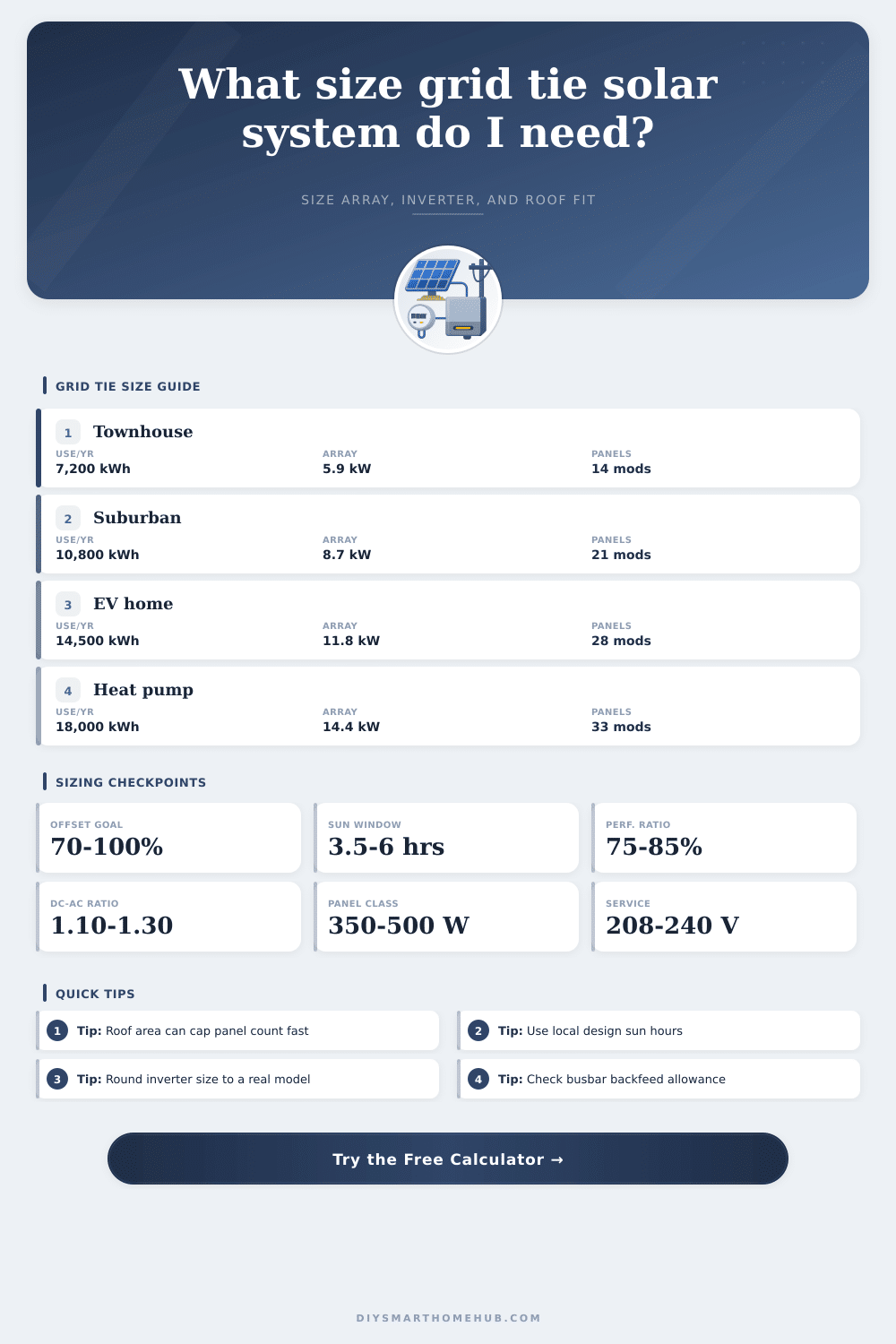
Most homes consumes between 7,000 and 18,000 kilowatt-hours of electricity every year. The amount of electricity that a home uses will depend upon the number and types of appliances that are used in the home. The amount of electricity that is used by the home can be divided by the number of peak sun hours in the area to determine the energy target for that homes solar system.
The solar system will not necessarily produce as much energy as could be theoreticaly achieve with the available sunlight due to factors like heat loss, loss to dust, and the electrical losses within the home. These energy losses can be between 15 and 25 percent of the total energy that could be produced with available sunlight. The size of the solar panels that are to be use in the solar system will also impact the size of the solar system.
For instance, a compact solar panel may be able to fit onto a homes roof if the roof is relatively small in area, even if a large solar panel will produce more power. In addition to the size of the panels, the footprint of the solar panels must be determined. There must be space on the homes roof for the panels to be ventilate, as well as to leave space for the edges of the roof.
In addition to the solar panels, the installer must also size the inverter that will be used in the solar system. The DC electrical array of the solar system should be sized to be 10 to 30 percent larger than the electrical output (in AC) of the inverter. A larger DC array will allow the system to capture more sunlight in the middle of the day.
However, the DC array should not be too large in size, or the setup of the solar panel system will waste money; the panels will not create any additional power for the solar system. Another factor that will limit the size of a grid-tie solar system is the area of the roof of the home. If the goal of installing a solar system is to offset 90 percent of the electricity use of the home, which uses 10,000 kilowatt-hours of electricity per year, the solar array will need to be sized at approximately 9 kilowatts DC.
A 9 kilowatt DC solar array will require the installation of approximately 21 solar panels. Each solar panel may cover an area of approximately 20 square feet, meaning that the roof will require approximately 420 square feet of area for the solar panel system. This area does not account for any shaded areas of the roof or any steep pitch of the roof; these factors will reduce the area of the roof that can be covered by solar panel systems.
Another factor that will limit the size of a grid-tie solar system is the electrical service provide to the home. The size of the electrical panel into which the power from the grid-tie solar system will be fed can be determined by checking the rating of the busbar of the electrical panel. Most electrical codes allow for solar panels to feed up to 20 percent extra power into the electrical panel.
Thus, if the grid-tie solar system that is to be installed requires more power than the electrical panel of the home can handle, the electrical service will have to be upgraded. Because electrical service upgrades can be costly, you must check the specifications of the electrical panel prior to install a grid-tie solar system. The performance ratio (PR) of the solar panels is a value that represents the amount of energy that the panels will actualy produce, as compared with the amount of energy that the panels produce in laboratory tests of the panels.
Solar panels typically do not produce 100 percent of the energy that is published in their descriptions due to factors like high temperature, for instance, which reduces the efficiency of the panels. Other factors that reduce the performance of solar panel systems include the panels becoming covered in dust. The performance ratio can be lower than the performance ratio that the manufacture of the panels publishes for the panels; the panels will produce less energy in the homes environment.
A lower performance ratio should be used in the calculations of the number of panels that will be needed for a solar system if the solar system will be installed in an area with high level of dust, or if the panels will be shaded from some portion of the area. The amount of electricity that the solar system will produce each year can be calculated by applying the performance ratio to the area of the panels that are to be manufacture; the system will produce enough energy to cover a large portion of the electricity use of the home. The amount of electricity that is produced will be lower in the winter than in the summer, because solar panels do not produce electricity when there is no sunlight.
The goal of installing a solar panel system is to offset 90 percent of the electricity that is used by the home each year, rather than 100 percent; producing 100 percent of the electricity that is required by the home would lead to the installation of a system that is too large. There are some mistake that should be avoided when installing a grid-tie solar system. One mistake is to use the peak sun hours for the location of the panels in calculations of the electricity that will be produced by the panels.
Instead, the design average for sunlight hours for the location should be used. Another mistake is to ignore the relation between the DC power of the solar array and the AC power of the inverter; the DC power array should be 10 to 30 percent larger than the AC power output of the inverter. Finally, one mistake that should be avoided is ignoring the area of the roof of the home.
The panels must fit onto the roof; this factor is more important then the calculations of how many solar panels will be required. To install a grid-tie solar system, each of these factors should be calculated or determine: the amount of electricity that will be used by the home each year, the area of the roof that is usable for solar panels, the specifications for the electrical service that is provide to the home, and the performance ratio of the solar panels.