Generator Size Calculator
Estimate the generator running watts, startup surge capacity, derated output, service amps, and fuel runtime needed for home backup, RV, or jobsite loads.
| Load | Typical Running Watts | Typical Starting Watts | Sizing Note |
|---|---|---|---|
| Refrigerator or freezer | 150 to 800 W | 1,200 to 2,400 W | Compressor start often drives the surge value. |
| 1/2 hp sump pump | 1,000 to 1,200 W | 2,100 to 4,100 W | Use the high end for hard starts or long discharge runs. |
| 1/2 hp well pump | 1,000 to 1,500 W | 3,200 to 5,000 W | 240 V pumps usually need split-phase output. |
| Gas furnace blower | 400 to 900 W | 1,200 to 2,350 W | ECM blowers start softer than older PSC motors. |
| Window air conditioner | 900 to 1,500 W | 2,200 to 4,500 W | Soft-start hardware can reduce the required surge. |
| Microwave oven | 1,000 to 1,800 W | 1,000 to 1,800 W | Usually a running load, not a large motor surge. |
Gasoline inverter portable
Best for electronics, quiet RV loads, and smaller outage panels. Typical surge ratio is about 1.25x with cleaner power and lower fuel use at light load.
Open-frame gasoline portable
Useful for high surge tools, pumps, and manual transfer panels. Typical surge ratio is about 1.20x and voltage dip should be considered for motor starts.
Propane or natural gas standby
Good for fixed backup panels and automatic transfer setups. Output is commonly lower on propane or natural gas than the same engine on gasoline.
Diesel standby or trailer
Strong for long runtime and heavier continuous loads. Surge ratio is often lower, but voltage stability is strong when the unit is sized with headroom.
| Scenario | Typical Running Load | Starting Load | Generator Class |
|---|---|---|---|
| Fridge, lights, phone chargers | 900 to 1,600 W | 2,200 to 3,000 W | 3,000 to 3,500 W inverter |
| Sump pump storm backup | 1,500 to 2,500 W | 4,000 to 5,500 W | 5,000 to 6,500 W portable |
| 30 amp RV service | 3,000 to 3,600 W | 3,500 to 4,500 W | 3,600 to 4,500 W inverter |
| Essential circuits panel | 4,500 to 7,000 W | 7,500 to 11,000 W | 8,000 to 12,000 W portable |
| Standby whole-home essentials | 8,000 to 12,000 W | 12,000 to 18,000 W | 14 to 22 kW standby |
| Condition | Typical Rule | Calculator Treatment | Why It Matters |
|---|---|---|---|
| Altitude above 1,000 ft | 2.5 to 3.5 percent per 1,000 ft | Fuel-specific derate curve | Less air reduces engine power. |
| Temperature above 77°F | About 1 percent per 10°F | Added to altitude derate | Hot air lowers combustion density. |
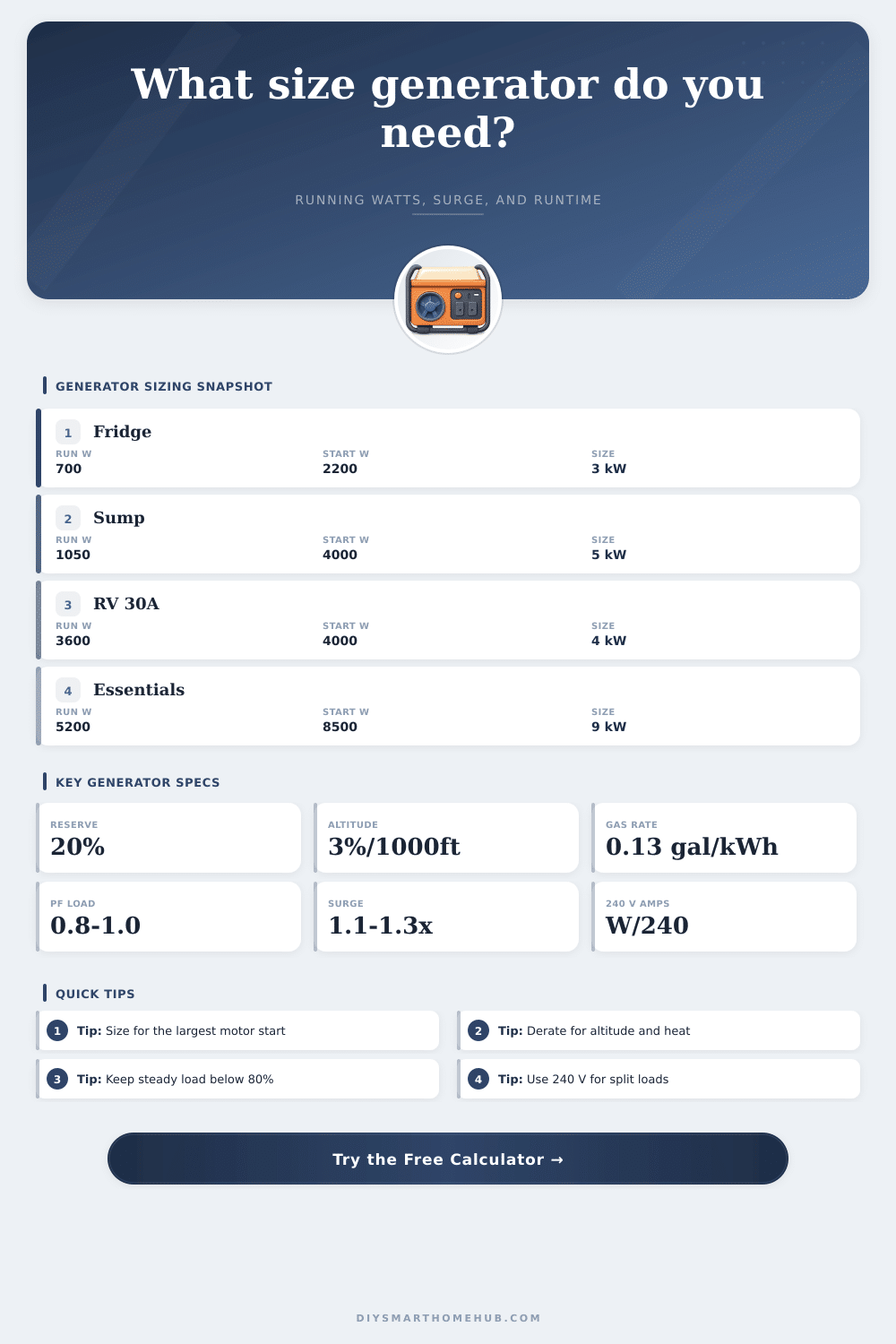
| Continuous loading | Keep near 80 percent or lower | Reserve margin raises required size | Headroom improves voltage stability. |
| 240 V loads | Need split-phase output | Amps shown at selected voltage | Well pumps and panels need balanced legs. |
| Project | Running Load | Peak Start | Typical Result |
|---|---|---|---|
| Single refrigerator outage | 700 W | 2,200 W | 3 kW inverter |
| Basement pump and freezer | 1,850 W | 4,300 W | 5 to 6.5 kW portable |
| Gas furnace essentials | 2,400 W | 4,800 W | 5.5 to 7 kW portable |
| Essential circuits panel | 5,200 W | 8,500 W | 9 to 11 kW portable |
| Large standby essentials | 10,500 W | 16,000 W | 18 to 22 kW standby |
In order to size a generator correctly, you must understand the difference between running watt and starting watts. Running watts are the amount of electricity that a generator will provide to an appliance in order to keep it run. Running watts are the continuous rate at which electronics use electricity.
Starting watts are the amount of electricity that the generator will have to provide in order to start an appliance that contain a motor. Many appliances that contain motor will require a surge of electricity when starting up that will be more greater than the amount of running watts that are required for that appliance to continue to run. If you size a generator to have only the running watts necessary for your appliances, the generator may not have enough starting watts to start the appliance.
How to Size a Generator
When sizing a generator, you must make sure that the generator has enough starting watts to handle the starting watt surge of the appliance that requires the most starting watts, while the generator also provide the running watts to all appliances that are running. The environment in which the generator is sized to operate in can also impact the performance of the generator. Many generators are specified to produce certain amount of power in ideal environmental specifications.
As the environment change, the generator may produce less power then that specification. Many generators are measured for their power output in laboratory specifications at sea level. The power output of a generator may be less if the generator is operating in high altitude or high temperatures.
High altitudes mean that there is less oxygen in the air for the generator to burn fuel, which is less efficient than burning fuel in an amount of oxygen containing air. High temperatures have the same impact on the combustion process of the generator as low oxygen levels in the air have, which means that the generator will produce less power under high temperature. This reduction in the power output of a generator based off the environment in which it operates is referred to as derating the generator.
As such, a generator may produce less watts in its operating environment then the wattage specified for the generator that is listed on its box. The type of fuel that is used for the generator also impact the performance of the generator. Common fuels for generators are gasoline, propane, natural gas, and diesel fuel.
Propane and natural gas have different amount of energy per volume than gasoline, meaning that using propane or natural gas for fuel as compared to gasoline may cause a drop in the total power output of the generator. Propane and natural gas have the benefit of not spoiling over time, but their different energy densities may cause the generator to produce less total power compared to gasoline. Diesel fuel is another fuel that can be used for the generator.
Diesel generators are more stable during operation and can run for longer periods without refueling than gasoline generators, however, diesel generators may cost more than gasoline generators. Another factor to consider when sizing a generator is the need for a reserve margin for the generator. The reserve margin for a generator is the amount of power that the generator provides but that is not used to power any appliance.
Generators are designed to not operate at 100% of its total capacity. If a generator is required to run at 95% of its total capacity, it may overheat and experience voltage instability. To avoid these problem, the generator should be sized to provide approximately 80% of the total power of the generator to the appliances that are to be operated.
Using 80% of the total power of the generator for the appliances ensures that the generator will have some capacity to handle small fluctuations in the amount of electricity that is required by the appliances, and it ensures that the voltage will remain steady. The specific type of appliance that you would like to operate will dictate the type of generator that should be used. Inverter generators provide a type of electrical signal that is considered to be “clean” as opposed to generators that do not include the inverter in their generator’s model.
The clean signal from an inverter generator is beneficial for appliances that are sensitive to power surge, such as laptops and cellular phone. The signal from a standard generator can damage the electronic device if used for long periods of time. However, appliances like jobsite compressors do not require such a clean signal, meaning that a standard generator that does not include an inverter will produce the necessary amperage to operate the jobsite compressor.
Finally, another factor to consider when sizing a generator is the runtime of the generator and how much fuel the generator will consume. The larger the generator, the more fuel it will use. If you use an oversized generator, it can lead to very rapid consumption of the fuel for that generator.
You must plan for how much fuel you would like to store for the generator, as eventually, a generator will run out of fuel. Other than ensuring that the generator has enough starting and running watts for all of the appliances that will be operated, you should also consider providing enough reserve margin and fuel for the generator to meet your need. In order to size a generator correctly, you must ensure that it has enough starting watts to start all appliances and enough running watts to provide power to all appliances that are running.
The generator must have a sufficient reserve margin to avoid overheating and voltage instability. Finally, the generator should have enough fuel to operate for the amount of time that you require with the appliances that are to be operated by the generator.