Gas Line Sizing Calculator
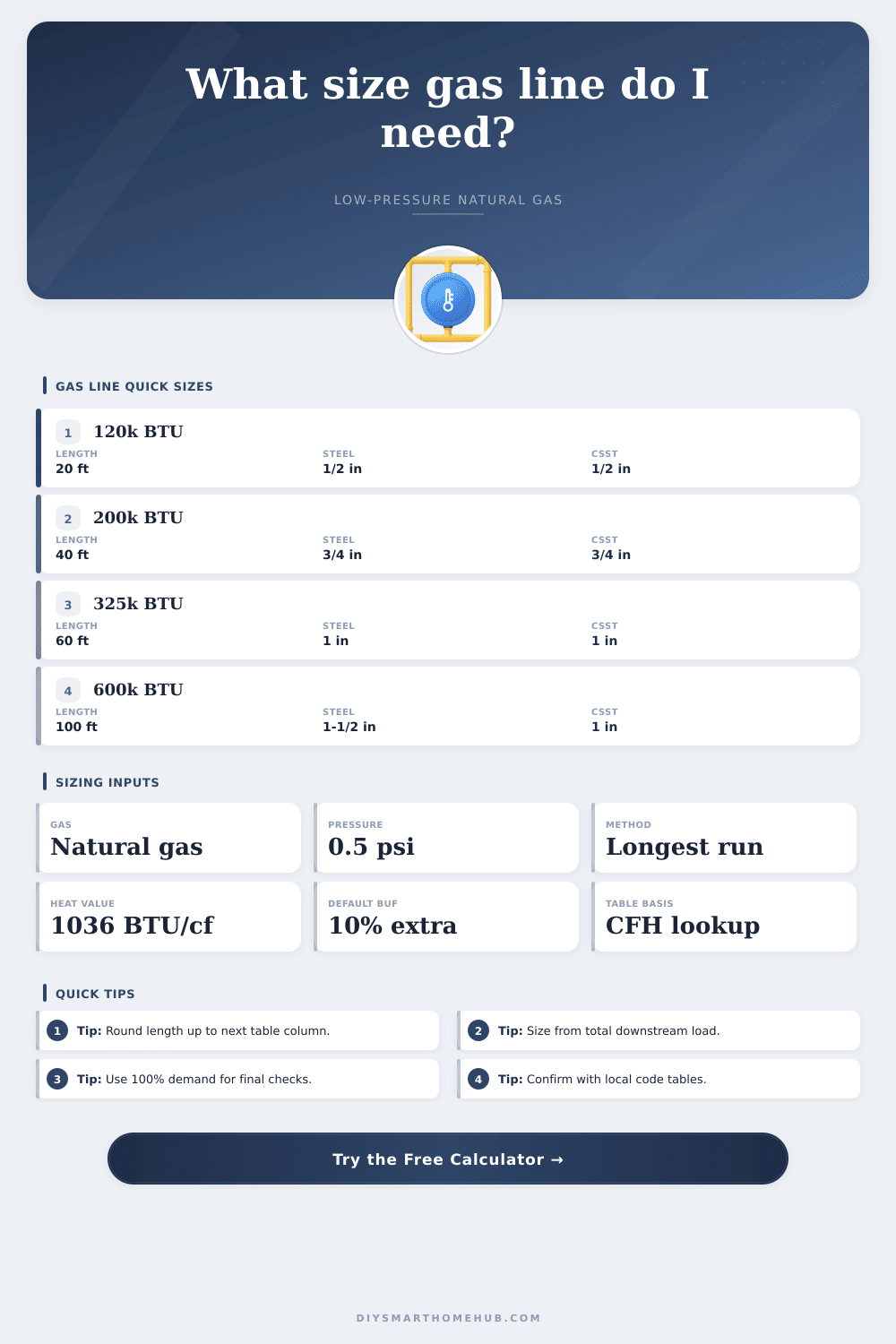
Estimate a conservative low-pressure natural gas pipe size from total connected appliance load, the longest developed run, and the capacity table you want to size against.
📏Scenario Presets
📋Calculator Inputs
Calculated Sizing Snapshot
⚙Reference Specs
Default natural gas heat value for CFH conversion in this calculator.
Every table here is for low-pressure natural gas service, with different allowable pressure drops.
Pipe tables list capacity in cubic feet per hour, so BTU load must be converted before sizing.
Results show common inch sizes with a matching DN tag for quick metric reference.
Steel line values come from the 2025 TracPipe manual, which cites NFPA 54 Table 6.2.1(b).
CSST options compare several pressure-drop tables so you can see how line-regulator allowances change capacity.
Use the longest developed length to the outlet served by the section you are checking.
A buffer is useful when you expect later upgrades such as a pool heater, boiler, or standby generator.
📊Schedule 40 Steel Capacity Table
| Nominal size | 20 ft | 40 ft | 60 ft | 100 ft |
|---|---|---|---|---|
| 1/2 in | 118 CFH | 81 CFH | 65 CFH | 50 CFH |
| 3/4 in | 247 CFH | 170 CFH | 137 CFH | 104 CFH |
| 1 in | 466 CFH | 320 CFH | 257 CFH | 195 CFH |
| 1-1/4 in | 957 CFH | 657 CFH | 528 CFH | 400 CFH |
| 1-1/2 in | 1430 CFH | 985 CFH | 791 CFH | 600 CFH |
| 2 in | 2760 CFH | 1900 CFH | 1520 CFH | 1160 CFH |
📐Gastite CSST Capacity Table
| Nominal size | 20 ft | 40 ft | 60 ft | 100 ft |
|---|---|---|---|---|
| 3/8 in | 22 CFH | 15 CFH | 13 CFH | 10 CFH |
| 1/2 in | 66 CFH | 47 CFH | 38 CFH | 30 CFH |
| 3/4 in | 133 CFH | 97 CFH | 80 CFH | 63 CFH |
| 1 in | 297 CFH | 213 CFH | 175 CFH | 137 CFH |
| 1-1/4 in | 441 CFH | 314 CFH | 258 CFH | 201 CFH |
| 1-1/2 in | 926 CFH | 658 CFH | 539 CFH | 419 CFH |
| 2 in | 1896 CFH | 1327 CFH | 1077 CFH | 827 CFH |
🚧Common Appliance Demand Guide
| Appliance | Typical input | Approx. CFH | Calculator note |
|---|---|---|---|
| Dryer | 35,000 BTU/h | 34 CFH | Common branch add-on |
| Range | 65,000 BTU/h | 63 CFH | Kitchen bundle anchor |
| Tank water heater | 40,000 BTU/h | 39 CFH | Good baseline load |
| 80k furnace | 80,000 BTU/h | 77 CFH | Typical single-system heat |
| Tankless heater | 180,000 BTU/h | 174 CFH | Often drives upsizing |
| Standby generator | 220,000 BTU/h | 212 CFH | Long runs need margin |
| Pool heater | 250,000 BTU/h | 241 CFH | Usually a larger branch |
| Fireplace | 30,000 BTU/h | 29 CFH | Small but often remote |
🏠Typical Project Bundles
| Project bundle | Total load | 40 ft steel | 40 ft CSST |
|---|---|---|---|
| Range + dryer | 100k BTU/h | 1/2 in works | 3/4 in works |
| Furnace + tank heater | 120k BTU/h | 3/4 in works | 1 in works |
| Tankless + cooktop | 245k BTU/h | 1 in works | 1-1/4 in works |
| Whole-house core | 325k BTU/h | 1-1/4 in works | 1-1/2 in works |
| Generator + furnace | 300k BTU/h | 1 in works | 1-1/4 in works |
| Pool heater + boiler | 410k BTU/h | 1-1/4 in works | 1-1/2 in works |
For each section of piping, total the downstream connected load and size against the longest developed run to the farthest appliance on that section.
If a generator, larger water heater, or pool equipment is genuinely planned, adding 10% to 20% buffer now can prevent a later re-pipe.
Gas line sizing is the process of choosing the correct diameters for the gas line. A person must size the gas line correctly. If the gas line is too small for the appliance that will be using gas, it will not supply enough gas to each appliance.
An undersized gas line will result in appliances that flicker or shut off. A gas line that is too large waste money on buying unnecesary materials. The natural gas move through the gas pipes at low pressure.
How to Size a Gas Line
The pressure of the natural gas decreases as the gas moves through the pipe. The natural gas experiences friction in the pipe, which lowers the pressure. The longer the distance that the natural gas travels, the more friction the gas line will experience.
For example, a 1/2 inch gas pipe may be able to provide enough gas for a dryer that is 20 feet from the gas line. The same 1/2-inch pipe may not provide enough gas to the dryer that is 60 feet from the gas line. To account for the drop in natural gas pressure, the code require the use of sizing tables.
These tables show the CFH output of a gas line of a specific type, size, and length. For example, you can use steel pipe for black iron installations. Another alternative is Corrugated Stainless Steel Tubing, or CSST.
The sizing tables require that you determine the length of the gas line, which is the total distance that the gas will travel, including all bends in the line. Another factor to consider in sizing the gas line is the BTUs per hour that each appliance will use. You must convert the BTUs per hour to CFH by dividing the BTUs per hour by the local gas heat value.
The heat value of natural gas is around 1,000 BTUs per cubic foot of gas. The total CFH value of all of the appliances that will be located along the section of the gas line must be calculated. For example, every appliance from the furnace to the pool heater must be accounted for.
Some use diversity factors for the appliances not all being used at the same time. Many building codes require the 100% load on each branch lines. Additionally, 10% gas demand is required for each line to allow for the addition of appliances without having to replace the gas lines.
Sizing tables for both steel pipe and CSST are available to determine how much gas will travel through each type of pipe. For steel pipe, the sizing tables for NFPA 54 show that a 3/4-inch steel pipe can move 170 CFH at 40 feet of length. The sizing tables for CSST show different values for the allowable drop in the pressure of the natural gas.
For instance, a half-inch water column is small, whereas 3 inches is a larger drop in pressure. A larger drop in pressure allows for more gas to travel through the pipe of the same size. However, the gas regulators must allow for the drop in pressure.
First, find the correct sizing table based off the type of pipe to be used. Then enter the length of the gas line and the total load of the appliances to be serviced. From this information, the tables will indicate the smallest size of pipe that will meet the demands of the total distance that the gas line will travel.
Many people make the mistake of measuring the length of a gas line with a measuring tape as the direct distance between two points. This measurement dont take into account the turns of the gas line. You must measure the distance that the gas line travels, including all turns.
This distance should then be rounded up to the next distance measurement shown in the sizing tables. For instance, a gas line that measured 42 feet should be sized as if it were 50 feet long. Furthermore, the heat content of the gas in a specific area can differ from another part of the country.
For instance, the gas lines along the East Coast may have a different gas heat content than along the West Coast. Additionally, building codes may require that you use steel pipe in areas that experience seismic activity. The longest-run method is employed in determining the size of the gas lines.
This method ensure that each portion of the gas line has the correct size. The longest-run method prevents a homeowner from using too much pipe between the gas meter and the gas line. For example, the distance of the longest appliance, such as the furnace at 50 feet, will determine the size of that gas line.
The distance to the other appliances, such as the range in the kitchen, will not determine the size of the line that feeds that appliance. Steel pipe is typically used for outdoor gas lines. CSST is used for indoor gas lines because it can bend around the joists of the floor.
Steel pipe is less expensive per foot than CSST. However, there are fewer fittings if CSST is used for the indoor gas line. An inspector will measure the sizes of the gas lines according to the sizing tables.
A worksheet that meets all requirements for the job should be provided to the inspector. A gas line that is undersized for the appliances may work during mild weather. However, each appliance will fail in the winter months when the demand for gas increases.
For example, the furnace blower may strain using too much gas, causing the furnace to exhibit error codes. To avoid these problems with the gas heating system, a person must start at the gas meter and work outwards to each appliance. Each portion of the gas line must be validated according to the longest gas appliance to ensure that the size of the gas line is correct.