Furnace Blower Size Calculator
Estimate furnace blower airflow from heating output, temperature rise, cooling tons, external static pressure, filter restriction, evaporator coil condition, and PSC or ECM motor behavior.
⚙Blower Presets
Pick a realistic furnace blower setup, then adjust BTU output, temperature rise, cooling tons, airflow per ton, static pressure, filter, coil, and motor profile.
📏Blower Sizing Inputs
📊Blower Motor And Spec Comparison Grid
Airflow follows the selected tap and drops as external static pressure rises above the blower table rating.
Motor torque and watts rise to hold target CFM until the motor reaches its usable pressure limit.
Many residential blower tables publish nominal CFM near 0.50 inches water column external static pressure.
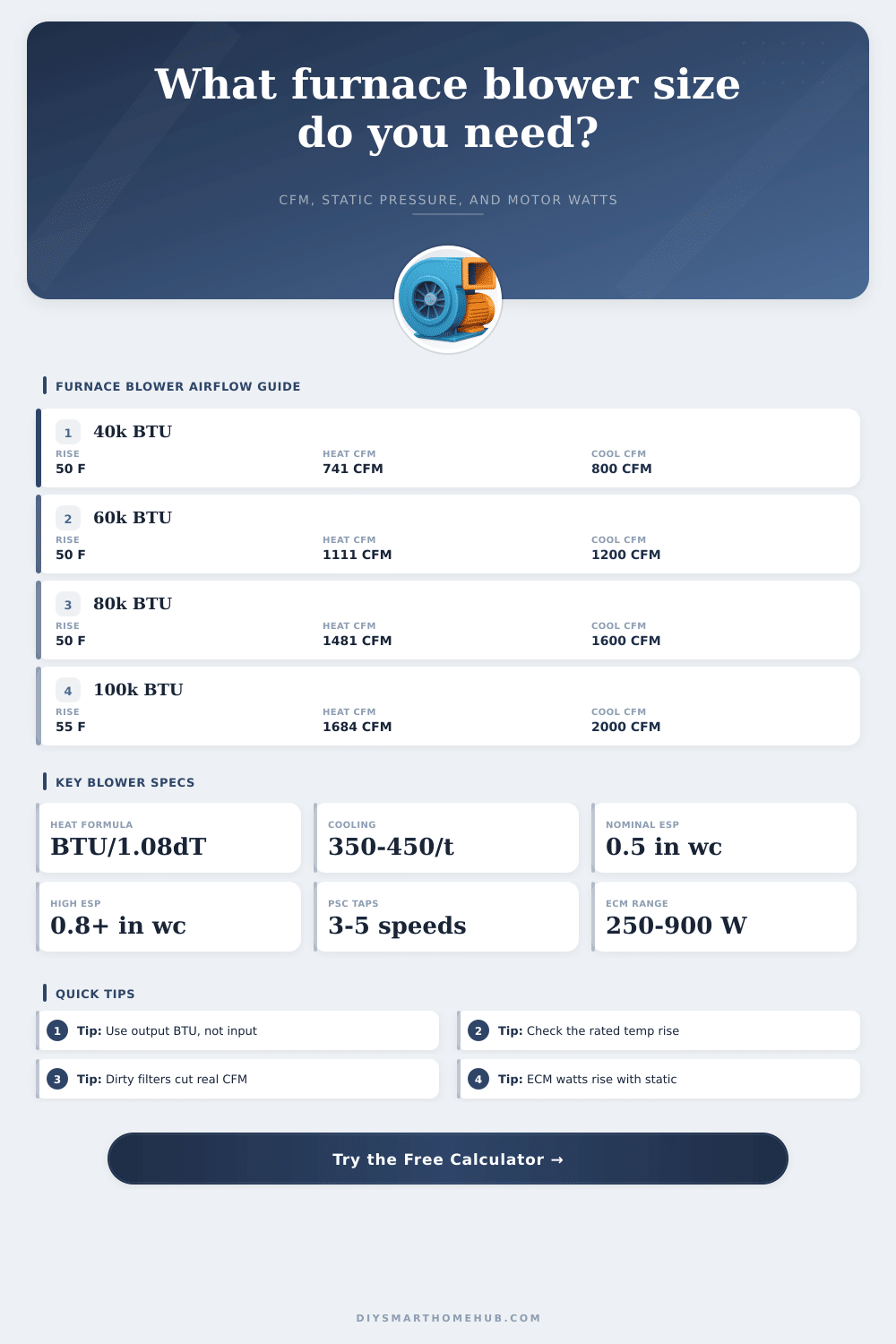
BTU/h equals 1.08 x CFM x temperature rise for standard-density residential air estimates.
📋Reference Tables
| Furnace output | 40°F rise | 50°F rise | 60°F rise |
|---|---|---|---|
| 40,000 BTU/h | 926 CFM | 741 CFM | 617 CFM |
| 60,000 BTU/h | 1,389 CFM | 1,111 CFM | 926 CFM |
| 80,000 BTU/h | 1,852 CFM | 1,481 CFM | 1,235 CFM |
| 100,000 BTU/h | 2,315 CFM | 1,852 CFM | 1,543 CFM |
| Cooling airflow target | Use case | 3 ton example | Watch point |
|---|---|---|---|
| 325 to 350 CFM/ton | Humid latent-focused cooling | 975 to 1,050 CFM | Lower airflow can increase coil moisture removal but must stay above equipment minimum. |
| 375 to 400 CFM/ton | Common residential design range | 1,125 to 1,200 CFM | Most manufacturer tables center around this range for rated capacity. |
| 425 to 450 CFM/ton | Dry climate or high sensible load | 1,275 to 1,350 CFM | Higher airflow can reduce latent removal and may raise duct noise. |
| Over 450 CFM/ton | Special cases only | Over 1,350 CFM | Verify coil, blower table, duct velocity, and sensible heat ratio before using. |
| Static pressure range | PSC airflow effect | ECM watts effect | Field interpretation |
|---|---|---|---|
| 0.30 to 0.50 in. w.c. | Near nominal table airflow | Low to normal watt draw | Typical target range for many residential systems. |
| 0.51 to 0.70 in. w.c. | Noticeable airflow loss | Watts rise to hold CFM | Check filter face area, return path, coil, and trunk restrictions. |
| 0.71 to 0.90 in. w.c. | Large airflow loss likely | High watts and torque demand | Blower may miss target CFM even if motor nameplate looks large enough. |
| Over 0.90 in. w.c. | Severe derate on many taps | ECM may hit limit | Use manufacturer blower tables and correct duct restriction before final setup. |
| Restriction item | Typical derate | Calculator factor | When to choose it |
|---|---|---|---|
| Deep media cabinet, clean | 0 to 3 percent | 0.98 | Large 4 to 5 inch cabinet with good return area. |
| Standard 1 inch filter | 5 to 8 percent | 0.95 | Common MERV 8 to 11 filter with adequate face area. |
| High-MERV 1 inch filter | 10 to 14 percent | 0.89 | Dense pleated filter in a single return grille. |
| Loaded coil or tight transition | 10 to 18 percent | 0.86 | Dirty wet coil, cramped plenum, or restrictive coil cabinet. |
🛠Blower Setup Tips
A furnace blower serving both heat and cooling must satisfy the higher of the heating CFM formula and the cooling CFM-per-ton target. A heating-only check can miss an undersized cooling blower.
This calculator estimates derate behavior, but final setup should use the equipment blower table at measured external static pressure with the installed filter and coil in place.
The furnace blower size will determine how much air that the furnace will deliver to a house. Additionally, the furnace blower size will also determine how efficient the motor will operate. Many peoples feel that if they have a larger motor, it will solve all there furnace blower motor problems.
However, using a larger motor will not always solve these problem for their ductwork. In order to find the correct size of furnace blower motors for the ductwork, you must account for all the restriction to the movement of the air. Factors such as the delivered output of the furnace, the target temperature rise, the tonnage for cooling systems, and the static pressure will help determine the correct furnace blower sizes.
How to Choose the Right Furnace Blower and Motor
The delivered BTU output is one of the most critical measurement of a furnace. This is the measurement of the heat that the furnace blower will move. Therefore, this measurement is more important then the input of the BTU furnace rating.
Another important measurement is the temperature rise. This measurement will tell you the amount of airflow that the furnace must move in order to not overheat the furnace heat exchanger. For example, if you have a 60,000 BTU furnace with a 50-degree temperature rise, the furnace will require 1,100 CFM of airflow.
However, if the house is also equipped with a three ton cooling system, it will require 1,200 CFM of airflow. The calculator will compare these two measurements to determine the actual amount of airflow that the furnace blower must be able to move. Another critical measurement is the static pressure.
Static pressure is one of the measurements that many people will underestimate when setting up there heating system. However, static pressure is important to take into account for the amount of resistance to the airflow. For example, a clean 1-inch filter will add 0.16 inches of water column resistance to the system.
A high MERV pleated filter will add 0.24 inches of water column resistance to the system. If the static pressure reach 0.7 inches of water column, the PSC motor will lose significant amount of airflow. However, the ECM motor will increase its torque and watt draw to maintain the target CFM of airflow.
Therefore, the calculator will use the estimated watt draw of the motor in addition to the airflow measurements. The condition of the filter and the cooling system coil can add additional restrictions to the airflow that isnt accounted for in the original system. For example, a wet cooling coil or a tight transition can reduce the delivered CFM of the furnace by 10 to 18 percent.
In order to account for this, the calculator include separate factors for the filter and the cooling coil that you can see on the calculator. If there is a gap between the nameplate CFM of the furnace and the actual CFM that is deliver, there may be a comfort problem in some of the room in the house. In order to determine the correct motor for the furnace, you must make a decision between a PSC motor and an ECM motor.
The PSC motor is more common and cheaper up front. However, the airflow from the PSC motor will drop as the static pressure increase. The ECM motor will cost more money up front.
However, it will maintain its airflow and its watt draw to fight the static pressure. An ECM motor will maintain its airflow more better than a PSC motor. The calculator will show the difference in watts that each motor will draw at the static pressure of the furnace.
Most HVAC system will not run under the same conditions in which the motor table for the furnace were created. The ductwork will be different, the filters will be different, the coil will have dirt on it after being in operation for some period of time. When calculating the size of the furnace blower motor, it is best to use actual measurements for static pressure, the filter, and the cooling coil.
By doing so, you can reach the target airflow that the furnace should move through the system in order to maintain the temperature in the house and to ensure that the cooling coil does not lose too much moisture and freeze up. In order to complete the calculations for airflow with a furnace blower motor, you first must measure the static pressure with the filter and cooling coil in place before making a decision about the type of motor that will best suit the furnace. Once you have the static pressure of the system, the other calculations become much more simple.
By using the required CFM of airflow to the rooms in the house, you can ensure that the furnace motor will run quiet and use less energy. Furthermore, by ensuring that the airflow is the correct amount to the rooms in the house, the furnace and air conditioner will remain in there original design.