🎵 Frequency to Note Converter
Enter any frequency in Hz to instantly find the musical note, octave, cents deviation, and MIDI number
MIDI 69
Middle C
Lowest MIDI
Near upper limit
per Octave
Semitone
per Octave
0–127
128 notes
| Note | Frequency (Hz) | MIDI Number | Cents from C4 |
|---|---|---|---|
| C4 | 261.63 | 60 | 0 |
| C♯4 / D♭4 | 277.18 | 61 | 100 |
| D4 | 293.66 | 62 | 200 |
| D♯4 / E♭4 | 311.13 | 63 | 300 |
| E4 | 329.63 | 64 | 400 |
| F4 | 349.23 | 65 | 500 |
| F♯4 / G♭4 | 369.99 | 66 | 600 |
| G4 | 392.00 | 67 | 700 |
| G♯4 / A♭4 | 415.30 | 68 | 800 |
| A4 | 440.00 | 69 | 900 |
| A♯4 / B♭4 | 466.16 | 70 | 1000 |
| B4 | 493.88 | 71 | 1100 |
| Octave | C (Hz) | A (Hz) | MIDI Range |
|---|---|---|---|
| C0 – B0 | 16.35 | 27.50 | 0 – 11 |
| C1 – B1 | 32.70 | 55.00 | 12 – 23 |
| C2 – B2 | 65.41 | 110.00 | 24 – 35 |
| C3 – B3 | 130.81 | 220.00 | 36 – 47 |
| C4 – B4 | 261.63 | 440.00 | 48 – 59 |
| C5 – B5 | 523.25 | 880.00 | 60 – 71 |
| C6 – B6 | 1046.50 | 1760.00 | 72 – 83 |
| C7 – B7 | 2093.00 | 3520.00 | 84 – 95 |
| C8 – B8 | 4186.01 | 7040.00 | 96 – 107 |
| String / Note | Instrument | Frequency (Hz) | MIDI |
|---|---|---|---|
| E2 | Guitar (low E) | 82.41 | 40 |
| A2 | Guitar / Bass | 110.00 | 45 |
| D3 | Guitar / Bass | 146.83 | 50 |
| G3 | Guitar / Violin | 196.00 | 55 |
| B3 | Guitar (B string) | 246.94 | 59 |
| E4 | Guitar (high E) | 329.63 | 64 |
| A4 | Violin / Oboe tuning | 440.00 | 69 |
| C4 | Piano Middle C | 261.63 | 60 |
| E1 | Bass Guitar (low E) | 41.20 | 28 |
| D4 | Flute (D4) | 293.66 | 62 |
Converter of incidence to note works as simple tie between the physical world and music. It accepts just number values of incidence, measured in hertz or Hz, and them assign to known musical notes. Like this if you have something around 440 Hz or 523.25 Hz, the program points exactly, what note it represents and in what octave it finds itself.
The principle is really easy. Enter any value of incidence, and it shows the most close musical note together with all details about pitch, that you maybe need. There are many free online tools, that do that quickly and reliably.
How to Turn Hertz into Musical Notes
Great advantage is the second direction: point name of note, and the calculator gives its incidence. So you can switch between cycles each second and names of notes, and vice versa, withuot some effort.
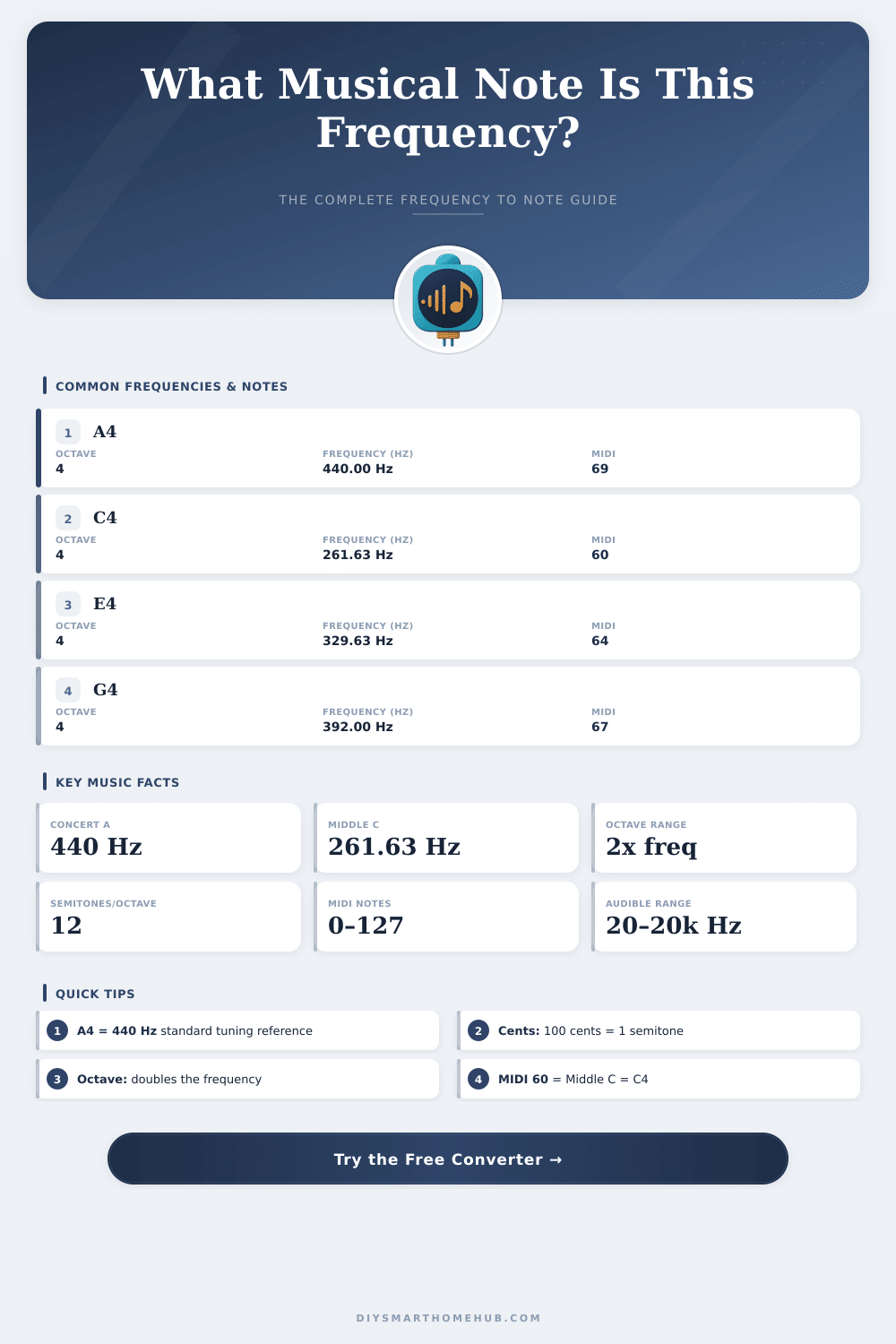
For modern music the base is A4 in 440 hertz, so the note A in the fourth octave set exactly to that value. All other notes receive their incidence counted from that spot by means of 12-tonal equal disposition. The usual way in human usage places the middle C as C4, with B3 right under it.
On the other hand, some prefer to start at C0. It makes sense, if one thinks: know F5 right away reveal, that it sits seven octaves above the base, so seven semitones over something.
Charts show all musical notes threw eight octaves of piano keys together with their hertz. The 12 semitones in equal disposition extend from around 16.35 Hz, the most bottom C, until almost 24 000 Hz for the most upper B. Here the limit: human hearing only catches from around 20 Hz until 20 000 Hz, so those big notes on both sides actually escape from our hearing.
The relation between octaves are clearly pure. Double the incidence, and you upward jump exactly one octave; split it by means of two, and you down go one. That is the simple part.
It gets harder when you have several tones with various harmonies standing one on the other. Analyse complex waveform and find, that notes one really hears? It is entirely other matter.
There is no single right match for common value to note. Everything depends on your basic pitch, that today almost always is A in 440 Hz, and on the method for counting the rest. Some musicians want, that such tools offer options beyond equal disposition, but basic online tools usually do not give that.
Beyond that basic online programs, there are apps and plugins. For instance, a JavaScript app can convert whole lists of incidences in groups of pitches with info about octaves, deviation from 12-TET and even format for leagues. It also makes them as musical notes and export to MusicXML.
There are also devices for Max/MSP and otherplugins for incidence-to-note calculations, with free versions for download.