Flexible Duct Size Calculator
Find the correct flex duct diameter and max run length for smart HVAC branch runs
Results
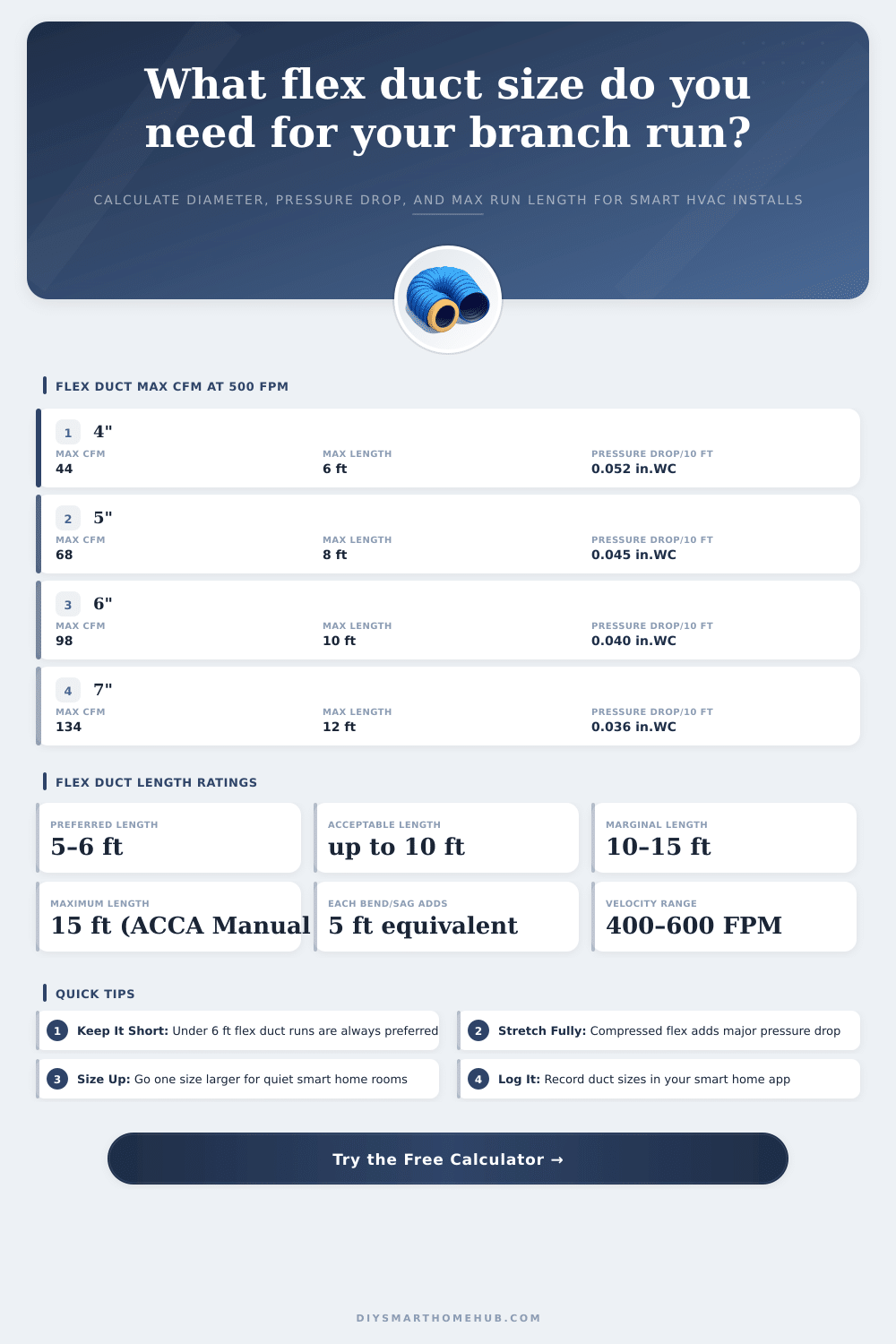
| CFM | Recommended Diameter | Max Length | Pressure Drop / 10 ft |
|---|---|---|---|
| 50–80 | 5" | 8 ft | 0.045 in.WC |
| 80–100 | 6" | 10 ft | 0.040 in.WC |
| 100–120 | 6" | 10 ft | 0.048 in.WC |
| 120–150 | 7" | 12 ft | 0.038 in.WC |
| 150–175 | 8" | 15 ft | 0.033 in.WC |
| 175–200 | 8" | 15 ft | 0.038 in.WC |
| 200–275 | 10" | 15 ft | 0.029 in.WC |
| 275–395 | 12" | 15 ft | 0.026 in.WC |
| 395–535 | 14" | 15 ft | 0.024 in.WC |
| Attribute | Flex Duct | Rigid Duct | Notes |
|---|---|---|---|
| Friction Rate | 20–30% higher | Baseline | Corrugated interior increases resistance |
| Effective Friction Factor | Rigid × 1.25 | 1.0× baseline | Fully extended, no sags |
| Recommended Velocity | 400–600 FPM | 600–900 FPM | Lower velocity reduces noise in flex |
| Max Branch Run | 15 ft (preferred 6 ft) | No limit (per Manual D) | ACCA Manual D guideline |
| Pressure Drop / 100 ft | ~0.08–0.12 in.WC | ~0.06–0.10 in.WC | At standard velocity |
| Sag / Bend Penalty | +5 ft equiv. per sag | Minor (smooth interior) | Each compression point adds resistance |
| Installation Ease | High — flexible routing | Lower — requires fittings | Flex suits tight smart home spaces |
| Sound Attenuation | Good — absorbs noise | Lower — can transmit noise | Flex preferred near bedrooms |
| Insulation Options | R-4.2, R-6, R-8 | Wrap added separately | Flex includes factory insulation |
| Smart Home Suitability | Branch runs only | Main trunk preferred | Use flex last 6–15 ft to diffuser |
Choosing the right flexible duct size really does make a big difference. Whether you work on a residential or commercial space, right size ensures that the air flows smooth. This keeps steady temperature through the whole building and stops the HVAC system from working too hard
Flexible ducts come in many different sizes. You will find inner diameters from 2 to 24 inches; that gives many options. The most common stored sizes are 2, 3, 4, 5, 6, 7, 8, 10 and 12 inches.
How to Pick the Right Flexible Duct Size
If you need something outside that range, you will have to make a special order, and that usually taks around four to six weeks before it arrives at your door.
The CFM, that is the cubic feet of air each minute (determines the size of duct you need). For instance, four-inch duct simply will not work for most range hoods. 10-inch round duct can handle airflow of more than one ton of air.
If you choose 12-inch round duct, you get even more breathing room. If you have 1.5-ton system that needs 600 CFM, you probably will need eight of those 6-inch flexible ducts to do the job. The key is: your return duct must match or beat the CFM that your AC unit or furnace pushes out.
Metal and flexible ducts do the same thing but in different ways. 6-inch metal duct works similarly to 8-inch flexible duct, although metal gives better flow and lower pressure. The trade-off?
Metal costs more at first. Even so, flexible ducts work almost like rigid tubes if you keep them straight and avoid kinks, only they do not last as long. When you need more capacity, sizing up your ductwork is the simplest answer.
Most small diameters, like 4-inch, are commonly used for branches away from the main lead. You will see them for example in RVs as 4-inch aluminum flexible ducts. Some RVs even use 2-inch ducts in very tight places.
The problem is, that 2-inch branch from 5-inch main duct commonly creates problems with the airflow, especially when it must reach the far spots.
Fiberglass flexible ducts come in lengths of 12 or 25 feet, with diameters of 3, 4, 5 or 6 inches. Many insulated options have thick fiberglass insulation with R-4.2, and they have strong outer covers to protect everything.
The installation is just as important as the size. Sharp curves or kinks will choke the airflow, so keep everything smooth and straight. Semi-rigid flexible ducts give more structural support when that is needed.
If you install flexible duct vertically, it needs support brackets at least every 6 feet. And those straps should be at least 1.5 inches wide. Ducts commonly end up too kinked or folded, which blocks the air.
Removing unnecessary extra ductwork and straightening the curves can dramatically improve the effect. Flexible ducts are great when you work in tight or irregular spaces. Only remember: in unconditioned areas, you do not stuff flexible ducts in holes that are smaller than the outer diameter of the duct itself.