Fan Power Consumption Calculator
Estimate running watts, circuit amps, daily kWh, monthly kWh, and standby energy for ceiling fans, box fans, tower fans, exhaust fans, and smart DC fans.
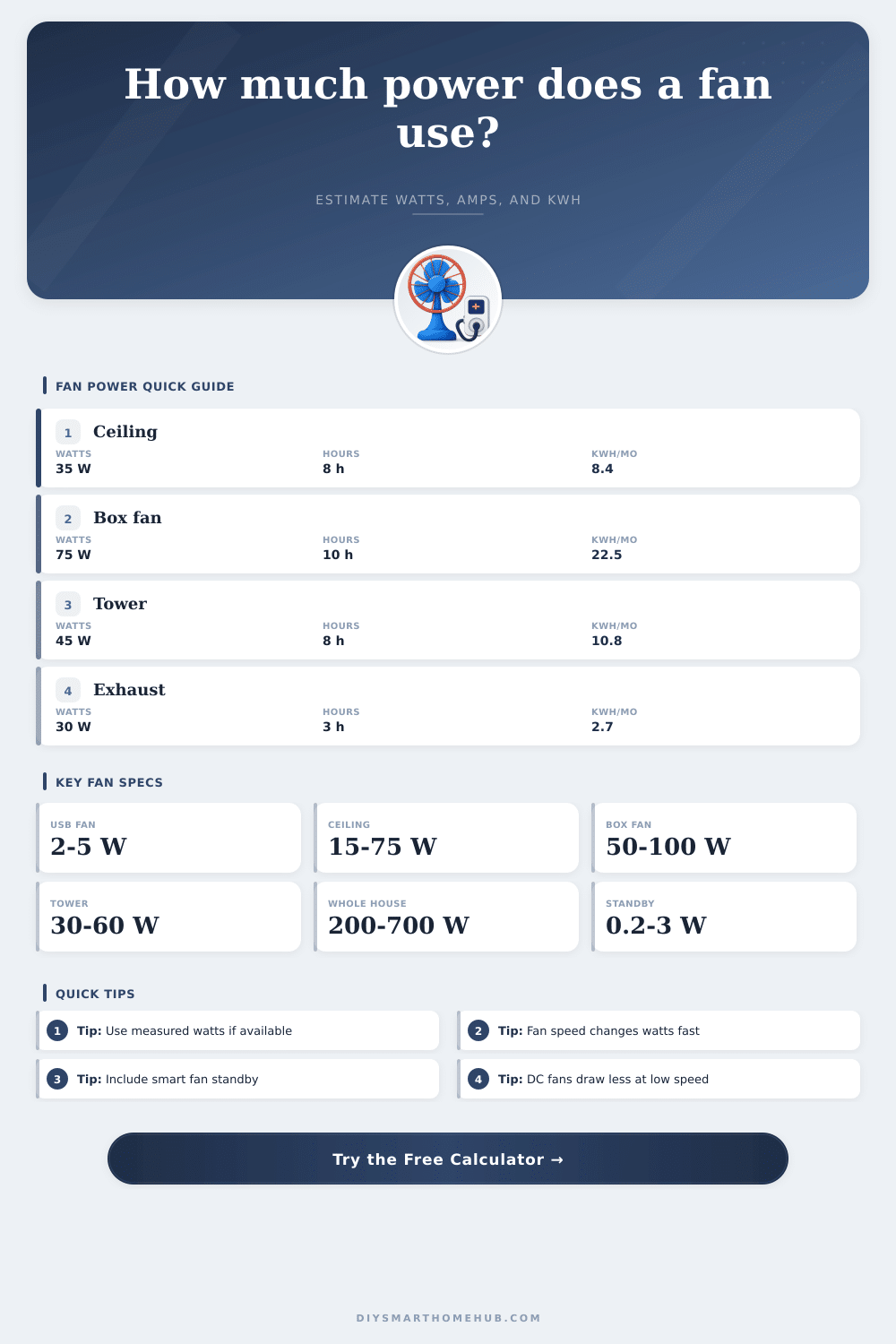
| Fan type | Typical watts | Common voltage | Best calculator preset |
|---|---|---|---|
| USB or small desk fan | 2 to 5 W | 5 V USB or adapter | USB desk fan |
| DC ceiling fan | 6 to 35 W | 120 V or 230 V driver | DC ceiling low |
| AC ceiling fan | 30 to 75 W | 120 V or 230 V | Ceiling medium/high |
| 20 inch box fan | 50 to 100 W | 120 V | 20 in box fan |
| Tower or pedestal fan | 30 to 70 W | 120 V or 230 V | Smart tower fan |
| Bathroom exhaust fan | 20 to 90 W | 120 V or 230 V | Bath exhaust fan |
| Inline duct fan | 40 to 180 W | 120 V or 230 V | Inline duct fan |
| Whole-house attic fan | 200 to 700 W | 120 V or 240 V | Whole-house fan |
Nameplate and measured wattage should take priority over these planning ranges.
| Average speed | DC/ECM motor | AC stepped motor | Measured linear mode |
|---|---|---|---|
| 40% | About 10% of full watts | About 23% of full watts | 40% of full watts |
| 60% | About 22% of full watts | About 44% of full watts | 60% of full watts |
| 80% | About 51% of full watts | About 70% of full watts | 80% of full watts |
| 100% | Full rated watts | Full rated watts | Full measured watts |
| Running load | At 120 V, PF 0.85 | At 230 V, PF 0.85 | At 120 V, PF 0.60 |
|---|---|---|---|
| 25 W | 0.25 A | 0.13 A | 0.35 A |
| 50 W | 0.49 A | 0.26 A | 0.69 A |
| 100 W | 0.98 A | 0.51 A | 1.39 A |
| 500 W | 4.90 A | 2.56 A | 6.94 A |
| Scenario | Adjusted watts | Runtime | Monthly kWh |
|---|---|---|---|
| Small USB fan at desk | 4 W | 8 h/day, 22 days | 0.7 kWh |
| Efficient DC ceiling fan | 18 W | 10 h/day, 30 days | 5.4 kWh |
| AC ceiling fan on medium | 35 W | 8 h/day, 30 days | 8.4 kWh |
| Box fan overnight | 75 W | 10 h/day, 30 days | 22.5 kWh |
| Bath exhaust fan timer | 30 W | 1 h/day, 30 days | 0.9 kWh |
| Whole-house fan evening run | 450 W | 3 h/day, 20 days | 27.0 kWh |
Electric fans uses electricity to move teh air within the body of the fans. Because electric fans use electricity, they contributes to an electric bill for each household that owns one of these appliance. While many individual use electric fans because they are less expensive to operate than air conditioning units, those electric fans still require a continuous supply of electricity from the electrical outlet to which they is plugged in.
The more electric fans that is being used in a household and the greater amount of wattage that each fan emit contributes to the electric bill for that household. The amount of electricity that electric fans use is related to the type of motor that those device contain. Electric fans that has DC motors are more efficient than those that have AC motors.
How Fans Use Electricity and How to Save Energy
By decreasing the speed of a fan that has a DC motor, that fan will use less electricity than by decreasing the speed of an electric fan that use an AC motor. Because of the physics of the movement of the air by the electric fan, the reduction of the speed of the fan will lead to a faster reduction of the amount of electricity that is being used by the fan than in relation to the reduction of the amount of wind that that fan releases. Thus, by reducing the speed of an electric fan, an individual will save a large amount of electricity yet lose only a small amount of the desired breeze that is emitted from that fan.
Another factor that relate to the amount of electricity that an electric fan uses is the issue of standby power. If the electric fan include a remote control to change the settings of the fan, then the fan will still draw electricity even though the fan motor are not spinning. Although the amount of electricity that the fan draws while in this standby mode is small, it is still drawn 24 hours per day, seven days per week.
The standby power of all of the smart device in a household add to become a significant portion of the electric bill of that household. Thus, it is important for individuals to distinguish between the electricity used by fans when they are spinning versus when they are idle. The efficiency with which an electric fan converts the electricity to the mechanical work that move the fan motors is referred to as the power factor of the motor.
Another factor that impact the efficiency with which an electric fan operates is the power factor of its motor. If the power factor of a motor is low, then the electric fan is not effective converting the electricity to the motors movement. Therefore, electric fans that has a low power factor will draw more electric current from the circuit than their motors use to perform work.
This measurement of the electric current of an electrical device is referred to as the amperage into which an individual must look to determine if the combination of electric fans in a household will create a tripping of the circuit breaker. In understanding how much electricity that is being used by electric fans, it is important to consider both the wattage of each fan and the length of time that each fan is used during the household day. While wattage is a measurement of the power of that fan, the number of kilowatt-hours that each fan uses over a specified length of time is the measurement that will help an individual to understand the cost of the electricity that is used by those electric fans.
Finally, there are different types of electric fans that can be used in the home. For instance, USB fans use very little electricity compared to other type of electric fans. However, whole-house fans will use a great deal of electricity due to the amount of air that is to be move in the home.
By knowing the type of motors that are contained within the fans and for how long they are used, an individual can calculate the amount of electricity that is used by each fan. Furthermore, by adjusting the speed at which the electric fans operate and the length of time that they are used, an individual can reduce the amount of electricity that is used by those electric fans in the body of the home.