Electricity Bill Split Calculator
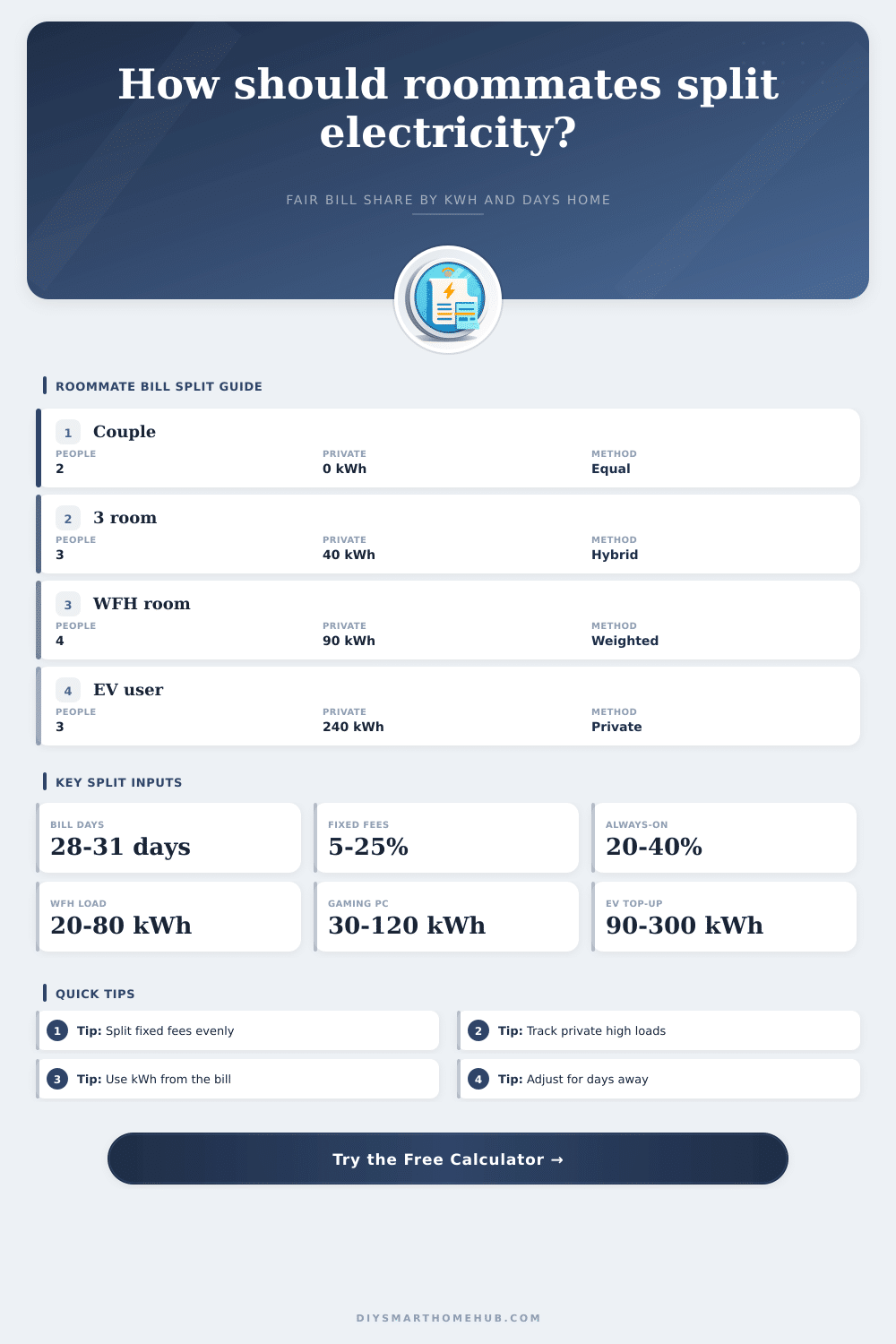
Estimate a fair roommate share from the total bill, metered kWh, fixed charges, days home, private high-load devices, and the split method everyone agreed to use.
| Method | Formula Basis | Best For | Watch Point |
|---|---|---|---|
| Equal split | Total bill / people | Similar schedules and devices | Ignores private loads |
| Days-home weighted | Present days and profile weight | Travel, short stays, sublets | Still estimates shared use |
| Equal shared plus private | Common kWh equal, private kWh assigned | EV, server, room AC, dehumidifier | Private kWh must be realistic |
| Hybrid weighted split | Shared equal plus weighted adjustment | Mixed schedules and mixed device loads | Agree on profile choices first |
| Private Load | Typical Power | Monthly Use Basis | Typical kWh |
|---|---|---|---|
| Gaming desktop | 300 to 600 W while active | 3 to 6 hours daily | 27 to 108 kWh |
| Work laptop and monitors | 60 to 180 W while active | 8 hours, 22 workdays | 11 to 32 kWh |
| Portable room AC | 700 to 1400 W running | 4 hours daily | 84 to 168 kWh |
| Small server or NAS | 25 to 120 W continuous | 24 hours daily | 18 to 86 kWh |
| EV level 1 charging | 1.2 to 1.4 kW charging | 6 hours, 15 nights | 108 to 126 kWh |
| Profile | Weight | Common Scenario | Calculation Meaning |
|---|---|---|---|
| Light: mostly away | 0.70x | Office worker, few evenings home | Lower share of variable common use |
| Standard evenings | 1.00x | Typical roommate schedule | Reference occupant weight |
| Work from home | 1.20x | Computer and daytime HVAC use | Moderate common-load increase |
| Gaming or media PC | 1.35x | High active plug load | Higher variable-use allocation |
| Private AC or heater | 1.55x | Room comfort appliance | Use with private kWh field |
| Server or EV user | 1.70x | Continuous or high kWh load | Private kWh should dominate |
| Bill Line Item | Where It Goes | Why It Matters | Calculator Input |
|---|---|---|---|
| Energy usage charge | Variable pool | Tracks kWh actually consumed | Total bill minus fixed fees |
| Customer or meter charge | Fixed pool | Does not change with one roommate's use | Fixed delivery/base charges |
| Delivery demand or rider | Usually fixed or shared | Often tied to the account, not a device | Add to fixed charges if flat |
| Metered kWh | Energy basis | Converts bill dollars into kWh shares | Metered energy on bill |
Living with roommates can lead to tensions when the electric bill arrive for the month, as the electric bill does not always reflect the amounts of electricity that each roommate use. Usually, the roommate will split the electric bill equally. However, this split can be unfair to those who use more electricity then others in the room.
For instance, roommates that works from home may use more electricity than others that are away from the home for extended period of time. Additionally, individuals that owns electric vehicles may use more electricity than those that only use device like a lamp. Thus, splitting the electric bill equally may lead to tensions between the roommates.
How Roommates Can Fairly Split the Electric Bill
The electric bill can be divided into two different component. Each individual pay for a fixed fee for having a connection to the electrical grid, as well as pays for the variable fees for the amount of electricity that are used in the home. Most think the fixed fee is even split among the roommates, since each roommate must pay for the connection to the electrical grid.
However, the roommates can calculate the variable fees individually according to each roommate’s electricity consumption. The variable fees for each roommate can be challenging to split, since each roommate may have a more different lifestyle than others in the house. For instance, different roommates may be present in the home for different amount of time.
One roommate may be away from the home for two week, while another may live in the house for twelve hour every day. Additionally, each roommate may use electricity for different device. For instance, a roommate that uses computers that consumes a great deal of electricity may use more of the electricity than a roommate that only use a mobile phone.
There is various devices in the home that are referred to as private high-load devices. Such device use a great deal of electricity. Examples of such devices includes air conditioners, electric heaters, and computer server racks.
Because these devices can lead to high electric bills, the roommate that own such a device may view splitting the electric bill equally as unfair. To avoid argument between the roommates, it is possible to isolate these devices and calculate the electricity that they use. Thus, only the remaining electricity that is split can be divide among the roommates.
The use of a mathematical approach to splitting the electric bill can help to remove the emotion between the roommates. For instance, using a formula that calculate the electric bill will produce a neutral number. The roommates usually accept a neutral number more than a number that one roommate propose.
However, it is not necessary to find the most perfect mathematical formula. Instead, it is more important to create an agreement that is seen as fair to all roommates. Thus, if the difference in cost between an equal split and a calculated split is small, it is best to split the electric bill equally to avoid tensions.
However, if the split is significantly different, dividing the electric bill according to each roommate’s actual use of electricity is the best approach to create stability within the relationship between the roommates. The best approach to splitting an electric bill is to create an agreement among the roommates prior to the arrival of the bill. Each roommate should determine how the roommates will split the fixed fee and how the remaining electric bill will be split according to each roommate’s consumption of electricity.
Finally, each roommate should decide in advance how to handle private high load devices. Following these step will allow the roommate to avoid argument over the use of electricity.