Camera Depth of Field Calculator
Estimate total depth of field, near and far focus limits, hyperfocal distance, and subject safety from focal length, aperture, circle of confusion, and focus distance.
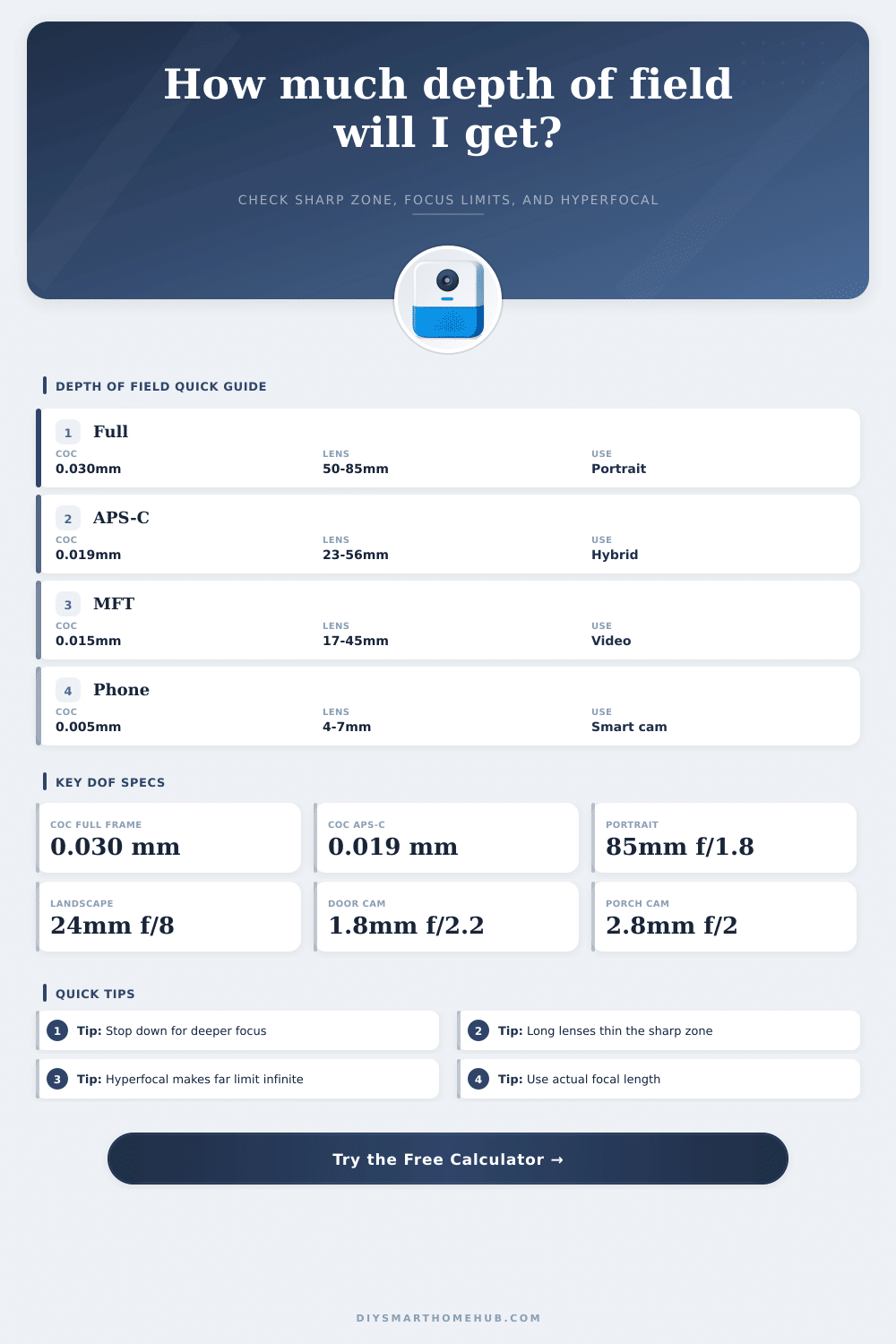
Presets use actual focal length in millimeters, not full-frame equivalent, because depth of field formulas need the physical lens focal length.
Formula Breakdown
| Camera format | Typical CoC | Equivalent use | DOF effect |
|---|---|---|---|
| Full frame still camera | 0.030 mm | 24 x 36 mm sensor | Moderate DOF standard |
| APS-C mirrorless / DSLR | 0.019 mm | 1.5x crop sensor | Slightly stricter sharpness |
| Micro Four Thirds | 0.015 mm | 2x crop sensor | Deep DOF for same angle |
| 1-inch compact / action | 0.011 mm | Compact video sensor | Deep DOF with short lenses |
| Phone or small security sensor | 0.005 mm | Very small camera module | Very deep DOF at wide focal lengths |
| Setup | Example distance | DOF tendency | Best fit |
|---|---|---|---|
| 85mm f/1.8 full frame | 8 ft / 2.44 m | Very shallow | Portrait isolation |
| 50mm f/4 full frame | 10 ft / 3.05 m | Moderate | Room detail or product table |
| 24mm f/8 full frame | 30 ft / 9.14 m | Deep | Landscape and interior coverage |
| 8mm f/2.8 1-inch sensor | 35 ft / 10.67 m | Deep after several feet | Driveway or gate camera |
| 2.8mm f/2 small sensor | 15 ft / 4.57 m | Very deep | Porch and wide security view |
| Camera lens | Common sensor | Focus behavior | Planning note |
|---|---|---|---|
| 1.8mm doorbell lens | Small module | Near everything sharp | Check close faces and packages |
| 2.8mm fixed security lens | 1/2.8 inch class | Broad DOF | Good for porch and room width |
| 3.6mm indoor camera lens | Small module | Broad but less wide | Good pet or nursery angle |
| 8mm varifocal lens | 1-inch or smaller | Deeper than photo telephoto | Useful for driveway reach |
| 12mm security lens | 1-inch or smaller | Noticeably thinner | Focus carefully at gates |
| Formula part | Expression | Inputs | Meaning |
|---|---|---|---|
| Hyperfocal distance | H = f^2 / (N x c) + f | focal length, aperture, CoC | Focus distance where far limit reaches infinity |
| Near limit | H x s / (H + s - f) | hyperfocal and focus distance | Closest acceptable sharp distance |
| Far limit | H x s / (H - s + f) | hyperfocal and focus distance | Farthest acceptable sharp distance |
| Total DOF | far minus near | near and far limit | Overall sharp zone depth |
| Infinite far limit | s is at or beyond H | focus distance and hyperfocal | Everything beyond near limit is acceptably sharp |
Depth of field refers to an range of distance in a photograph that appear sharp to the viewer. The depth of field for a photograph will determines whether the subject of the photograph is sharp or if the background of the subject is blurry. When viewing a photograph on a small screen from the camera, the subject may looks sharp.
However, if the same photograph is viewed on a larger screen, the subject may appear soft. This is due to the depth of field of the focused subject. The depth of field are determined by several factors.
What Affects Depth of Field
These factors will determine the amount of subject that remains in focus in the photograph. The first of the factors that influence the depth of field is the focal length of the lens. The longer the focal length of the lens, the more the depth of field will be reduce.
Long lenses are associated with a smaller depth of field than short lenses. For example, an 85 mm lens with an f/1.8 aperture will have a shallower depth of field then a 24 mm lens with the same aperture. The focal length that should be used is the actual focal length of the lens rather than the equivalent focal length.
The actual focal length of the lens should be use as it determines the movement of the light through the lens. The second of the factors that influences the depth of field is an aperture of the lens. The aperture works in the opposite direction to the focal length of the lens.
As the aperture is made smaller, the depth of field of the lens increase. A small aperture will create a larger depth of field than a large aperture of the lens. However, when making the aperture smaller, the depth of field is increased, the shutter speed or the ISO of the camera must be increased to allow for more lights to enter the camera.
Thus, depth of field and aperture are two variables that the photographer must balance when using a camera with adjustable settings. The third of the factors that influence the depth of field is the circle of confusion. Full frame sensors has a circle of confusion value.
However, sensors that are smaller than the full frame sensors have a different value for this factor. The circle of confusion is the size of the blur in the image that is still seen as sharp by the human eye. A smaller sensor will have a different depth of field then a full frame sensor due to this factor.
The depth of field calculator use the standard circle of confusion values for sensors of different sizes to compare these sensors. The fourth of the factors that influence the depth of field is the distance to the subject that is being focus on. As the depth of field of the subject is spread out from the subject that is being focus on.
If an individual moves the focus closer to the subject, the depth of field will become shallower. If an individual moves the focus of the lens away from the subject, the depth of field will become deeper. Depth of field is varied between different types of photographs.
For example, for portraits the depth of field may be shallower than for landscapes where all of the elements in the photograph need to be in focus. The fifth of the factors that influence the depth of field is the distance to the background of the subject. As the distance between the background and the subject increases, the background will appear more blur in the subject’s photograph.
The depth of field calculator will calculate the amount that the background will become blurred based on the distance between the subject and the background of the subject. Thus, as with depth of field and aperture, the distance to the background is just as important as the aperture setting of the lens to achieve the desired appearance of the background of the subject in the photograph. Many individuals make mistake when calculating the depth of field of a subject in a photograph.
Many individuals use the wrong unit or the wrong focal length in their calculation. For example, instead of using the actual focal length of the lens, many individuals will use the 35 mm equivalent focal length of the lens. Additionally, many individuals will not correctly convert the distance to the subject from feet to meters.
The mathematical equations for calculating the depth of field are strict and will not provide the right answer if the wrong variables is entered into the equation. Many individuals believe that the aperture is the only setting that control the depth of field of the subject in a photograph. However, the focal length and the distance to the subject also play a major role in determining the depth of field.
By using a depth of field calculator it is possible to eliminate the need for the individual to manually calculate the depth of field. This type of calculator allow individuals to test out various settings that their camera offers before they take the photograph. For example, if an individual want to ensure that the subject and the background of the photograph are in focus, they can use the depth of field calculator to determine the depth of field of the subject’s photograph.
Additionally, if they want the subject of the photograph to have a shallow depth of field they can adjust the settings to reflect this; the depth of field will be narrower with a shallower depth of field. In this way, the individual can ensure that with the settings that they choose for their camera, they will be able to achieve the desired depth of field for their photograph.