DC to AC Inverter Calculator
Size a backup inverter around running watts, startup surge, battery voltage, chemistry, and discharge limits so the battery bank and inverter match the load instead of barely surviving it.
Enter the running watts your inverter must support. Surge multiplier covers the short startup spike from compressors, pumps, and other motor loads.
Calculation Breakdown
| Load | Running Watts | Startup Range | Typical Match |
|---|---|---|---|
| Router and modem | 20-40 W | 1.2x | 300 W inverter |
| CPAP with humidifier | 60-90 W | 1.5x | 300-500 W pure sine |
| Full-size refrigerator | 150-220 W | 2.5x-3x | 1000 W surge-ready |
| Microwave oven | 1000-1500 W | 1.5x-2x | 2000 W inverter |
| Inverter Size | 12 V Bank | 24 V Bank | 48 V Bank |
|---|---|---|---|
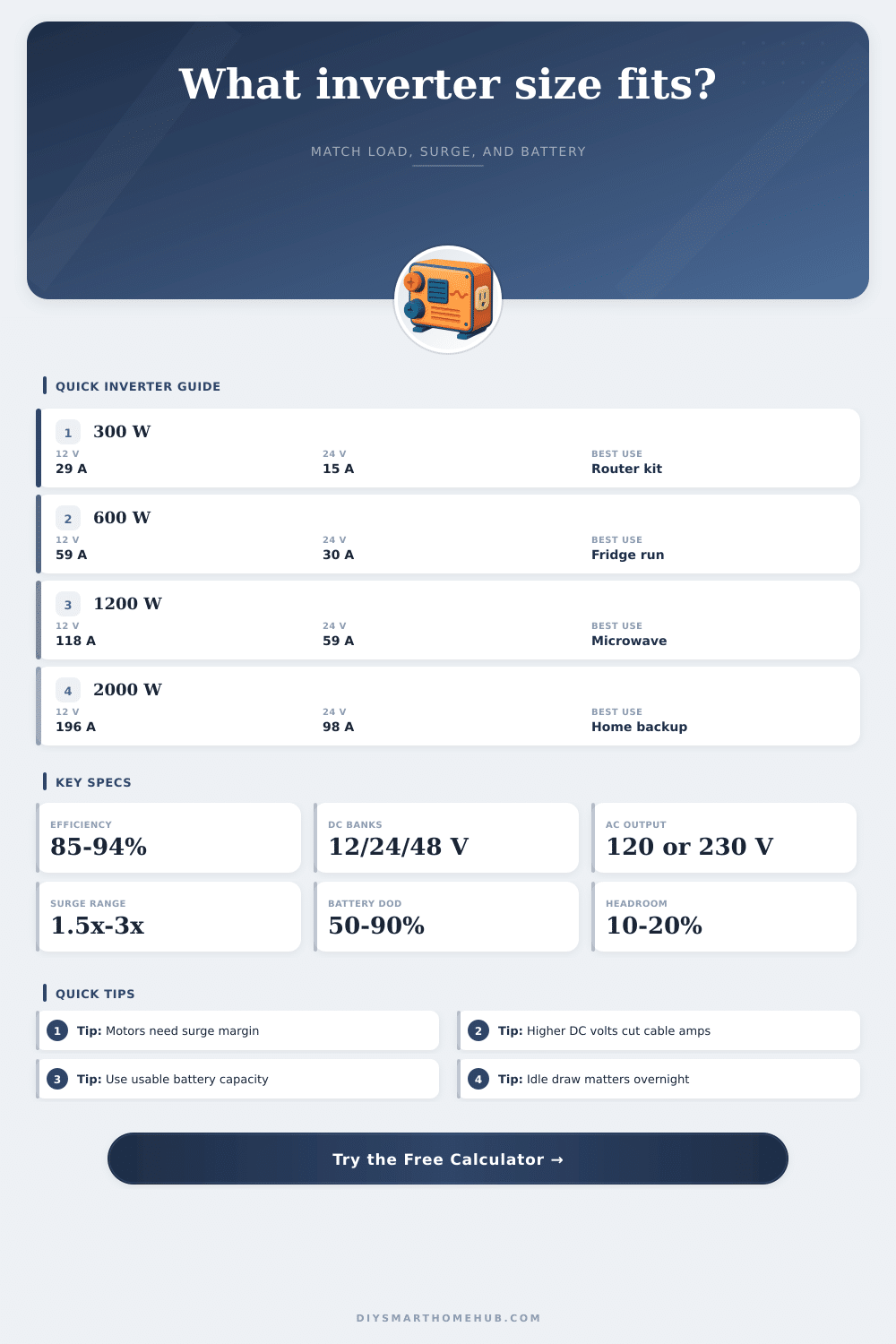
| 300 W | 29 A | 15 A | 8 A |
| 600 W | 59 A | 30 A | 15 A |
| 1200 W | 118 A | 59 A | 30 A |
| 2000 W | 196 A | 98 A | 49 A |
| Battery Bank | 300 W Load | 600 W Load | 1200 W Load |
|---|---|---|---|
| 12 V 100 Ah AGM | 1.8 hr | 0.9 hr | 0.4 hr |
| 24 V 200 Ah AGM | 7.3 hr | 3.6 hr | 1.8 hr |
| 24 V 200 Ah LFP | 13.2 hr | 6.6 hr | 3.3 hr |
| 48 V 100 Ah LFP | 13.2 hr | 6.6 hr | 3.3 hr |
| Profile | Efficiency | Surge | Best Fit |
|---|---|---|---|
| Modified sine basic | 88% | 1.6x | Simple resistive loads |
| Pure sine general | 92% | 2.0x | Electronics and mixed loads |
| Pure sine heavy surge | 94% | 3.0x | Fridges, pumps, compressors |
| Pure sine low idle | 91% | 1.8x | Overnight medical loads |
A refrigerator may only run at 180 watts, but the compressor can briefly demand more than twice that. The continuous inverter rating alone is not enough for startup-heavy loads.
If full-load current climbs past about 120 amps on a 12 volt bank, shifting to 24 or 48 volts usually cuts cable stress and makes inverter sizing more realistic.
An inverter is an device that takes the direct current from a battery and turns that into alternating current that can be used to operate household appliance. Many people use inverters during power outages to allow them to operate household appliances using the battery. However, the inverter isnt 100% efficient in the conversion of the direct current to alternating current; some of the energy from the battery is lost as the inverter converts that energy into heat.
Inverters typically has efficiency ratings between 85% and 94%. Thus, the inverter will always lose some of its energy during the conversion process, and the energy that the inverter outputs will always be less than the energy that is input from the battery. Another factor to consider when selecting an inverter is its continuous wattage rating.
How to Choose the Right Inverter and Battery
The continuous wattage of an inverter determine the amount of power that the inverter will be able to provide to its appliances. Some appliances, like routers or lights, will require a certain amount of continuous wattage to operate. Other appliance, like refrigerators or water pumps, use motors that require a startup surge of power, meaning that they require a higher wattage input during startup than while in operation.
An inverter that is too small will not be able to handle such startup wattages for these appliances, and it will continually fail or “trip” while attempting to start these appliances. An inverter that is too large will require the individual to spend more money and to transport more of the equipment due to the extra weight that is required to provide the extra amount of power. The duty cycle of the appliances that will be used with the inverter is another factor to consider in the selection of the inverter.
Not all appliances will be continuously running; some will cycle on and off periodically. For instance, a refrigerator might only run 45% of the time while a CPAP machine might run continuously. Thus, consideration of the duty cycle will allow the individual to determine the length of time that the battery will last.
Furthermore, it is also recommended to include a buffer of 10% to 25% into these calculation to prevent the inverter from overheating. Battery voltage is another factor to consider in the selection of an inverter. Battery voltage will impact the amount of current that flow through the wires.
Common battery voltages are 12 volts. However, 12 volt batteries require a high current to provide the wattage that the appliances require. For instance, to power an appliance that draws 1200 watts at 12 volts will require over 100 amps of current.
Thus, higher voltages will allow for lower amperage, meaning that thinner wires can be used to convey the electricity from the battery. The chemistry of the battery can also impact the way that the inverter use energy from the battery. Lead acid batteries, such as flooded batteries or AGM batteries, have limited depth of discharge; they should only be used at 50% of their capacity.
Using more than 50% of the batteries capacity will shorten the life of those batteries. Lithium iron phosphate batteries, however, allow 80% to 90% of the batterys capacity to be used. Additionally, the voltage of lithium iron phosphate batteries is maintained at a flat curve, meaning that the inverter does not struggle to provide power to the appliances.
Individuals can also purchase either a modified sine wave inverter or a pure sine wave inverter. Modified sine wave models are typically less expensive; however, they can make fans buzz and can make laptops and other electronics malfunction. A pure sine wave inverter mimics the power supply provide by the electrical grid, so it is better for electronics.
Wiring the inverter appropriately is important to avoid fires in the inverter. Using wires that are too thin for the amount of power to pass through can lead to fires or the failure of the inverter. Thick copper wires, such as 2/0 gauge copper wires should be used if the amperage that is drawn from the battery are high.
Using a higher voltage battery bank will reduce the amount of amperage, meaning that smaller wires will be required. Another additional factor that can be considered is the idle draw of the inverter. Idle draw is the amount of power that the inverter draws while it is not powering any appliance.
Some inverters can draw 8 to 16 watts when idling. Thus, these watts will reduce the amount of time that the battery will run the inverter. In order to create an inverter and battery system that will effectively power the appliances that an individual plan to use, the individual should first note the wattage and surge wattages of each of their appliances.
Based off these notes, the individual can calculate the total wattage, voltage, and capacity of the battery. By ensuring that each appliances wattage match the capacity of the battery, as well as the capability of the inverter, the inverter will function correctly during a power outage.