❄ CSPF to EER Calculator
Convert Cooling Seasonal Performance Factor to Energy Efficiency Ratio by climate zone
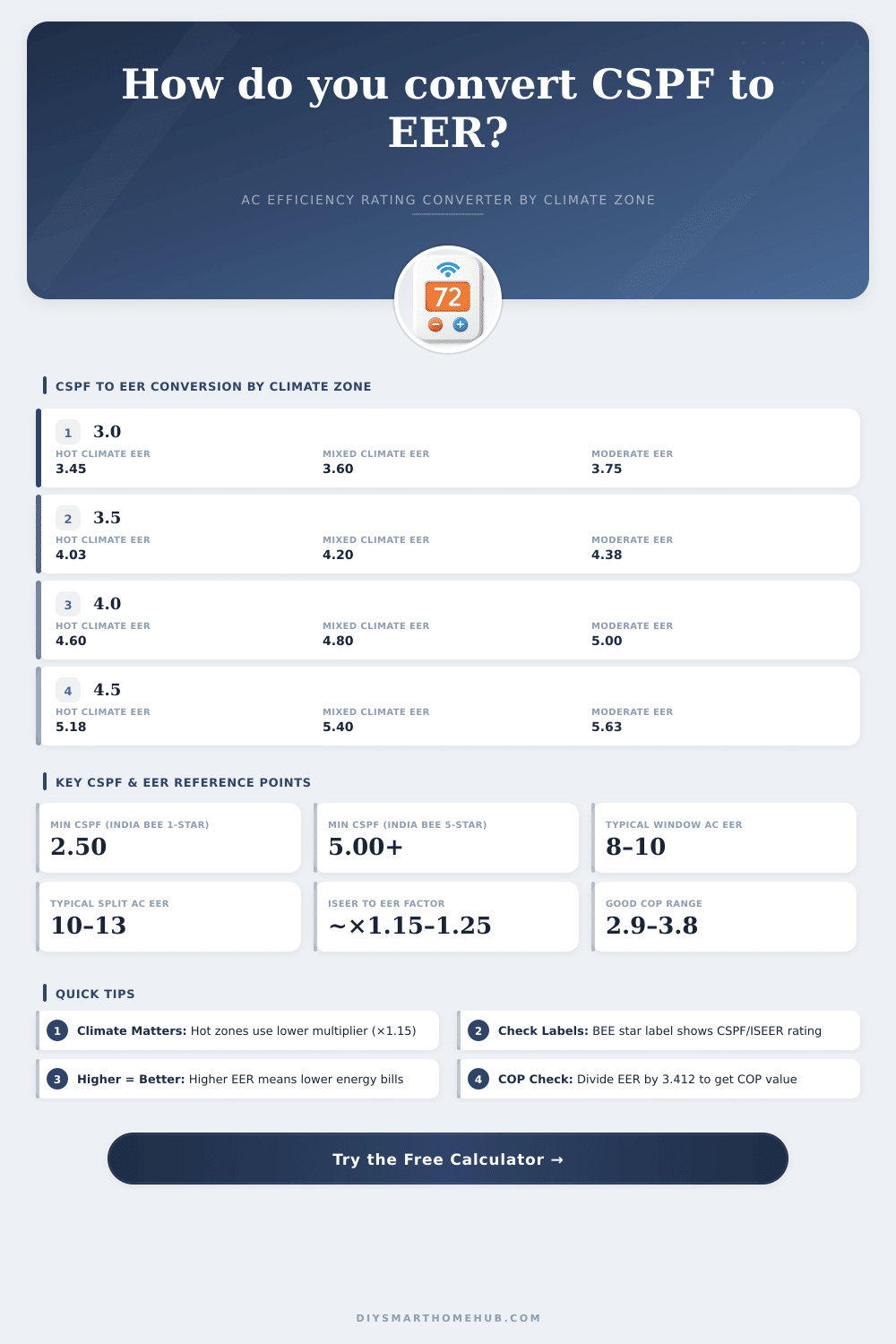
| CSPF Rating | Hot Climate EER (×1.15) | Mixed Climate EER (×1.20) | Moderate EER (×1.25) | Approx. COP |
|---|---|---|---|---|
| 2.5 | 2.88 | 3.00 | 3.13 | 0.84–0.92 |
| 3.0 | 3.45 | 3.60 | 3.75 | 1.01–1.10 |
| 3.5 | 4.03 | 4.20 | 4.38 | 1.18–1.28 |
| 4.0 | 4.60 | 4.80 | 5.00 | 1.35–1.47 |
| 4.5 | 5.18 | 5.40 | 5.63 | 1.52–1.65 |
| 5.0 | 5.75 | 6.00 | 6.25 | 1.68–1.83 |
| 5.5 | 6.33 | 6.60 | 6.88 | 1.85–2.02 |
| 6.0 | 6.90 | 7.20 | 7.50 | 2.02–2.20 |
| 6.5 | 7.48 | 7.80 | 8.13 | 2.19–2.38 |
| 7.0 | 8.05 | 8.40 | 8.75 | 2.36–2.56 |
| CSPF Range | BEE Star Rating | EER Equiv. (Mixed) | Efficiency Class | Recommendation |
|---|---|---|---|---|
| Below 3.10 | 1 Star | Below 3.72 | Poor | Avoid – high running cost |
| 3.10 – 3.29 | 2 Star | 3.72 – 3.95 | Below Average | Budget option only |
| 3.30 – 3.49 | 3 Star | 3.96 – 4.19 | Average | Acceptable for low use |
| 3.50 – 3.99 | 4 Star | 4.20 – 4.79 | Good | Recommended choice |
| 4.00 – 4.99 | 5 Star | 4.80 – 5.99 | Very Good | Best value pick |
| 5.00 – 5.99 | 5 Star+ | 6.00 – 7.19 | Excellent | Premium inverter grade |
| 6.00+ | Super Efficient | 7.20+ | Superior | Top-tier inverter AC |
CSPF, so, Cooling Seasonal Performance Factor, estimates the whole cooling the device removes from the internal air during the active cooling period divided by the total energy it consumes during that same time. EER operates otherwise. It simply shows the cooling capacity compared to the used power in a particular test condition, in watts per watt.
Here where everything becomes clear. Those two measures estimate efficiency from entirely different viewpoints. EER has a clear weakness: it measures only one moment, full capacity.
CSPF and EER: How They Are Different
So you see the activity of the unit only at that lone spot. CSPF gives a fuller image, because it follows the energy during the whole cooling season. That differnece is genuinely important.
Europe altered the system halfway. Before 2013 they used EER and COP for air conditioners and heaters. Later the ErP norm arrived and swapped them for SEER and SCOP as new standards.
There is even a conversion formula: SEER matches (1.12 minus the square root of (1.2544 minus 0.08 times EER)) divided by 0.04.
For regions with genuinely warm climates appeared CSPF T3. The ISO committee about refrigeration and air conditioning made it for testing of air conditioners and heat pumps in such conditions. It follows the standard ISO 16358-1 Revision 1 from 2019 for T3 warm zones. What makes it useful is that the seasonal calculation genuinely reflects the actual cooling season in warm climates…
More exactly than only EER.
If you compare the efficiency values, the math stays simple. The approximate conversion is 7 divided by 5, so 1.4. Not like this hard, although it sounds like this.
Want to see the numbers in practice? The Kolin Primus Gold 1 hp reaches CSPF 6.31. The Carrier Optima 1 hp has 3.14 comparatively.
For EER the Kolin has 15.5, while Optima 10.6. Those differences are huge.
Global comparisons by means of ISO CSPF shows what is available in Japan, China, Korea, European Union and United States. Energy efficiency for air conditioners usually estimate by means of EER, but CSPF bids an alternative mode. Minimal standards require for instance 3.10 Wh/Wh for units under 4.5 kW, and 2.90 Wh/Wh for smaller unitsunder 7.1 kW.