CFM to Tonnage Calculator
Convert airflow (CFM) to AC/HVAC cooling capacity (tons) for smart home system sizing
Calculator
Please enter a valid positive value.
Tonnage Spec Grid
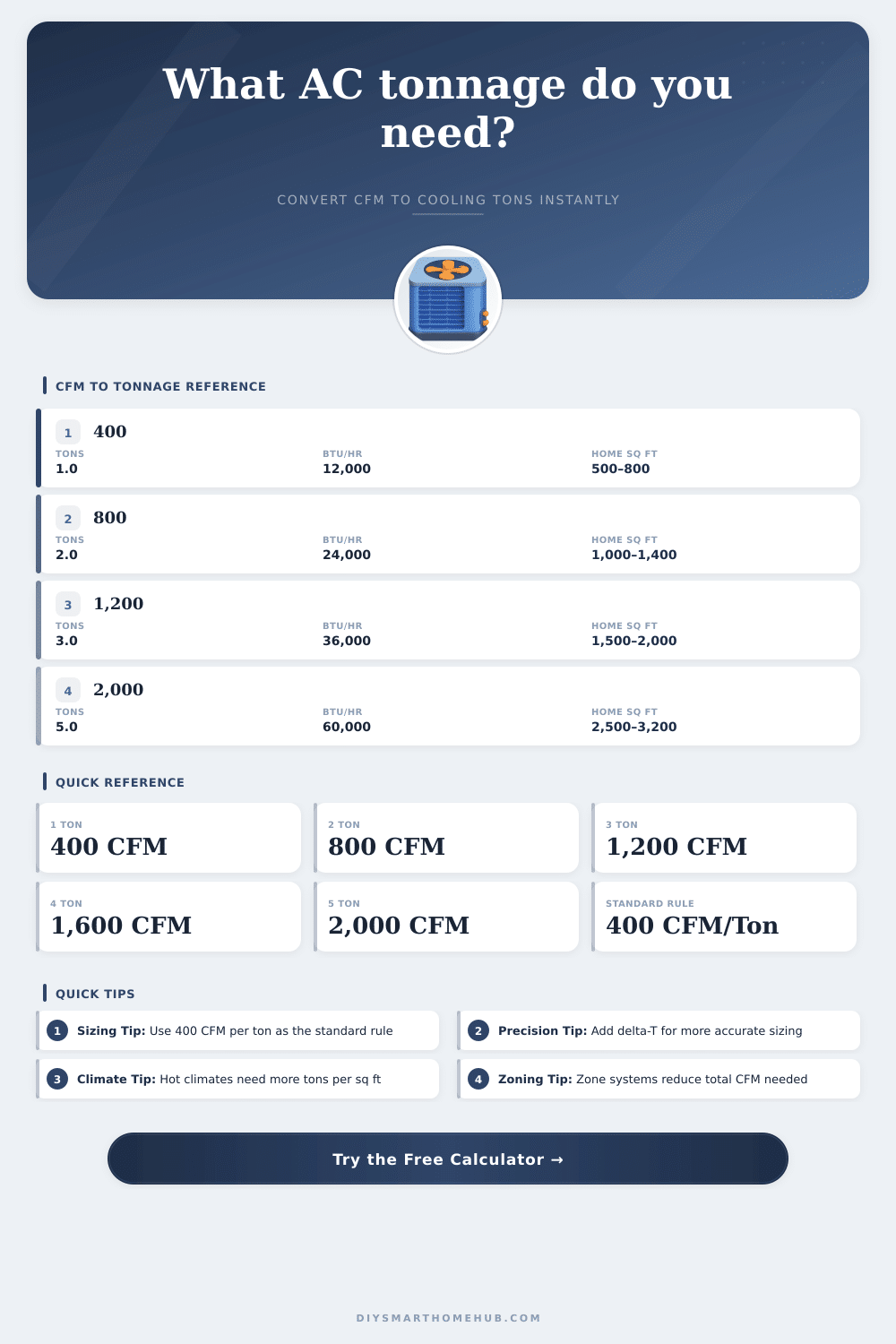
CFM to Tonnage Reference Table
| CFM | Tons | BTU/hr | Approx Sq Ft |
|---|
Climate Zone Sizing Guide
| Climate Zone | Sq Ft per Ton | 1,000 Sq Ft | 2,000 Sq Ft | 3,000 Sq Ft |
|---|---|---|---|---|
| Hot / Humid | 400–500 | 2.0–2.5 Tons | 4.0–5.0 Tons | 6.0–7.5 Tons |
| Hot / Dry | 450–550 | 1.8–2.2 Tons | 3.6–4.4 Tons | 5.5–6.7 Tons |
| Mixed | 500–600 | 1.7–2.0 Tons | 3.3–4.0 Tons | 5.0–6.0 Tons |
| Cold | 600–800 | 1.25–1.7 Tons | 2.5–3.3 Tons | 3.75–5.0 Tons |
Smart HVAC Tonnage Sizing
The 400 CFM per ton rule is an industry standard starting point for residential systems. For smart home HVAC, use precise mode with your actual supply/return temperature difference (typically 15–25°F) for more accurate tonnage. Under-sizing causes the system to run continuously; over-sizing causes short cycling and humidity issues.
Zoning and CFM Distribution
Multi-zone systems allow you to distribute total CFM across separate areas. Calculate the required tons per zone using zone CFM, then sum for total system capacity. Smart thermostats and variable-speed air handlers var you fine-tune airflow per zone, improving efficiency and comfort without oversizing the central unit.
CFM is for cooling, because it shows cubic feet of air each minute each ton. It shows how much air the cooling device cools for individual tons of capacity. CFM explains the airflow that enters the room, namely cubic feet each minute CF estimates volume, M marks time, so CFM actually is a rate, not simply amount.
Normal 1 ton of cooling capacity requires 400 CFM of airflow. So 2 tons is 800 CFM, and so on. 6-ton system with 400 CFM each ton delivers 2400 CFM.
How Much CFM for Each Ton of Cooling
Typical home central AC or heat pump reach average 400 CFM each ton for the air. Here matters the home size. Big houses require more CFM for good airflwo.
Coolers measure in tons. Home devices range from 1 to 5 tons. Commercial systems become much bigger.
The 400 CFM each ton is well known rule of thumb. Its origin probably is only rule of thumb, but ASHRAE backed it in several books for homes and basic commercial units. Makers also accepted it.
For instance maker puts “4” in the model of the condenser for ton, and the same air handler shows 1600 CFM. Some makers put the ton directly in the number, but usually not the precise value.
Even so not every system operates at exactly 400 CFM each ton. Old models had around 200 CFM each ton, while new high-efficiency reach 400. In places like California limits to 350 (450 CFM each ton).
Warm-humid climate profits from 330 or 350 CFM each ton for more latent capacity. New efficient mini-splits save energy by less airflow and colder air temperature.
The right CFM each ton should adapt to the planned load. Home with many plants, trees and open water stresses latent loads. Houses with lot of glass but little latent load means more sensible loads.
Systems can have 550 or 350 CFM each ton according to the load kind.
For fast calculation divide the total CFM by 400. For instance 1970 CFM divided by 400 give almost 5 tons. 3.5-ton AC unit requires 1500 (1700 CFM).
5-ton two-stage unit delivers 1400 CFM in low stage and 1750 in high. Occasionally the pipes are the real problem. The blower gives enough CFM, but ductsystem does not send the air well to every room.