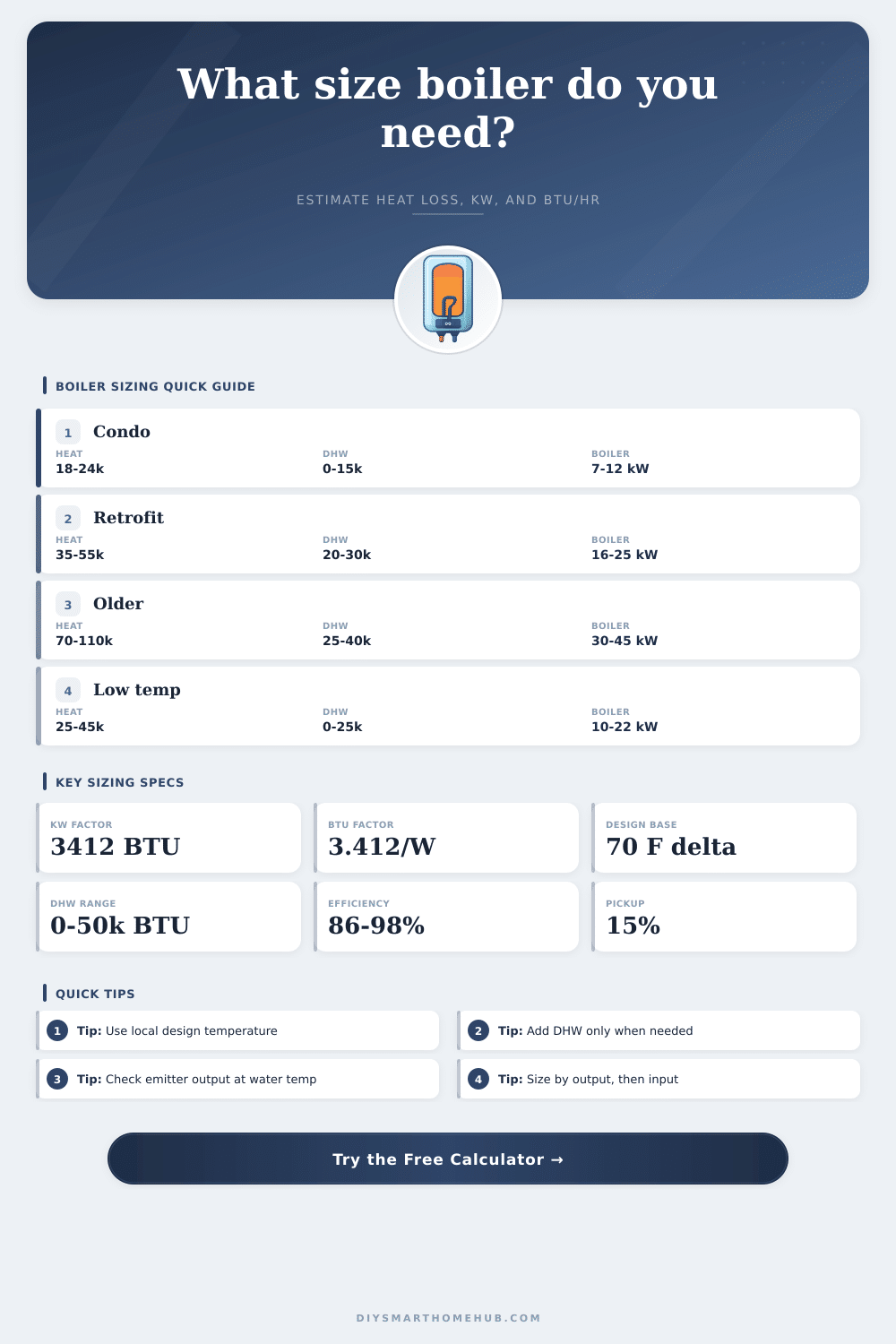
Boiler Size Calculator
Estimate hydronic boiler output from design heat loss, indoor and outdoor temperatures, domestic hot water allowance, boiler efficiency, and emitter temperature capability.
🏠Boiler Sizing Presets
Pick a real starting point, then adjust the design temperature, envelope profile, DHW allowance, efficiency, and emitter type for the actual system.
📏Heat Loss And Boiler Inputs
⚙Boiler And Emitter Spec Cards
📊Boiler And Radiator Comparison Grid
Condensing boiler with radiant floor
- Water profile120/100 F
- Efficiency fitBest
- Emitter outputLow temp
- Watch pointFloor limit
Condensing boiler with panel radiators
- Water profile140/120 F
- Efficiency fitStrong
- Emitter outputMedium
- Watch pointPanel area
Cast iron radiator system
- Water profile160/140 F
- Efficiency fitGood
- Emitter outputHigh mass
- Watch pointOversizing
Fin-tube baseboard boiler
- Water profile180/160 F
- Efficiency fitFair
- Emitter outputHigh temp
- Watch pointLoop length
📘Reference Tables
These tables show the assumptions used by the calculator so the BTU/hr, kW, DHW, and emitter results stay transparent.
| Heat-loss profile | BTU/hr per sq ft at 70 F delta | Typical building | Best use |
|---|---|---|---|
| Super insulated / passive shell | 12 | Very airtight, thick insulation | Low-temperature boilers and radiant systems |
| Modern tight construction | 18 | Recent code-built home | Condensing boiler with modest margin |
| Average insulated retrofit | 28 | Updated windows and attic insulation | Common hydronic replacement estimate |
| Older mixed insulation | 40 | Leaky windows, partial insulation | Higher heat loss before envelope upgrades |
| Leaky or solid-wall home | 55 | Uninsulated masonry or high infiltration | Use as a rough upper screen only |
| DHW profile | Allowance added | kW equivalent | When to use |
|---|---|---|---|
| Space heating only | 0 BTU/hr | 0 kW | Separate water heater or heating-only boiler |
| Small draw / indirect priority | 15,000 BTU/hr | 4.4 kW | Low simultaneous hot-water demand |
| One bath home | 25,000 BTU/hr | 7.3 kW | Apartment, small home, modest storage |
| Two bath family | 35,000 BTU/hr | 10.3 kW | Typical family home with indirect tank |
| Combi boiler high flow | 50,000 BTU/hr | 14.7 kW | When hot-water flow drives the boiler size |
| Emitter type | Water profile | Rated output basis | Temperature correction |
|---|---|---|---|
| Panel radiators | 170/150 F | 45 W per sq ft served | Near Delta 50 rating |
| Cast iron radiators | 160/140 F | 38 W per sq ft served | Mass helps cycling stability |
| Fin-tube baseboard | 180/160 F | 52 W per sq ft served | Needs hotter water for output |
| Radiant floor | 120/100 F | 18 W per sq ft served | Low-temperature, large area emitter |
| Low-temp panel radiators | 140/120 F | 45 W per sq ft served | Output drops at lower water temperature |
| Hydronic unit heater | 180/160 F | 65 W per sq ft served | High output for garages and workshops |
| Conversion or sizing step | Formula | Example | Result |
|---|---|---|---|
| BTU/hr to kW | BTU/hr / 3412.142 | 68,000 / 3412 | 19.9 kW |
| kW to BTU/hr | kW x 3412.142 | 24 x 3412 | 81,891 BTU/hr |
| Output to input | Output / efficiency | 80,000 / 0.94 | 85,106 BTU/hr |
| Radiator correction | (Actual delta C / 50)^1.3 | Delta 33 C | 0.58 multiplier |
💡Boiler Sizing Tips
A boiler sized from average winter weather will be small on the coldest design day. Use the local outdoor design temperature and the indoor setpoint you actually expect.
A condensing boiler may have enough kW, but radiators, baseboard, or radiant floor loops must still release that heat at the chosen water temperature.
Selecting a boiler for an home requires an understanding of how the boiler must replace the heat that leave the building. If the boiler is too small to heat the homes, it will continually run and eventually fail to maintain the desired comfortable temperature within the home. If, however, the boiler is too large, it will continually cycle on and off to try to maintain the desired temperature, and the large boiler will waste both fuels and eventually wear out it’s components.
The heat loss of a building must be calculated to ensure that the boiler will provide the correct amount of heat to that building. Heat loss is calculated for buildings by determining the thermal performance of each of the building’s envelope, which are its walls, windows, and insulation. Homes that is moddern and contain high levels of insulation will lose less heat than older homes that have low insulation level.
How to Choose the Right Boiler and Water Heater
Therefore, a heating load calculation will need to account for the thermal performance of each of these component to determine how much heat the heating system need to provide to each home. Within the heating load calculation, it is also necessary to consider the design temperatures of the home. The indoor design temperature is the temperature that is to be maintain within the house.
The outdoor design temperature is the extreme cold temperature that the heating system must account for. The outdoor design temperature is different than the average winter temperature of a region; the outdoor design temperature is the lowest extreme of that climates temperature variation throughout the year. Using the average winter temperature of the region in place of the outdoor design temperature will result in an undersized heating system.
Another consideration for heat loss calculation is the domestic hot water that the water heater must provide. The water heater must account for the domestic hot water load in the total heat output of the water heater. The amount of domestic hot water that a home requires will depend upon the number of bathrooms within the home and the number of individual who use the hot water at the same time.
It is impossible for a water heater to heat the water for space heating and supply hot water for a shower at the same time. The efficiency of a water heater should also be considered in the determination of the size of the water heater. A water heater that has an efficiency of 94% will use less fuel than a water heater with an efficiency of 88% to provide the same amount of heat.
The size of the water heater should be calculated according to the heat output that the home requires rather than the fuel input rate of the water heater. The fuel input rate is the heat output divided by the efficiency; using the fuel input rate of an older water heater to size a new water heater will result in the selection of a water heater that is too large for that home. The capacity of the emitters (such as radiators or baseboards) that are within each home will also limit the performance of the water heater.
A water heater that can output 90,00- BTUs per hour will not be of any use in a home whose emitters can only release 60,000 BTUs per hour. In either case, the size of the water heater should not be ignored in the face of this problem; instead, either the homeowner should increase the size of the emitters that are in the home, or the temperature of the water within the emitters should be increased. In accounting for domestic hot water, the efficiency of the water heater, and the capacity of the emitters in the home, it is necessary to add a 15% margin to the heat loss calculation for the home.
This 15% margin is not arbitrary; it is used to account for the increased amount of heat that the system requires when it is start; without this 15% margin, the system may reach its maximum output limit while attempting to provide heat to the home on the coldest days of the year. Finally, calculations of heat loss for individual homes will never be exact. Some homes contain different type of insulation than others, for example.
Thus, while the calculation software can provide an estimate of the amount of heat that the water heater will have to provide, actual measurements of the home (such as by calculating the heat loss of each room in the home by an infrared scan of the area) will provide a more accurate figure. By selecting a water heater that can provide the heat that the home requires, that works in conjunction with the homes emitters, and that maintains a reasonable output level, the home will remain comfortable during the winter months and fuel will not be unnecessary consumed to heat that structure. You should of chosen a heater based off these facts to make sure it dont fails.