Battery Runtime Calculator Watts
Estimate how long a battery bank can run smart home gear, network equipment, cameras, medical devices, fridges, and backup loads from watts, volts, amp-hours, chemistry, and conversion losses.
📌Real Runtime Presets
🔋Battery And Load Inputs
Runtime Estimate
⚙Battery Runtime Spec Grid
📊Reference Tables
| Battery Chemistry | Typical Planning DoD | Round-Trip Efficiency | Runtime Note |
|---|---|---|---|
| LiFePO4 deep-cycle | 80% to 90% | 92% to 98% | Strong usable capacity and stable voltage through most of the discharge. |
| AGM sealed lead-acid | 40% to 50% | 80% to 88% | Best modeled conservatively because high current and age reduce runtime. |
| Flooded lead-acid | 40% to 50% | 75% to 85% | Long life usually comes from shallower cycling and temperature control. |
| Gel lead-acid | 45% to 55% | 82% to 88% | Similar runtime math to AGM, with careful current limits. |
| Lithium NMC pack | 75% to 85% | 90% to 94% | High energy density, but the BMS discharge limit must exceed the load. |
| Smart Home Load | Typical Watts | Battery-Friendly Runtime Use | Calculation Detail |
|---|---|---|---|
| Fiber ONT, modem, and WiFi router | 25 to 45 W | Excellent for compact DC or small inverter backup | Low steady watts make runtime mostly a watt-hour question. |
| Smart hub shelf with bridges and alarm panel | 40 to 80 W | Good match for 12 V or 24 V battery packs | DC conversion can add runtime compared with AC inversion. |
| PoE switch with cameras and NVR | 120 to 300 W | Works best with larger 24 V or 48 V banks | Night infrared LEDs can raise the load above daytime values. |
| Laptop, monitor, router, and dock | 80 to 180 W | Useful for workday backup with measured watts | Charging laptops can draw more than idle workstation loads. |
| Mini fridge or efficient refrigerator average | 60 to 150 W | Needs surge support plus enough average watt-hours | Runtime should use average watts, but inverter must handle startup. |
| Sump pump or utility pump while running | 500 to 1,200 W | Usually a high-current intermittent backup load | Use duty-cycle average for runtime and surge watts for equipment limits. |
| Bank Voltage | Current At 100 W | Current At 500 W | Current At 1,000 W |
|---|---|---|---|
| 12 V nominal | 8.3 A before losses | 41.7 A before losses | 83.3 A before losses |
| 24 V nominal | 4.2 A before losses | 20.8 A before losses | 41.7 A before losses |
| 48 V nominal | 2.1 A before losses | 10.4 A before losses | 20.8 A before losses |
| Example Project | Load Watts | Battery Example | Estimated Runtime |
|---|---|---|---|
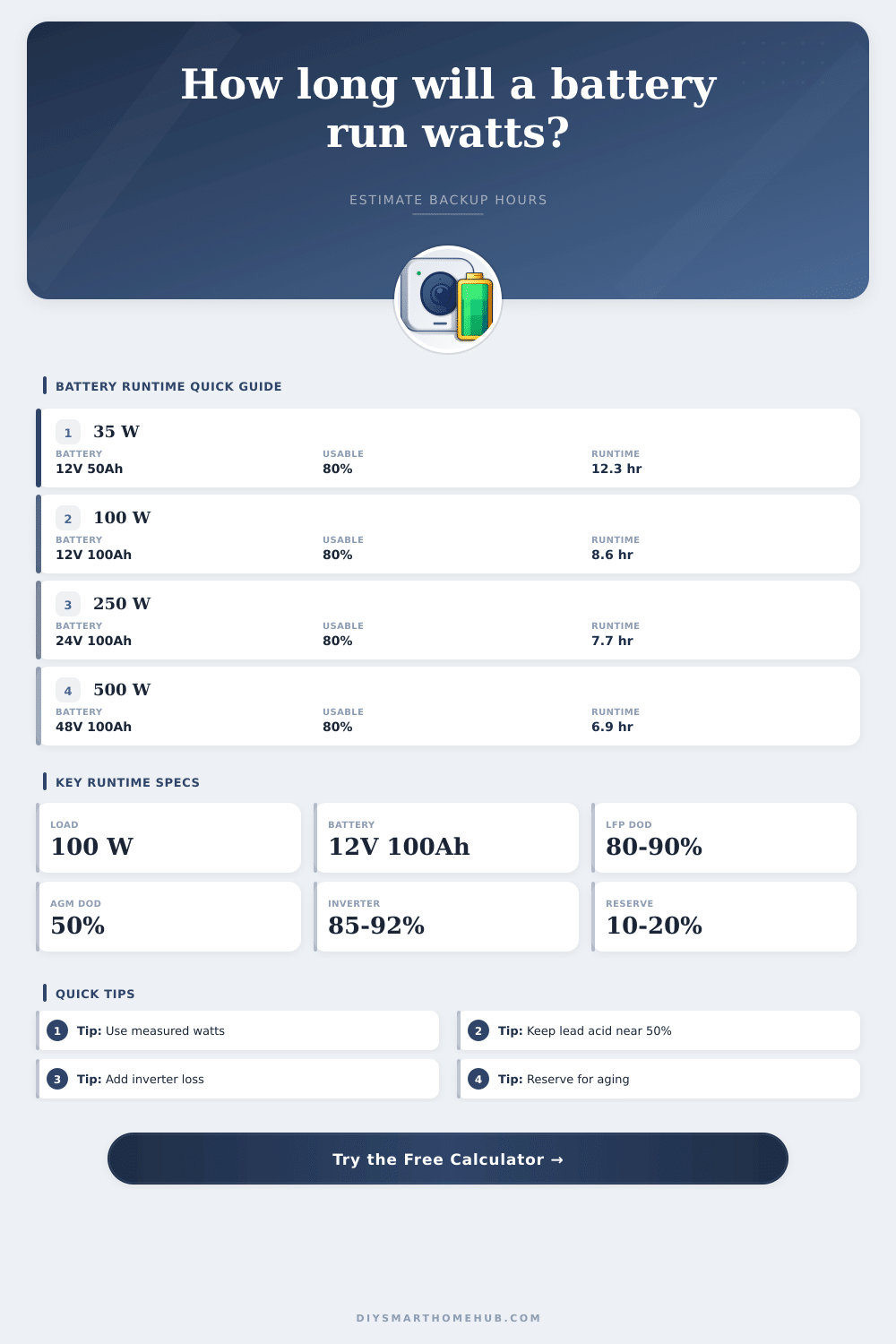
| Internet-only outage backup | 35 W | 12 V 50 Ah LiFePO4, direct DC | About 14 hours at 85% usable capacity. |
| Smart hub and camera shelf | 75 W | 12 V 100 Ah LiFePO4 through inverter | About 12 hours with 90% conversion efficiency. |
| Small NVR and PoE cameras | 160 W | 24 V 100 Ah LiFePO4 through inverter | About 11.5 hours before reserve cutoff. |
| Garage freezer average load | 120 W | 12 V 200 Ah AGM through inverter | About 9 hours when limited to 50% depth. |
| Critical home essentials | 500 W | 48 V 100 Ah LiFePO4 through inverter | About 7 hours with a healthy 48 V bank. |
🧭Spec Comparison Grid
Direct DC Loads
Direct DC equipment can reach roughly 94% to 98% path efficiency, so small network shelves often run longer from the same battery.
AC Inverter Loads
Inverters commonly land near 85% to 92% efficiency, and very small loads can be less efficient because the inverter has its own overhead.
Lead-Acid Batteries
Lead-acid runtime should be planned near 50% depth, with extra caution for high current draw, cold spaces, and older batteries.
LiFePO4 Batteries
LiFePO4 batteries usually allow much deeper usable capacity, making them better for long runtime at the same nameplate watt-hours.
Series Layout
Series wiring raises bank voltage. At the same watts, a 24 V bank carries half the current of 12 V, and 48 V carries one quarter.
Parallel Layout
Parallel strings add amp-hours and runtime. Matching batteries by type, age, and capacity keeps runtime estimates more realistic.
✅Runtime Tips
This calculator estimates steady-state runtime from watts and battery energy. It does not replace manufacturer limits for surge current, BMS discharge rating, inverter overload behavior, or required electrical protection.
When the power go out, many devices that rely upon electricity from a power outlet will stop working. While many device will have a battery backup system, it is important for individuals to understand how long that battery backup will last. When determining how long a battery backup will last, many individuals may look at the capacity of the battery and the wattage of the device to which the battery will be applied.
This calculation are incorrect, however, due to the loss of energy that can happen within the device and the battery when too much power is being draw from the battery. In order to calculate the length of time that a battery backup will provide power to a device, it is important to account for energy losses within the device. Such energy losses occurs due to the laws of physics.
How to find out how long a battery backup will last
For instance, if the device that the battery is to power requires alternating current (AC) power, an inverter will be required to convert the direct current (DC) energy from the battery to the AC energy that the device require. The conversion from DC to AC is not 100% efficient to the battery, and some of the energy from the battery is lost as heat during this conversion process. Thus, the battery must work more harder than the device suggests, and batteries with a low efficiency rating will provide less runtime to the devices.
The chemistry of the battery can also impact how much energy is used from the battery. For example, if lead acid batteries or AGM batteries are used, it is not recommended to allow the batteries to drain to 0% charge. If a lead acid battery or AGM battery is allowed to drain to 0% charge, the batteries will be damaged.
Thus, with lead acid batteries or AGM batteries, only approximately half the capacity of the battery can be used. In contrast, if a Lithium Iron Phosphate (LiFePO4) battery is used, it is possible to use the majority of the energy from the battery without damaging the battery. Therefore, deep discharge batteries are the best type of battery to use for battery backup systems for devices.
In addition to the type of battery that is selected for the system, the voltage of that battery system can also impact the efficiency of the battery system. For instance, 12 volt battery backup systems are common, but the batteries may have to provide high currents to the devices to which they are connect. High currents in the battery system can create heat in the system, which could cause the system to fail or create issue in the system.
High voltages are more stable than 12 volt systems, and they can provide power to large load of devices. Furthermore, high voltage systems allow for the use of thinner wires due to the reduction of currents in the system. Thus, for professional installation of battery backup systems, high voltages are preferred to 12 volt systems if the wattage to be provided to the devices is high.
It is also important to measure the actual load of the devices that the battery backup is to provide with power. The wattage ratings of the devices are often not accurate. For instance, while the label on a WiFi router may state that the device require 25 watts of power, the router may only draw 12 watts of power while it is in operation.
In contrast, a mini-fridge may require low watts of power when the mini-fridge is idling, but when the mini-fridge starts up, the compressor within the mini-fridge will draw massive amounts of power. If the inverter system is not able to handle these power surges from the mini-fridge, the inverter will shut off the devices, even if the battery backup system has a high amount of capacity. Thus, while it is important to calculate the average watts that the devices require, it is also critically important to account for peak watts to ensure that the inverter can start those devices.
After determining the actual load of the devices that the battery backup system will power, it is important to determine the target runtime of the battery backup. From the target runtime that is targeted, a calculator can determine how many battery module is that will be required to provide the energy to the devices for the amount of time that is targeted. Using a battery backup system calculator will help to ensure that there are not too few modules provide to the devices, and that there are not too many modules provide to the devices.
Too few battery backup modules will result in the devices being without power before the targeted runtime. It is also important to include some extra energy into the battery backup system. Batteries will lose some of their capacity over time as they age.
Additionally, cold weather will reduce the amount of capacity of the batteries. Thus, providing extra energy to the system to provide for the devices ensures that there is enough energy to operate the devices. Furthermore, if the system allows for enough energy to be used by the devices, it will also make it easier for the system to handle high loads by the devices.
Therefore, including extra energy into the system is better than providing less energy to the devices, so the system will have the amount of energy needed. Overall, by accounting for the battery chemistry, accounting for energy losses due to the laws of physics, and accounting for the actual wattage of the devices in the system, it is possible to create a reliable battery backup system.