Hydronic Baseboard Heater Size Calculator
Size a baseboard zone from room heat loss instead of guesswork. Compare emitter types, water temperatures, and usable wall length to see whether your selected enclosure can cover the design load.
🌐 Unit System And Presets
Each preset applies realistic room dimensions, envelope assumptions, emitter type, and design water temperatures, then runs the full sizing calculation automatically.
🏠 Zone Inputs
The model uses a room-level heat loss coefficient, then sizes active emitter length from interpolated output per foot at the selected average water temperature and placement condition.
📈 Sizing Results
🔧 Emitter Reference
Standard fin-tube
High-output fin-tube
Cast iron baseboard
Low-temp oversized
Panel convector
Typical water delta
Usable wall target
Placement derate
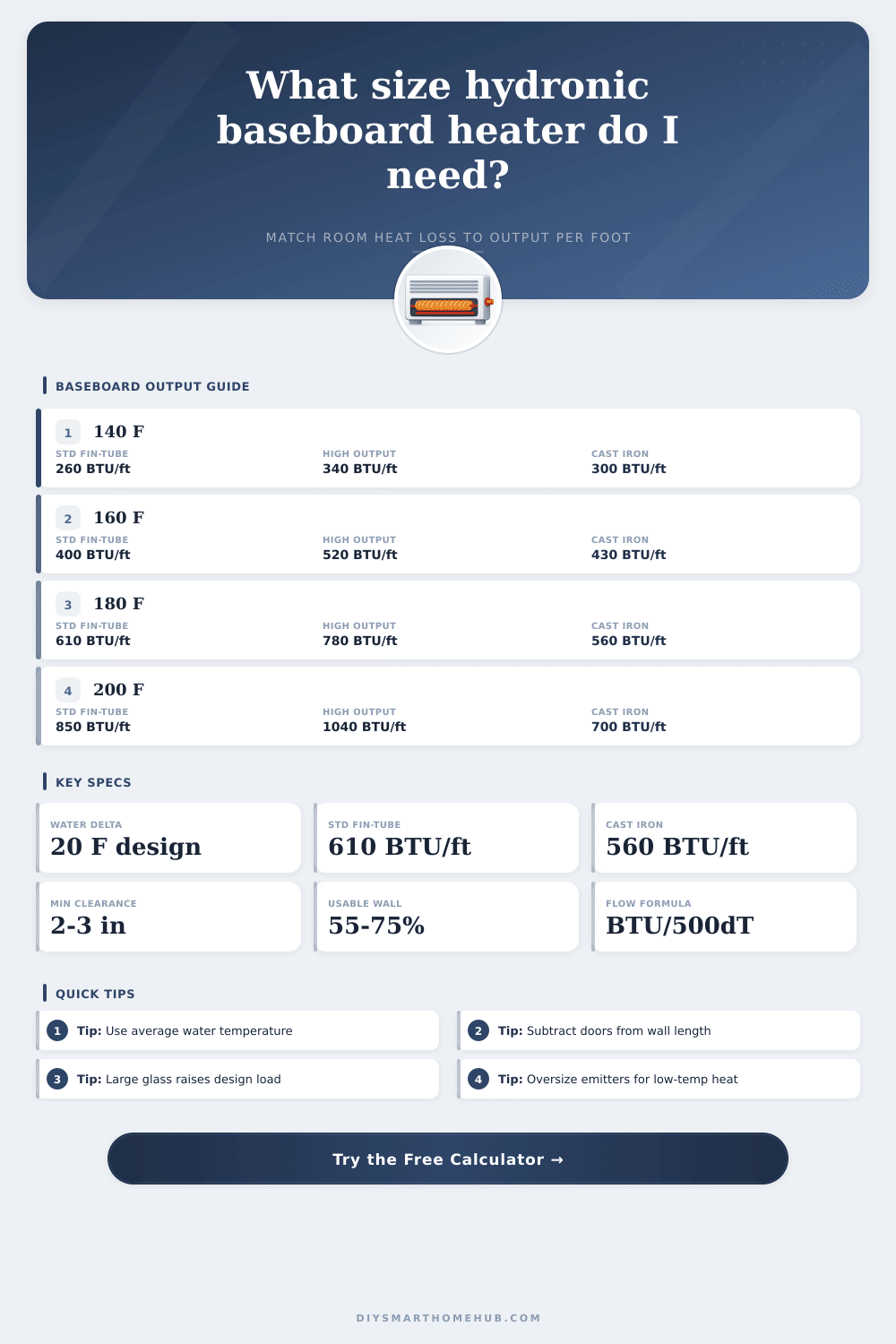
📄 Output Per Foot Table
| Average Water Temp | Standard Fin-Tube | High-Output Fin-Tube | Cast Iron Baseboard | Low-Temp Oversized | Panel Convector |
|---|---|---|---|---|---|
| 120 F | 180 BTU/ft | 240 BTU/ft | 170 BTU/ft | 150 BTU/ft | 210 BTU/ft |
| 130 F | 220 BTU/ft | 290 BTU/ft | 220 BTU/ft | 190 BTU/ft | 260 BTU/ft |
| 140 F | 260 BTU/ft | 340 BTU/ft | 300 BTU/ft | 240 BTU/ft | 320 BTU/ft |
| 150 F | 320 BTU/ft | 430 BTU/ft | 360 BTU/ft | 300 BTU/ft | 390 BTU/ft |
| 160 F | 400 BTU/ft | 520 BTU/ft | 430 BTU/ft | 370 BTU/ft | 470 BTU/ft |
| 170 F | 500 BTU/ft | 640 BTU/ft | 500 BTU/ft | 440 BTU/ft | 580 BTU/ft |
| 180 F | 610 BTU/ft | 780 BTU/ft | 560 BTU/ft | 520 BTU/ft | 700 BTU/ft |
| 190 F | 720 BTU/ft | 920 BTU/ft | 630 BTU/ft | 600 BTU/ft | 820 BTU/ft |
| 200 F | 850 BTU/ft | 1040 BTU/ft | 700 BTU/ft | 680 BTU/ft | 930 BTU/ft |
Catalog ratings vary by enclosure, airflow, and manufacturer. These values are intended for preliminary zone sizing and physical fit checks, not final submittal documentation.
🏗 Room Load Coefficients
| Envelope Quality | Load Coefficient | Typical Room Condition | When It Fits Best |
|---|---|---|---|
| Super insulated | 0.24 | High-performance shell, air sealed | New builds and deep energy retrofits |
| Modern code-level | 0.33 | Good insulation and low leakage | Recent additions and renovated rooms |
| Typical existing | 0.42 | Average insulated room | Most balanced residential zones |
| Older leaky | 0.55 | Drafts, modest insulation, more glass | Pre-upgrade homes and bonus rooms |
| Poorly insulated | 0.68 | Low insulation or very cold perimeter | Unfinished envelopes and hard-to-heat spaces |
🏡 Common Room Sizing Guide
| Room Type | Area | Typical Design Load | Standard Fin-Tube Length |
|---|---|---|---|
| Small bedroom | 140-180 sq ft | 4,000-6,000 BTU/hr | 8-12 ft |
| Living room | 250-360 sq ft | 7,000-12,000 BTU/hr | 14-24 ft |
| Finished basement | 300-450 sq ft | 8,000-14,000 BTU/hr | 16-28 ft |
| Sunroom | 180-300 sq ft | 9,000-16,000 BTU/hr | 18-32 ft |
| Primary suite | 250-340 sq ft | 6,500-11,000 BTU/hr | 13-22 ft |
💡 Practical Sizing Notes
Baseboard output tables are usually tied to average water temperature. A 180 F supply with a 20 F drop behaves like a 170 F average water condition, not a full 180 F output point.
Some rooms have enough load capacity on paper but not enough open perimeter. When fit margin goes negative, switch to higher output footage or raise water temperature if the system allows it.
Hydronic baseboard heaters work by means of circulating warm water through the heater. Usually that happens through tubes with fins. The heat from the water passes through the tubes to the fins and later spreads in the room.
Such systems can be separate electrical units that heat their own reservoir of liquid, you call them electrical hydronic baseboard heaters. They can also feed into the central heating system of home for instance as hydronic baseboard radiator. Here the water heats in the furnace and a pump moves it.
How hydronic baseboard heaters work
Valves operate the flow commonly according to thermostat control. Warm water flows through tubes in the baseboard heaters.
Hydronic baseboard heaters first appeared in the 1940s. You created them as lightweight and easy alternative for cast-iron radiators. Although radiant floor heating quickly spread fin-tube baseboards stays important part of hydronic heating in United States. Runtal baseboards serve as direct replacement for fin-tube or cast iron baseboards.
You can use them with water temperatures around 140 degrees Fahrenheit what makes them good radiant alternative or addition to convection heating. Runtal Radiators have a 5-year limited guarantee and each of them for North America is made in United States in Zonal Hill Massachusetts.
Such heaters well answer for steady and pleasant room heating without swings of temperature. The heating continuously gives off heat even after the thermostat turns the outside circle thanks to its liquid-full sealed heating element. This low form perfectly suits for rooms bathrooms bedrooms and dens.
The system is especially safe. No one risks burns because everything is firmly closed and the water never overheats. All warm water plumbing is covered by means of the cover of the baseboard heater.
Almost impossible to light something by means of hydronic heating rather than by means of electrical baseboard with bare elements. Instead of that electrical elements directly heat the air the heating part warms the water or oil that then heats the air. Quality hydronic baseboard heaters have thermal safe features for best home comfort.