Arc Flash PPE Calculator
Estimate incident energy, PPE category, arc rating margin, and component readiness for a task worksheet. Use the current arc flash study and qualified review for final energized-work decisions.
1.PPE selection presets
2.Arc flash and PPE inputs
PPE worksheet result
Complete the inputs to calculate an arc flash PPE selection worksheet.
3.PPE component/spec grid
Common CAT 2 reference rating for panels and MCC tasks.
Often used up to 1000 V AC when tested and in date.
Face shield may fit lower bands; hood is needed for higher bands.
Arc blast planning commonly includes hearing protection.
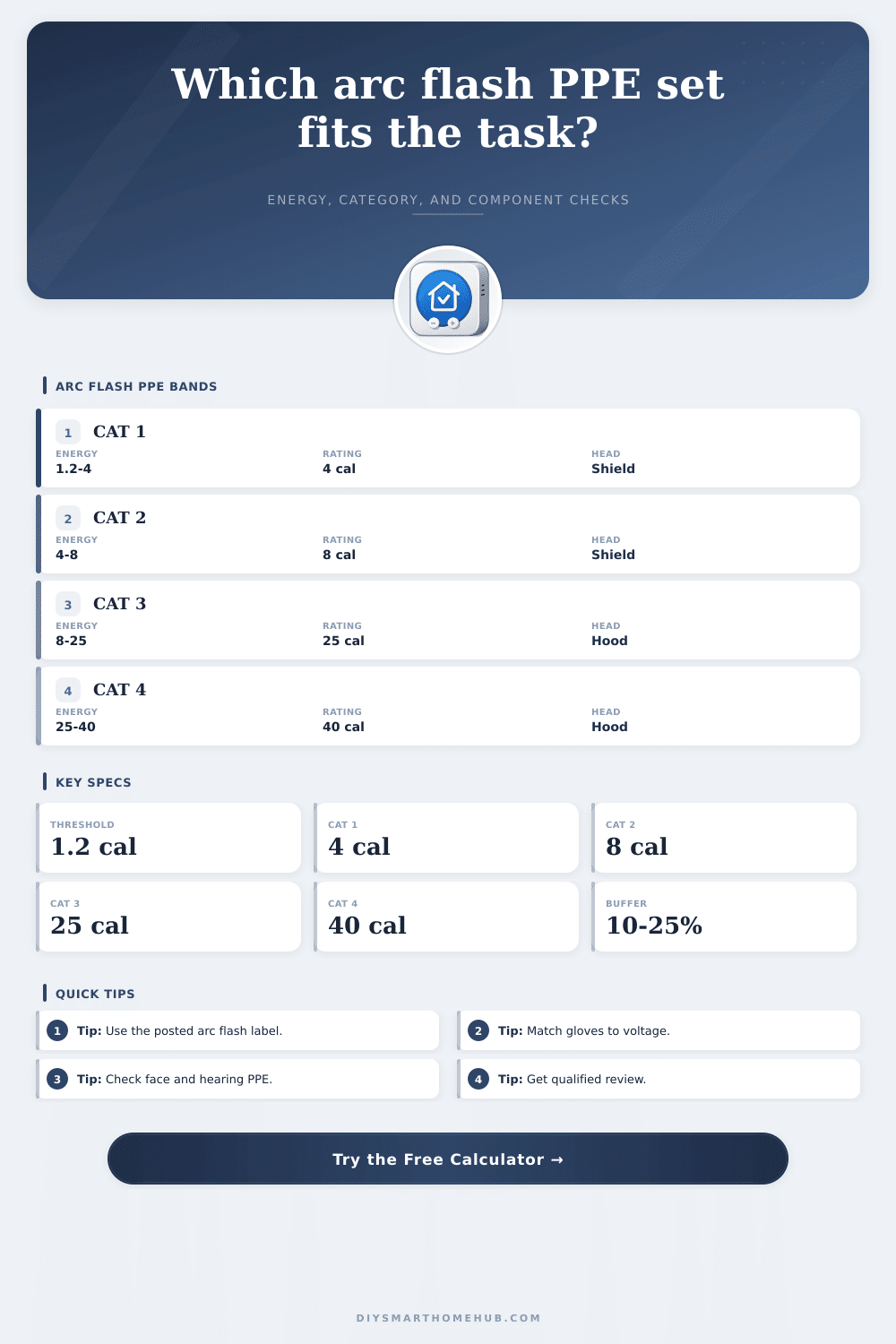
4.Arc flash PPE category table
| Calculated energy | Worksheet band | Minimum arc rating | Typical head protection |
|---|---|---|---|
| Below 1.2 cal/cm2 | Below arc-flash PPE threshold | Site policy minimum | Safety glasses or task-specific PPE |
| 1.2 to 4 cal/cm2 | PPE Category 1 | 4 cal/cm2 | Arc-rated face shield as required by policy |
| More than 4 to 8 cal/cm2 | PPE Category 2 | 8 cal/cm2 | Arc-rated face shield and balaclava when required |
| More than 8 to 25 cal/cm2 | PPE Category 3 | 25 cal/cm2 | Arc flash hood or equivalent head system |
| More than 25 to 40 cal/cm2 | PPE Category 4 | 40 cal/cm2 | Arc flash hood with complete rated system |
| More than 40 cal/cm2 | Engineering review | Reduce hazard or use engineered method | Do not treat as routine energized work |
5.Rubber glove class table
| Glove class | Max use voltage AC | Common task band | Checklist note |
|---|---|---|---|
| Class 00 | 500 V | Low-voltage controls | Leather protectors and test date still matter. |
| Class 0 | 1000 V | 120 V to 600 V systems | Often the minimum practical low-voltage glove choice. |
| Class 1 | 7500 V | Low and some medium-voltage work | Confirm with actual nominal voltage and task. |
| Class 2 | 17000 V | Medium-voltage equipment | Requires stricter handling and inspection discipline. |
| Class 3 | 26500 V | Higher medium-voltage systems | Use only within an approved electrical safety program. |
| Class 4 | 36000 V | High-voltage class tasks | Selection must be directed by qualified procedures. |
6.Component checklist reference
| Component | What the calculator checks | Pass signal | Review signal |
|---|---|---|---|
| Arc-rated body PPE | Selected arc rating against buffered incident energy | Positive cal/cm2 margin | Negative margin or above 40 cal/cm2 |
| Rubber insulating gloves | Glove class max voltage against selected voltage | Class rating exceeds nominal voltage | Selected class below task voltage |
| Face shield or hood | Category band against selected head protection | Shield for lower band, hood for higher band | Safety glasses only or hood below band |
| Hearing protection | Hearing option selected for arc-blast planning | Plugs, muffs, or dual protection selected | No hearing protection selected |
| Restricted approach | Entered boundary against task voltage | Boundary noted for energized work control | No boundary entered for energized conductors |
7.Preset worksheet table
| Preset | Voltage and fault | Working distance | Why it is useful |
|---|---|---|---|
| Meter check CAT 1 | 208 V, low fault current | 18 in | Shows the lower edge of PPE selection. |
| Panel work CAT 2 | 480 V, moderate fault current | 18 in | Good baseline for branch panel tasks. |
| MCC bucket CAT 2 | 480 V, MCC enclosure | 18 in | Checks gap and enclosure effects. |
| Switchboard CAT 3 | 480 V, slower clearing | 24 in | Demonstrates higher head-protection needs. |
| MV switchgear | 4160 V, wider distance | 36 in | Highlights glove class and approach notes. |
8.Planning notes
Safety caveat: Arc flash calculations here are simplified planning estimates. Final PPE selection, energized work justification, restricted approach controls, and shock protection must come from the current site arc flash study, adopted electrical safety standard, equipment labels, and a qualified electrical worker or engineer.
You’ve never seen it happen, the moment just before you come in contact with a hot, live terminal. No warning sirens. No flashing lights. Just…hmmm…it’s humming. And all of a sudden, it’s either going to be business as usual with a successful repair, or a ride to the burn unit.
Before you even crack open a panel, this is an attempt to make unknown dangers of electricity more real by making the tangible choices about what to wear. This arc flash PPE calculator will calculate the incident energy and give you your PPE category. It will also check rating of your personal protection equipment and confirm if your components is ready for qualified task review.
How to Choose the Right Safety Gear
It’s no secret: Electricians understand importance of personal protective equipment, but the trick is providing the right protection for whatever threat you are facing. To figure out what kind of protection you should of had, enter your clearing time and fault current into the calculator above. It will do all the number crunching for you.
You have more to consider then just whether to wear a full arc flash hood or a basic face shield. This is important because it is much safer to lean toward over-dressing rather than under-dressing for any situation. You’ll feel warmer on a hot summer day, but you won’t die.
First, look up your protective device’s clearing time and the maximum fault current that could be possible on the circuit. These two values determines the energy the arc has available to deliver before the breaker opens. Older, slow-acting breakers take ten cycles to open rather than three, which leads to a massive increase in thermal exposure. A simple meter test may seem safe, but a legacy breaker will change a routine job to Category 3 or 4 in a heartbeat.
The tool adjusts those variables for electrode gap and working distance and presents you with buffered incident energy value. And so we arrive at that buffer percentage, where science and common sense meet. Why add ten to twenty-five percent onto the calculation? Because arc flash studies don’t guarantee anything; they’re an estimate. Adding a safety margin ensures your clothes has some leeway in case something goes wrong and there’s a spike of extra energy.
A positive margin indicates your arc-rated fabric will be able to withstand the heat while remaining intact. A negative margin means it’s time to take a step back, reevaluate your circuit coordination, or immediately invest in better gear.
Half the story The other half of the equation is that the calculator confirms whether or not your rubber insulating gloves will protect you from the system voltage. You should not use Class 0 gloves on 4160-volt switchgear. Not good. And deadly.
The page’s reference table makes this clear: You’ll need a higher-class glove than actual voltage of the job at hand. Likewise, personal protective equipment for the head goes from basic face shields in the lower classes to fully enclosed hoods as energy level rise. Working within an energized enclosure is no time for safety glasses by themselves.
Protection for your ears is one item that’s frequently overlooked until it’s too late. Even if you survive without burns on your skin, arc blasts produce shock waves that will damage your eardrum no matter what. Whether you choose plugs, muffs or some combination of both, your use of hearing protection are an important part of any safety plan.
Your hearing matters as much as keeping your hands safe, this is a little thing and it’s worth pointing out. Most of us depend on labels we see posted and don’t realize all of the variables they represent. A branch panel is different than one located at a motor control center. The motor control center has a different shape that affects how much the arc expands and then reflects energy back out at you. Deeper enclosures concentrate that energy creating more caloric load on you. Knowing that can eliminate complacency when doing what appears to be a less risky task.
This all-in-one tool should be viewed as a comparison worksheet, not an engineered study replacement. Local standards, NFPA 70E or other qualified engineer’s studies is required along with your current site studies. Run your presets and note the shift in requirements based off various scenarios. Then apply that logic to what is happening at your sites.
Walk out of each job just like you walked into it, intact, unburned and prepared to go do it again. Knowing when to don the PPE and when not to is what makes the difference between the pro and the guy who relies on luck.