Appliance Wattage Calculator
Estimate running watts, starting surge watts, daily energy, monthly energy, and circuit amps from appliance nameplate ratings and real usage patterns.
Appliance wattage results
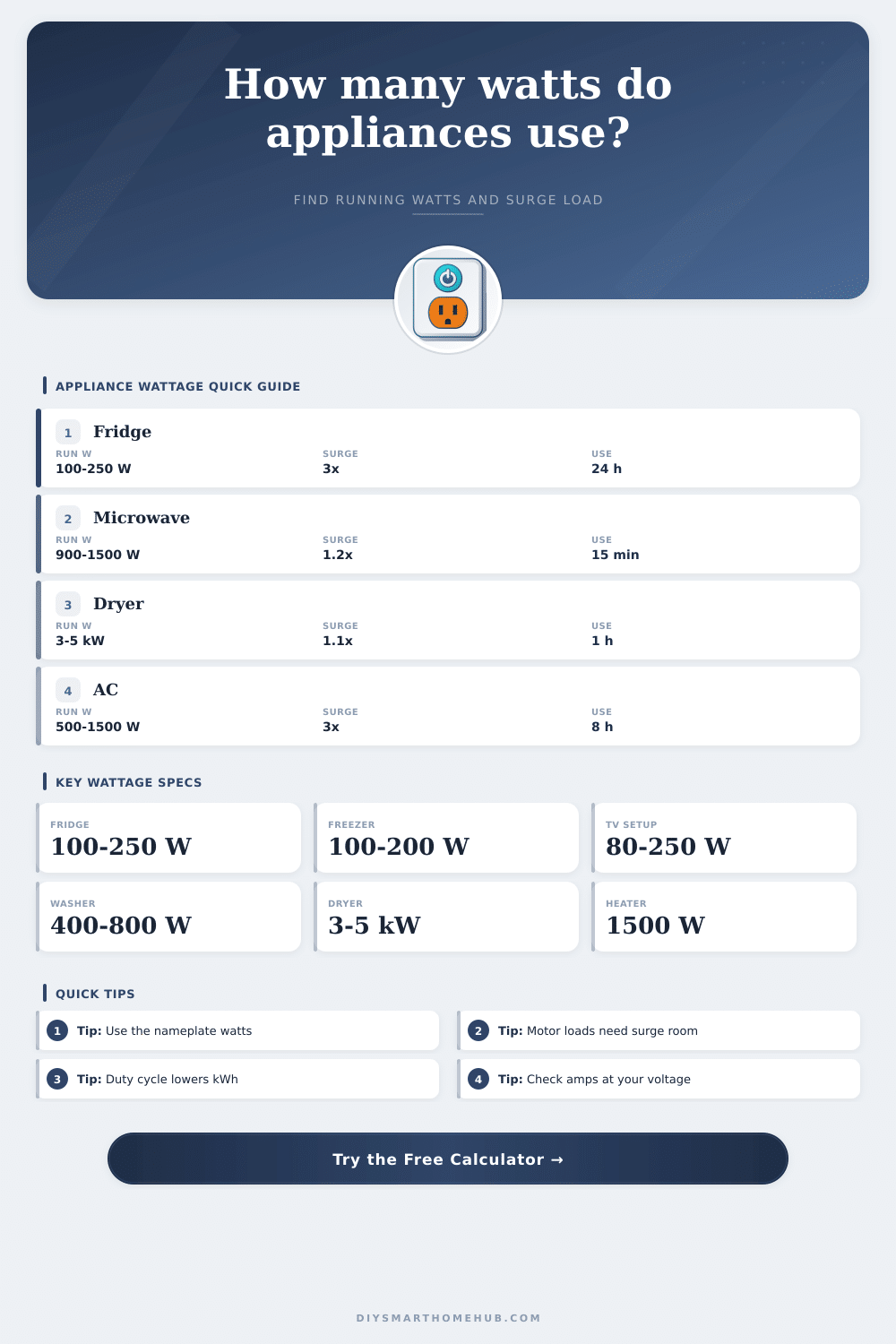
| Appliance | Typical running watts | Starting factor | Best duty cycle input |
|---|---|---|---|
| Modern refrigerator | 100-250 W | 2.5x-3.5x | 30%-50% |
| Chest freezer | 100-200 W | 2.5x-3.5x | 35%-50% |
| Microwave oven | 900-1500 W | 1.0x-1.3x | 100% |
| Coffee maker | 600-1200 W | 1.0x | 100% while brewing |
| LED TV and streaming box | 80-250 W | 1.0x-1.2x | 100% |
| Desktop computer setup | 150-600 W | 1.0x-1.3x | 35%-100% by workload |
| Clothes washer | 400-800 W | 1.5x-2.5x | 40%-70% per cycle |
| Electric dryer | 3000-5000 W | 1.0x-1.2x | 100% heat portion |
| Motor or heat load | Running watts | Starting watts estimate | Calculator setting |
|---|---|---|---|
| Window air conditioner | 500-1500 W | 1500-4500 W | 3.0x surge, 50%-80% duty |
| Sump pump 1/3 hp | 700-900 W | 2100-2700 W | 3.0x surge, event hours |
| Space heater | 750-1500 W | 750-1500 W | 1.0x surge, 100% duty |
| Dishwasher heated dry | 1200-1800 W | 1300-2000 W | 1.1x surge, cycle hours |
| Dehumidifier | 300-700 W | 900-2100 W | 3.0x surge, 35%-80% duty |
| Furnace blower | 400-800 W | 800-2000 W | 2.0x-2.5x surge |
| 120 V load | Amps at PF 1.00 | Amps at PF 0.90 | Common example |
|---|---|---|---|
| 600 W | 5.0 A | 5.6 A | Small appliance |
| 1200 W | 10.0 A | 11.1 A | Microwave or dishwasher |
| 1500 W | 12.5 A | 13.9 A | Portable heater |
| 1800 W | 15.0 A | 16.7 A | Large countertop load |
| 2400 W | 20.0 A | 22.2 A | Multiple appliances |
| Scenario | Inputs to start with | Main output to watch | Why it matters |
|---|---|---|---|
| Backup power sizing | Running W, surge x, buffer | Starting load with buffer | Motors can trip undersized inverters |
| Energy monitoring | Hours, duty cycle, days | Daily and monthly kWh | Thermostat cycling changes totals |
| Circuit check | Voltage, PF, buffer | Current in amps | Low PF increases apparent amps |
| Battery inverter planning | DC voltage, watts, PF | DC side amps | Lower voltage means higher current |
When you are planning out a power system for a camper or a storm, its important to understand the difference between running watt and starting watts for the appliances that you will be using. The generator or inverter that you purchase will have specific wattage ratings print on teh box. However, it is possible that the generator or inverter will fail to provide power for your camper or storm if you are not aware of how the appliances uses electricity.
Many appliances use a surge of electricity when they begin to operate; some appliances require relatively small amount of power to operate, but others require larger bursts of power in order to start the appliance motor. It is important to understand that running watts and starting watts is actualy different measurements of the power that is required to run many of the appliances. The running watts for an appliance is the amount of power that is required for the appliance to remain operational.
Know the Difference Between Running Watts and Starting Watts
The starting watts for an appliance is the amount of power that is required for the appliance to overcome inertia and begin to turn on. For instance, appliances like refrigerators may require a relatively large amount of starting watts in order to start the refrigeration process, but the refrigerator will require a smaller amount of running watts in order to remain operational. If the generator or inverter is only sized for the running watts of the appliances, those devices will trip or shut down whenever the appliances start to turn on.
In order to ensure that your power system will function proper during the camping or storm scenario, you should use a surge multiplier for the appliances. A surge multiplier allow you to calculate the amount of power that is required to handle the initial surge of the appliances; ensuring that you use a surge multiplier will ensure that your generator and inverter do not fail whenever the appliances that use motors begin to start up. Additionally, you should include a buffer into your calculations for your power system.
Providing a buffer for your power system insurance for your power system and ensures that your power system will remain stable. You also need to understand the concept of a duty cycle in your power system planning. The duty cycle indicates the amount of time that the appliance need to actually run compared to the total length of time that the appliance will be plugged into power.
Appliances like refrigerators may run for 35% of the time that they are plugged into power. If you calculate your power system according to a 100% duty cycle, then you may purchase a battery bank that is much larger then you require. Therefore, it is important to differentiate between appliances that have a steady load (like an LED TV) versus those with a cycling load (like a dehumidifier).
Furthermore, it is important to consider the power factor that is created by the appliances. The power factor relate to how much electricity the appliance uses for its functioning. Appliances that use resistive power, like a space heater, will have a power factor of 1.0.
This indicates that the space heater is using all of the electricity that it is drawing from the power system to perform its useful work. Appliances that include motors and electronics will have a lower power factor. A lower power factor create apparent power.
Thus, appliances that contain motors and electronics will create apparent power, meaning that two appliances of the same wattage can create different amounts of stress on the power system that is created. Finally, it is important to ensure that your circuit features amps for the power system. If the power system is overloaded, the breaker will trip.
Additionally, overloading the circuit will wear down the insulation for the wires in the power system. Thus, it is important to check the current in amps that the appliances draw to see if the circuit is being pushed to close to its limit. If you have appliances with high level of draw, such as a microwave and a toaster, that the same circuit control, you may increase the risk of creating an overloaded circuit.