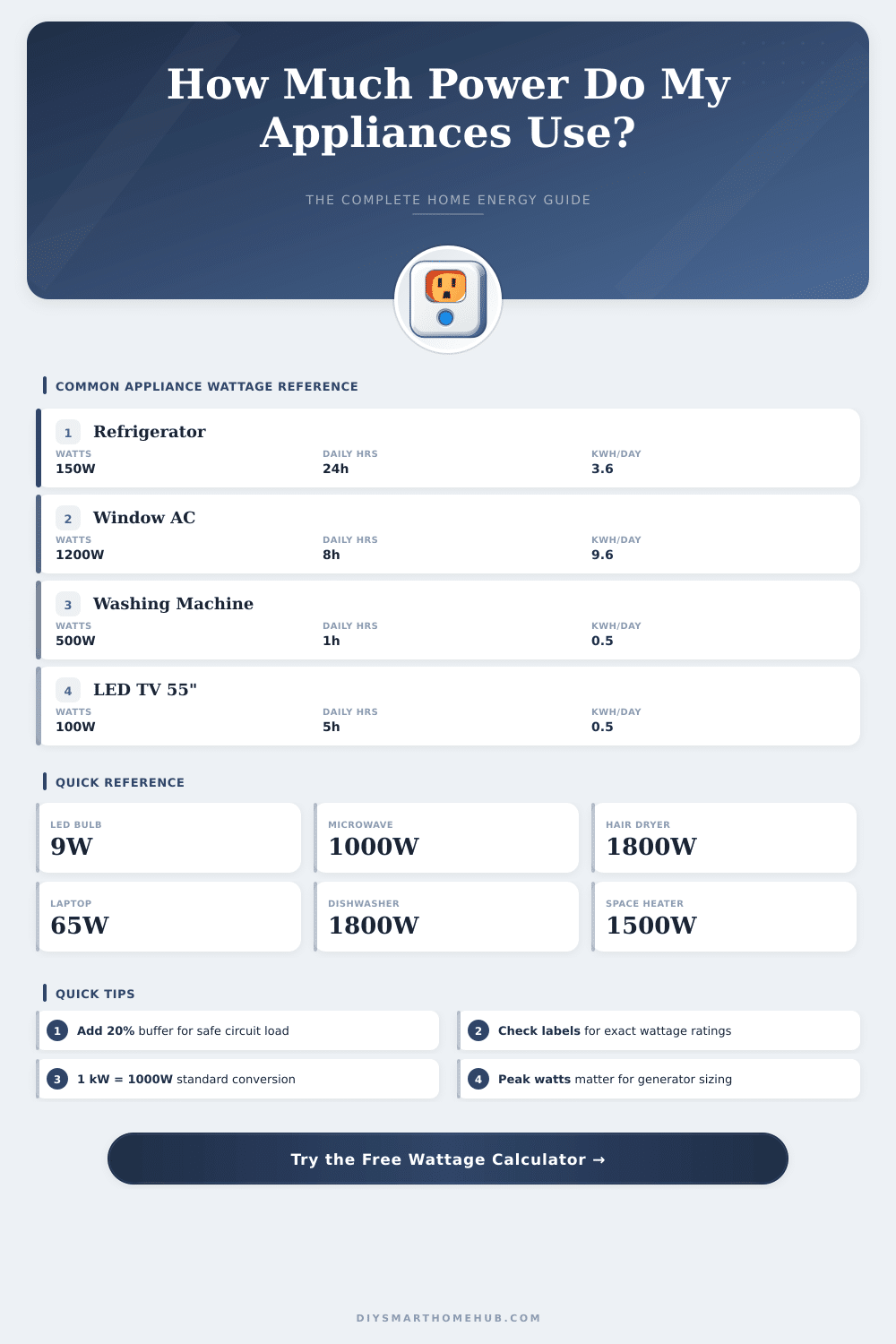
⚡ Appliance Wattage Calculator
Add your appliances to calculate total power load, daily energy use, and circuit requirements
| Appliance | Typical Watts | Range (Watts) | Category |
|---|---|---|---|
| Refrigerator (standard) | 150W | 100–200W | Kitchen |
| Refrigerator (side-by-side) | 200W | 150–300W | Kitchen |
| Microwave | 1,000W | 600–1,200W | Kitchen |
| Electric Oven / Range | 2,000W | 1,500–5,000W | Kitchen |
| Dishwasher | 1,800W | 1,200–2,400W | Kitchen |
| Coffee Maker | 1,000W | 750–1,250W | Kitchen |
| Toaster | 1,100W | 800–1,500W | Kitchen |
| Central AC (3-ton) | 3,500W | 2,000–5,000W | HVAC |
| Window AC (10,000 BTU) | 1,200W | 900–1,500W | HVAC |
| Furnace (gas, fan only) | 500W | 300–800W | HVAC |
| Space Heater | 1,500W | 750–2,000W | HVAC |
| Washing Machine | 500W | 400–1,400W | Laundry |
| Electric Dryer | 5,000W | 4,000–6,000W | Laundry |
| LED TV 32" | 50W | 30–70W | Entertainment |
| LED TV 55" | 100W | 80–130W | Entertainment |
| LED TV 75" | 170W | 150–200W | Entertainment |
| Desktop Computer | 200W | 150–400W | Office |
| Laptop | 65W | 30–120W | Office |
| Monitor (LED 24") | 27W | 20–40W | Office |
| Hair Dryer | 1,800W | 1,200–2,000W | Bathroom |
| Electric Shaver | 20W | 15–25W | Bathroom |
| LED Bulb | 9W | 6–15W | Lighting |
| CFL Bulb | 15W | 13–26W | Lighting |
| Incandescent Bulb | 60W | 40–100W | Lighting |
| Circuit Breaker | Max Watts (120V) | Max Watts (240V) | Safe Load (80%) | Typical Use |
|---|---|---|---|---|
| 15 Amp | 1,800W | 3,600W | 1,440W | General lighting, outlets |
| 20 Amp | 2,400W | 4,800W | 1,920W | Kitchen, bathroom circuits |
| 30 Amp | 3,600W | 7,200W | 2,880W | Electric dryer, AC units |
| 40 Amp | 4,800W | 9,600W | 3,840W | Electric range/oven |
| 50 Amp | 6,000W | 12,000W | 4,800W | EV charger, hot tub |
| 60 Amp | 7,200W | 14,400W | 5,760W | Central AC, sub-panels |
| 100 Amp | 12,000W | 24,000W | 9,600W | Small home service |
| 200 Amp | 24,000W | 48,000W | 19,200W | Standard home service |
| Watts | 1 Hr/Day | 4 Hrs/Day | 8 Hrs/Day | 24 Hrs/Day |
|---|---|---|---|---|
| 100W | 0.1 kWh | 0.4 kWh | 0.8 kWh | 2.4 kWh |
| 500W | 0.5 kWh | 2.0 kWh | 4.0 kWh | 12.0 kWh |
| 1,000W | 1.0 kWh | 4.0 kWh | 8.0 kWh | 24.0 kWh |
| 1,500W | 1.5 kWh | 6.0 kWh | 12.0 kWh | 36.0 kWh |
| 2,000W | 2.0 kWh | 8.0 kWh | 16.0 kWh | 48.0 kWh |
| 5,000W | 5.0 kWh | 20.0 kWh | 40.0 kWh | 120.0 kWh |
| Generator Size | Running Watts | Peak/Surge Watts | Best For |
|---|---|---|---|
| 1,000W Portable | 900W | 1,000W | Camping, small tools |
| 2,000W Inverter | 1,800W | 2,000W | RV, sensitive electronics |
| 3,500W Portable | 3,200W | 3,500W | Fridge, lights, TV |
| 5,500W Portable | 5,000W | 5,500W | Central AC, well pump |
| 7,500W Portable | 7,000W | 7,500W | Most home appliances |
| 10,000W Standby | 10,000W | 12,500W | Whole home backup |
| 20,000W Standby | 20,000W | 22,000W | Large homes, HVAC |
You must understand the differences between running watts and starting watts for your appliances. Appliances like toasters and lamps are resistive loads that use a steady amount of energy as long as they is on. However, appliances that have compressor, like refrigerators, will use a different and unpredictable amount of energy.
These appliances use a massive burst of energy to start the motor that perform the appliance’s task. If the power source cannot handle the starting wattage of these appliance, they will not be able to start up and the power source may even shut down. The starting surge multiplier is use to calculate the starting wattage for appliances with motors.
Difference Between Running Watts and Starting Watts
For instance, refrigerators requires three times the running wattage to start the compressor. Therefore, the refrigerator will require a higher wattage for a short period of time when starting up then it will require while running normal. Peak load is used to determine the maximum wattage that a system will require.
While average load determine the amount of energy that will be used over time, peak load determines the maximum amount of energy that will be drawn from the system at any one time. Another consideration is the duty cycle for an appliances. For instance, refrigerators will be on the power source for 24 hour a day.
However, the refrigerator compressor will not be running 24 hours a day. The compressor will start to cool the air in the refrigerator and then shut off once the air reach the refrigerator’s temperature. If you calculated the wattage for the refrigerator based on the assumption that it would be running at full power for 24 hours a day, you would vastly understate the amount of energy that the refrigerator uses.
However, by taking into consideration the duty cycle, you will have a realistic view of the kilowatt-hour consumption of the refrigerator. Another parameter to consider is the power factor. This determines the difference between the real and apparent power in a circuit.
In an ideal scenario, all of the power that is sent to an appliance will be utilized. In a real scenario, there will be loss in the system, especially with electronic devices and motors. The power factor will indicate the amount of current that must travel through the wires to perform the work of the appliance.
If the power factor of an appliance is low, it mean that there will be a high amount of current in the wires. Therefore, even though the device may use a low wattage of energy, the current that it draws could potentially trip a circuit breaker. In order to determine the exact wattage of an appliance, you have to refer to the nameplate on the appliance.
Not all appliances will use the same amount of power. Moddern appliances may draw a different amount of power then older appliances. If only the amps of an appliance are listed on the nameplate, you can calculate the wattage by multiplying the volts of the system by the amps that the appliance draw.
To calculate this accurately, you would have to estimate the power factor. When sizing an electrical system, it is important to include a safety margin. When an electrical system is running at maximum capacity, heat will begin to build up in the wire.
The heat will shorten the life of the wires and the components of the electrical system. A sizing buffer is necessary to account for any unexpected power demand and for the degradation of the battery over time. By taking into consideration the starting surge load, the duty cycle of the appliances, and the power factor of the circuits, you can be sure that the power system that you create for an area or building will be sufficient for the appliances that are to be used.