Airflow Calculator
Estimate room airflow targets from ACH, then compare them with the usable airflow your vent, grille, or duct opening can deliver from free area, velocity, and runtime.
📌Quick airflow presets
This calculator compares two airflow checks many quick charts skip: the usable airflow ceiling from opening area and velocity, and the room CFM needed to hit your chosen air-change target during the hours the fan actually runs.
📏Airflow inputs
💡Live planning notes
📈Airflow results
📊Airflow reference grid
📋Common opening airflow bands
| Filter size | Gross area | MERV 8 quiet | MERV 13 1 inch | MERV 13 4 inch | Typical use |
|---|
🏷Air path comparison
| Filter family | Free area | Quiet fpm | Max fpm | Ref drop | Best fit |
|---|
🏠Airflow planning table
| Scenario | Room volume | ACH target | Room CFM | Filter-safe CFM | Read |
|---|
🛠Practical airflow tips
If the target airflow is above the quiet band but still below the hard limit, expect more hiss at the return grille. Increasing face area is the cleanest fix.
When loaded pressure drop is already close to the budget on day one, the filter will become the system bottleneck before the next service interval arrives.
Airflow are the process of moving air through a room to replace the stale air with fresh air. To determine the proper airflow for a given room, you must consider both the requirements of that room and the capabilities of the air vent or air grille that will be use to achieve that airflow. For example, if the air vent is too small for the room, the air will move too quick through the vent and create too much noise.
If the air vent is too large or moves too little air through the room, the room will remain stale. ACH, or air changes per hour, is a measurement of the number of times the air in a room is replaced during a period of sixty minutes. You calculate the volume of air in a room by multiplying the length of the room by the width of the room and the height of the ceiling.
How Room Airflow, Filters, and Fans Work
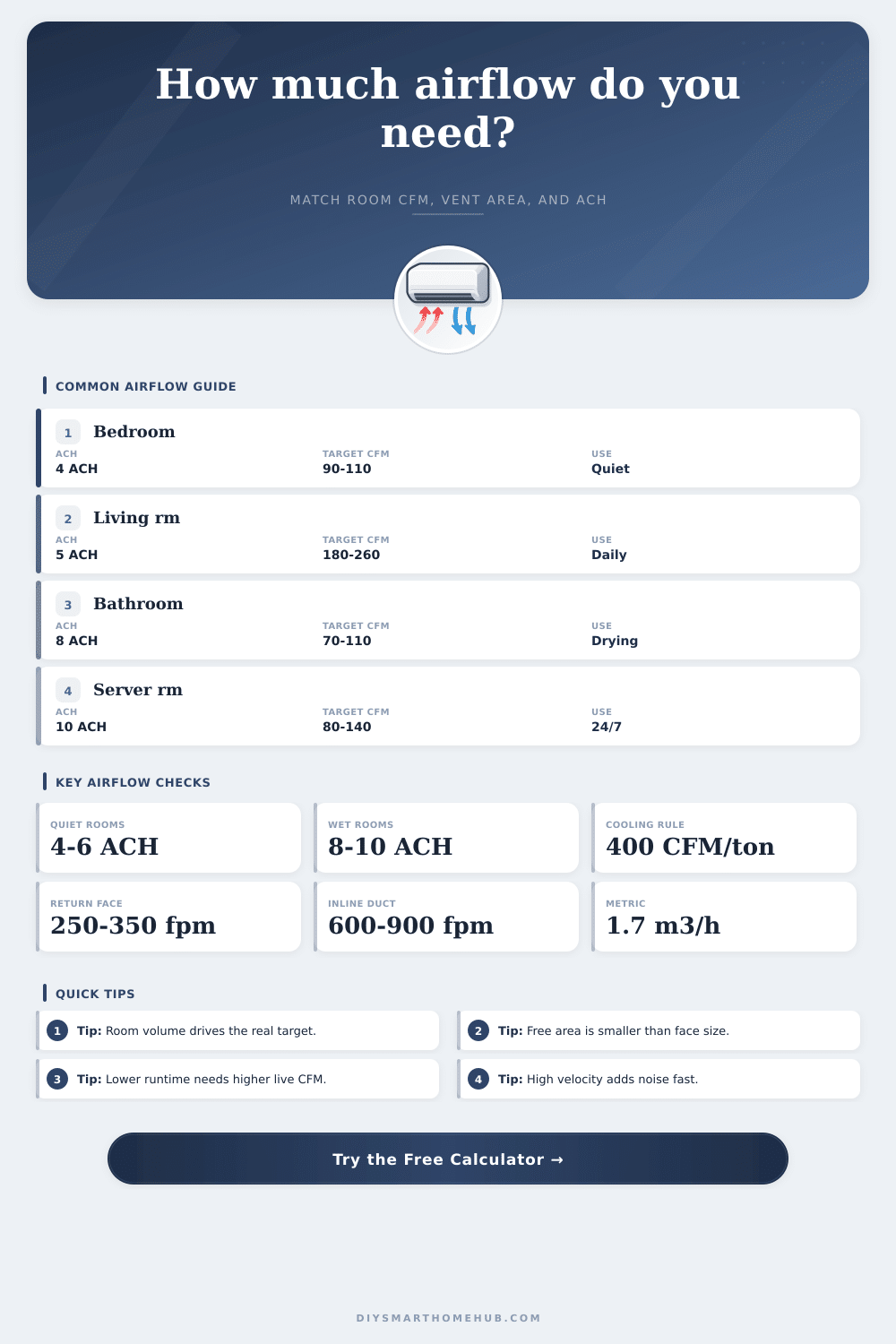
For instance, if a room has an ACH of four, that means that the entire volume of air in the room are replaced four times every hour. Because different types of rooms may contain different amounts of contaminants, different ACH requirement will be needed for different types of rooms. For instance, bedrooms will require an ACH of four or five to allow for the breathing and shedding of sleepers in the bedroom.
Rooms like kitchens and workshops, however, will require an ACH of eight to ten to allow for the grease and sawdust that accumulates in those areas. You must also consider the runtime of the fan that will help to achieve these ACH rate. For instance, if a fan does not operate twenty-four hours per day, it must move a sufficient amount of air during those active hours to achieve the ACH rates required by the room.
Air filter work to clean the air that moves through the system. However, the filters also create resistance to the airflow moving through them. Air filters come in various size.
For example, a pleated MERV 8 filter has a physical size that allow for air to move through it. However, the pleats in the filter and the frame of the filter create an area that is smaller than the physical size of the filter. If air is pushed too quickly through the filter, the velocity and the noise level of the air will increase.
Filters with a depth of four or five inches are considered to be better than thin filter in that the deeper media in the filter creates an increased resistance to the loading of dust and pet hair in the filter. If the filter becomes loaded with dust and pet hair, the resistance of the air to pass through the filter will increase. A filter that is half-spent is called a loaded filter.
Another consideration in fans and air filters is the budget for static pressure. Static pressure is the amount of pressure that the blower of the fan will have to provide to the air before the filter blocks the air. The face velocity for air grilles is the speed at which the air moves through the face of the grille.
For quiet environments, the face velocity should be under two hundred fifty feet per minute. If the face velocity is too high for the grille, the grille will make a whistling or rushing noise. Inline fans can handle higher face velocities.
However, as the face velocity increases, the power usages for the inline fan increases. Also, the bearings for the inline fan will make noise. The needs of the room will help to limit the air path of the air grille.
For instance, the server closet may require ten ACH. However, if too much air must move through a small air grille, the face velocity will be too high. In this case, using a deeper filter or using a larger air grille will fix the high face velocity of the air grille.
The type of motor for the system will impact how much air will move through the system. PSC motors are generally an older motor that will lose some of its original airflow as the air moves through the system and encounters resistance. ECM motors are different than PSC motors in that the ECM motor will maintain its original airflow even if the resistance of the system increase.
ECM motors also use less energy than PSC motors. ECM motors can extract ten percent more usable air from the same static pressure budget as PSC motors. Boost modes for the motor will increase the amount of air that moves through the system.
However, using boost modes will also increase the amount of power that the fan uses and the noise that the motor makes. Finally, the type of dust in the environment will impact the life of the filter. Rooms with a high amount of dust will load the filter more quickly than a location with a clean air environment.
Common mistakes include using a high MERV filter without enough face area for the room. For instance, if you place a high MERV filter into an environment with high concentrations of particulates, the system will struggle to move air through the environment. Many people will also ignore the runtime of the fan.
This error will make the air changes in the room insufficient. Finally, you should provide some buffer for the air changes. For instance, if the calculated air changes per hour for a room is five, allowing the system to provide fifteen or twenty percent more air changes than calculated will ensure that the air changes in the room will remain sufficient as the filter fills with dirt and dust.
The static pressure of the system changes according to a specific mathematical relationship with the airflow through the system. For instance, the static pressure decreases according to the airflow raised to the power of 1.35. This means that if the airflow is doubled, the static pressure will increase almost four times that of the original static pressure.
Because the static pressure increases so much with an increase in airflow, small air vents will struggle to move the air through the system and dense air filters. The larger the air environment that is to be cleaned, the more consideration must be placed into the design of the system. For instance, the static air changes in the environment, the placement of furniture, and the placement of ceiling fans will impact how the air moves through the environment.
Some areas of the environment may have a higher concentration of air movement than others. A smoke stick may be used to detect these areas of dead zones in the airflow. Establishing a rhythm for the maintenance of the system will ensure that the filters are changed at regular intervals to ensure that the airflow and air cleanliness in the area.