🌬 Air Purifier CADR Calculator
Estimate the smoke, dust, and pollen CADR a room really needs by blending room volume, ACH target, pollutant profile, placement loss, connected-space loss, and purifier family derating.
📌Preset Rooms
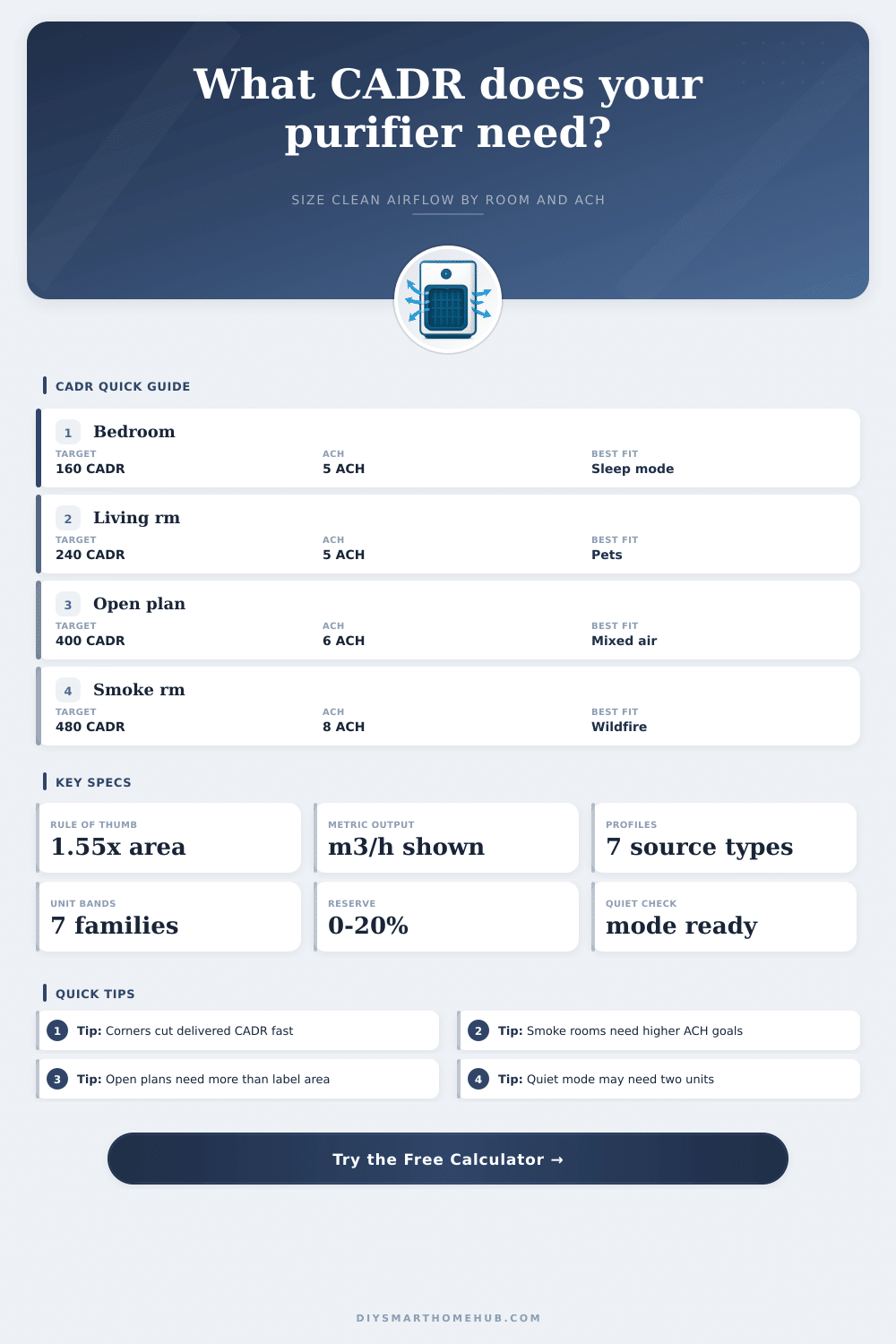
Each preset loads a realistic room size, pollutant profile, ACH target, placement condition, and purifier family so you can compare bedroom, pet, smoke, and open-plan scenarios quickly.
⚙CADR Inputs
💡How This Model Reads CADR
The calculator starts with room volume and target ACH, then converts that delivered airflow target into rated CADR after accounting for purifier family losses, placement losses, connected-space losses, and extra reserve.
Recommended CADR target
Run the calculator to see the required CADR, dominant particle target, selected-family fit, and estimated air-cycle time.
📊CADR Metrics
📑Purifier Family Bands
📋Coverage and Source Tables
| Family | Nominal CADR | Quiet CADR | 8-ft area at 4.8 ACH | Best fit |
|---|
| Profile | Added ACH | Driver bias | Main issue | Typical use |
|---|
| Preset | Area | Target ACH | Overall CADR | Suggested family |
|---|
💡Practical CADR Notes
Clean Air Delivery Rate (CADR) are a measurement of the amount of clean air that an air purifier produces when it is filtering smoke, dust, or pollen. Fans for air purifiers produce different speeds, and the filter promises will vary for different brands. However, each air purifier will have a CADR rating that describes the amount of clean air that the air purifier will actualy be delivered.
When air purifiers is purchased, the size of the room in which the air purifier will be used should be considered. Air purifier manufacturers rates the number of square feet that the air purifier can effectively clean under ideal condition. Ideal conditions for air purifiers do not reflect the use of real rooms; some rooms will have leaks in the structure through which air can escape the room, and the heights of ceilings within different rooms will vary.
How to Pick the Right Air Purifier by CADR and Room Size
Because the total volume of air within the room may impact the ability of an air purifier to provide fresh air, rooms should be sized according to the Air Changes per Hour (ACH) that is required to refresh the air within that space. For example, an ACH of four to five changes of the air in each room per hour will provide enough air exchange for humans within the room for daily use. However, if the air within a room is polluted with smoke from wildfires, an ACH of eight may be required to provide enough air exchange to remove the smoke particle from the room.
Air purifiers will contain HEPA filters that will remove different types of particles from the air at different rate. For instance, the air purifier will easily filter the larger size of particles such as pollen, but the air purifier will need to work at a higher rate to ensure that these particles are filtered. Particles such as smoke that are very small in size will require a higher rate of air exchange to ensure that the air within the room is clean.
Particles such as dust and pet dander that tend to settle within the air will require the air purifier to provide a steady amount of air movement to ensure that these particles do not settle within the air. As a result, each type of air pollutant requires a different amount of air exchange to ensure that the air within the room is clean, so the air purifier should be sized according to the pollutant that is the most difficultly to filter. Finally, the placement of the air purifier will impact the way in which it functions.
If you place the air purifier against the wall in a corner, or against furniture in the room, this will block the intake of the air purifier. Any blocking of the intake of an air purifier will reduce the amount of clean air that the air purifier delivers by ten to fifteen percent. Therefore, the air purifier should be placed against an open wall so that it has a clear path to the breathing zone of individuals in the room.
Finally, the air movement created by air purifiers will also allow for some movement of the clean air into open-plan living spaces to other rooms in the home. An open-plan loft will require twenty percent more rated power than a closed room due to the larger volume of air in an open-plan loft. Air purifiers are not all the same.
Most compact air purifiers are designed to sit on a bedside table or dresser and can only remove 160 Cubic Feet of air per minute. Compact air purifiers are suitable for nurseries but not large rooms. Tower air purifiers can remove 320 Cubic Feet of air per minute and provide better mixing of the air within the room.
Most air purifiers use carbon filters that will remove odors from the air. However, the presence of the carbon filter will slow the air purifier’s rate of remove particles from the air. Some air purifiers have a quiet mode to reduce the noise they make.
However, placing the air purifier into quiet mode will reduce the output of the air purifier by half. To find the correct size of the air purifier for a room, calculate the volume of the air in that room. A room 15 feet by 18 feet with an eight-foot ceiling will contain 2,160 cubic feet of air.
To cycle the air five times per hour in this room, an air purifier will have to cycle 170 Cubic Feet of air per minute. However, if the air purifier is to be placed in a corner of the room or if there is a door that is to remain open, the air purifier will need to have a CADR of 240 CFM to ensure proper cleaning of the air. Finally, it is recommended that you add ten percent to the calculations of the volume of air that the air purifier must be cleaned.
Over time, the air purifiers filter will fill with dust and particles from the air that need to be clean. A common mistake people make when purchasing an air purifier is to base the purchase on the size of the fan. A large fan will be of no use if the air purifier dont contain a HEPA filter.
The fan will only stir the air and redistribute the dirt that is in the environment. Air purifiers do not create clean air; they only clean the air that is already in the room that they are in. Therefore, the air purifier’s ability to mix the air in the room is of great importance.
It is better to use two smaller air purifiers in a room than to purchase a large air purifier for the same area. Finally, the last and most important decision to make is the type of air purifier that fits your environment. If you live in an area that often has wildfire smoke in the air, you need an air purifier with high CADR and high carbon content.
If you have pets at home, you will want an air purifier that can handle high levels of dust and pet dander. By calculating the volume of air in your room, determining the type of air pollutant in the room, and calculating any air leak, you can find the appropriate CADR of air purifier for your needs.