Air Filter Size Calculator
Estimate HVAC filter dimensions from served area, airflow method, return count, media type, thickness, and pressure-drop budget so you can choose a realistic nominal size or multi-filter bank.
📌Quick filter presets
The calculator estimates airflow from floor area, tonnage, or direct CFM, converts that airflow into required filter face area, then searches common nominal sizes using actual undersized filter dimensions and a media-specific pressure-drop curve.
📏Filter sizing inputs
💡Design cues
📐Reference sizing markers
📊Common nominal sizes and airflow
| Nominal size | Actual face | 1 in at 250 fpm | 2 in at 300 fpm | 4 in at 375 fpm | Typical fit |
|---|
🔎Media comparison table
| Media | Typical rating | Base face fpm | Clean drop ref | Load factor | Best fit |
|---|
📋Preset outcome table
| Scenario | Airflow | Recommended bank | Velocity | Clean drop | Why it lands there |
|---|
🛠Practical sizing notes
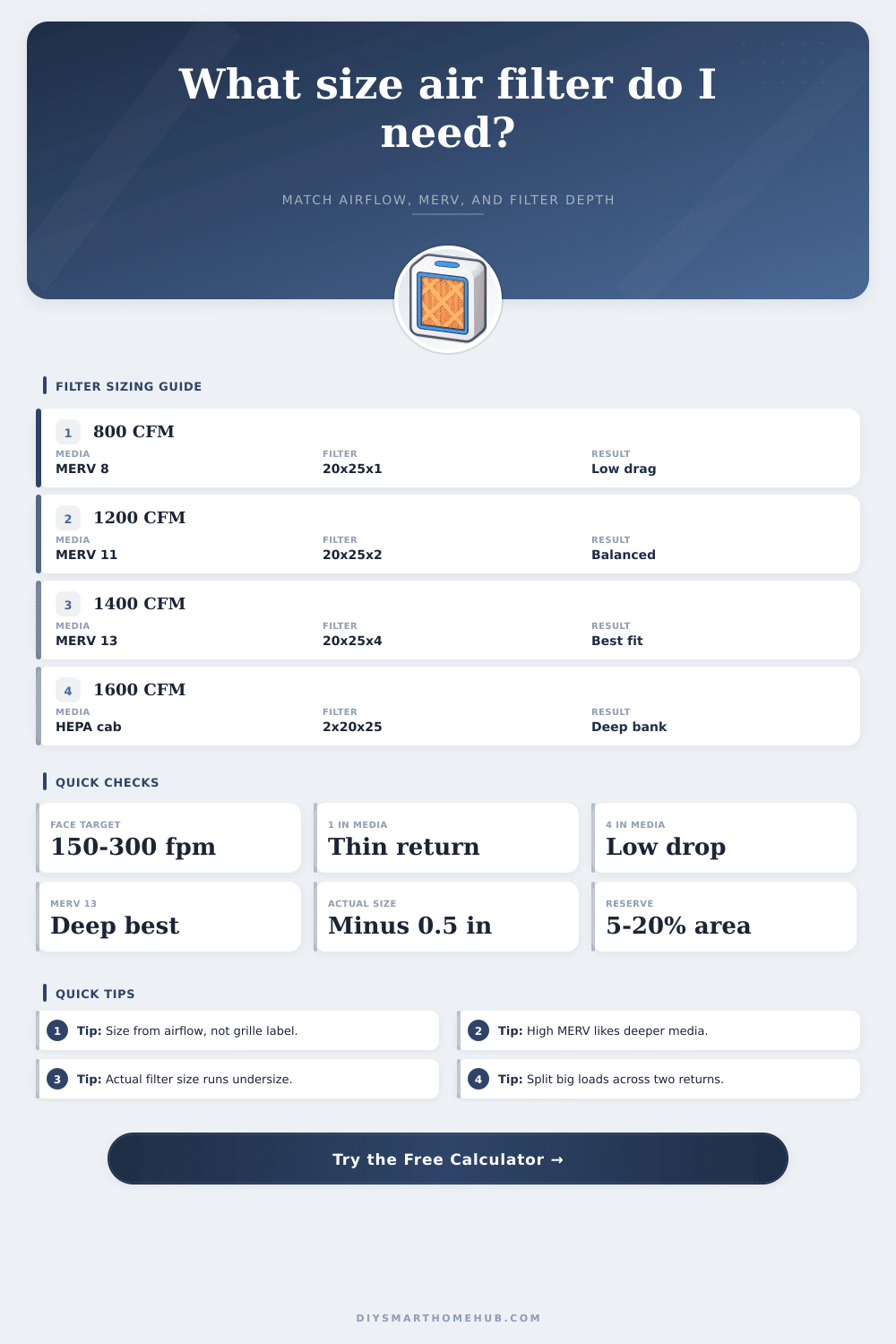
A return grille stamped 20 x 25 does not guarantee a true 20 x 25 filter face. Actual filters run undersized, so the cleanest sizing path is airflow to face area to nominal size.
As MERV climbs, usable face velocity usually drops. A 4-inch or 6-inch cabinet restores surface area through deeper pleats, which lowers filter resistance without giving up particle capture.
An air filter are a component that is included within the forced-air system. The air filter will pull the air from the HVAC system before it reach the coil or blower. It is essential to choose the apropiate air filter for you HVAC system.
If the air filter are too small for the HVAC system, the face velocity and air resistance within the system will increases, forcing the HVAC system to work harder to move the air through the system. Conversely, if the air filter is too large for the HVAC system, it is possible of wasting money on purchasing an air filter that are not necesary for the HVAC system. Face velocity is the measurement of the speed at which air move over the air filter.
How to Choose the Right Air Filter for Your Home
For residential HVAC systems, the face velocity should be between 150 and 300 feet per minute. A lower face velocity is used for air filters with dense media; the higher the face velocity of air moving over the air filter, the more quick the pressure drop will increase due to the accumulation of dust on the air filter. Air filters with thin fiberglass media allow air to easy pass through the media, while air filters with dense pleated media create more resistance to the movement of air.
A deeper air filter, such as a four inch air filter, can be used to increase the surface area of the air filter without taking up as much space within the HVAC cabinet. The nominal size of an air filter is not the same as the actual dimensions of the air filter. The nominal size is the size of the air filter that are labeled on the air filter.
The actual dimensions are slightly smaller than the nominal size of the air filter. For example, a nominal size of the air filter could be 20 by 25 inches, but the actual dimensions of the air filter may only be 19.5 by 24.5 inches. If you uses the actual dimensions of the air filter in the calculation of the face velocity, the results will be incorrect.
By splitting the air across two return air grille, the face velocity can be reduced. The amount of air that flow through a homes HVAC system determines the required size of the air filter. Many home require between 350 and 450 cubic feet of airflow per minute for every ton of air conditioning capacity.
The total amount of cubic feet of airflow that is required for a home must be calculated. Based off the size of the air filter that is installed into an HVAC system, the pressure drop of the air filter should not drop below 0.08 inches water column. In other HVAC systems, however, the pressure drop should not exceed 0.20 inches water column.
For homes with high ceilings or that may encounter dusty environments, more surface area for the air filter are required to avoid excessive rises in the static pressure of the air filter. The media that is used within an air filter can also impact the amount of air that pass through the air filter. Air filters that use fiberglass media allow air to easy pass through the media.
Pleated air filters that have a MERV of 13 allow for finer particles to be filtered but create more resistance to the airflow. Air filters that contain carbon media will allow odors to be reduced but will create more resistance to the movement of air through the air filter. HEPA air filters allow the air filter to capture the finest particles.
For these air filters, the face velocity should be the lowest. Thicker air filter, such as four-inch or six-inch air filters allow for more airflow and lower pressure drop within the HVAC system. To select the proper air filter for the home, there are steps that can be followed.
First, determine the amount of airflow that is required for the air conditioning system in the home. Calculate the number of air filter that will be used in the home and the depth of the media that will be used in the air filters. Based on the type of air filtration that is required for the home, select the media that will be used within the air filters.
Lastly, calculate the nominal size of the air filter that will provide the necesary surface area for the airflow and the HVAC system. By monitoring the air filter with a manometer, if the pressure drop reaches 0.25 inches water column, the air filter should of been resized to a larger and deeper media type for the HVAC system.