AGM Battery Charge Time Calculator
Estimate AGM recharge duration from capacity, state of charge, charger amps, bank voltage, temperature, and absorption taper.
🔋Real AGM Battery Presets
⚙Battery And Charger Inputs
📊AGM Spec Grid
📐AGM Battery Type Reference
| AGM type | Typical use | Reference current | Absorption behavior |
|---|---|---|---|
| Standby AGM / UPS | Alarm panels, UPS packs, emergency lighting | 0.10C to 0.20C | Longer taper near full charge |
| Deep-cycle AGM | Solar storage, RV house banks, marine loads | 0.15C to 0.30C | Moderate taper after about 80% SOC |
| Thin plate pure lead AGM | High-performance backup and vehicle starting | 0.20C to 0.40C | Accepts higher current when cool and healthy |
| Marine dual-purpose AGM | Boat electronics plus engine starting reserve | 0.15C to 0.30C | Moderate taper with voltage-regulated chargers |
| Mobility / scooter AGM | Wheelchairs, scooters, medical mobility packs | 0.10C to 0.25C | Gentler charge profile for paired 12V blocks |
| Telecom front-terminal AGM | 48V racks and cabinet backup strings | 0.10C to 0.25C | Designed for float service and controlled recharge |
⚡Charger Current And Time Reference
| Battery size | 5A charger | 10A charger | 20A charger | 40A charger |
|---|---|---|---|---|
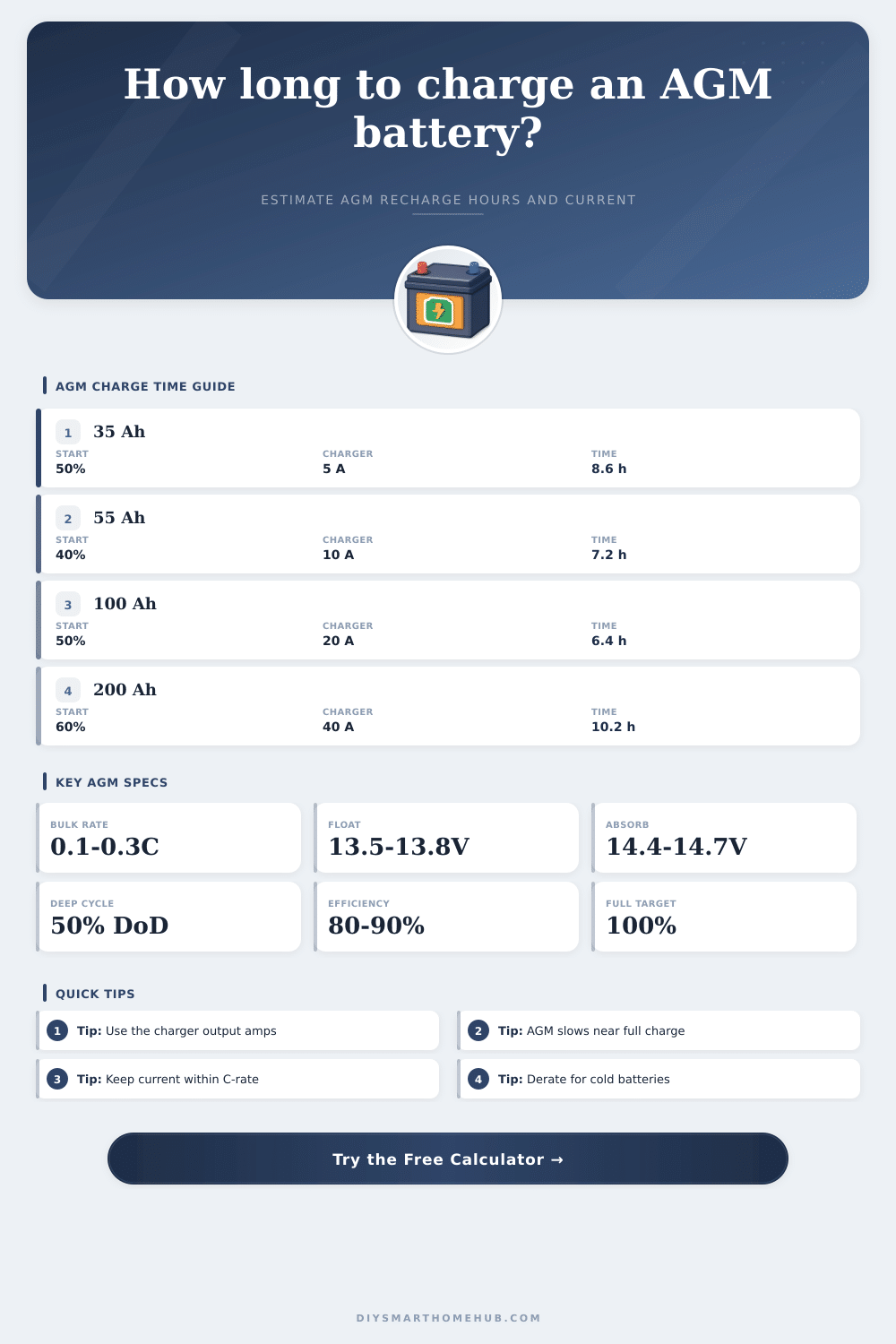
| 35 Ah AGM from 50% | About 8.6 h | About 5.1 h | Check battery limit | Check battery limit |
| 55 Ah AGM from 50% | About 13.5 h | About 8.0 h | About 5.2 h | Check battery limit |
| 100 Ah AGM from 50% | About 24.5 h | About 14.4 h | About 9.3 h | About 6.8 h |
| 200 Ah AGM from 50% | About 49.0 h | About 28.8 h | About 18.6 h | About 13.5 h |
Reference times assume 85% efficiency, normal temperature, and a full-charge absorption taper. Actual chargers may hold absorption until current falls to a termination threshold.
🌡Temperature And Voltage Reference
| Condition | Battery temperature | Current factor | 12V charging notes |
|---|---|---|---|
| Normal | 20-25°C / 68-77°F | 1.00x | Absorption often 14.4-14.7 V, float 13.5-13.8 V |
| Cool | 10-20°C / 50-68°F | 0.90x | Charging may take longer; temperature compensation raises voltage |
| Cold | 0-10°C / 32-50°F | 0.72x | Accepted current falls; some chargers reduce or extend absorption |
| Hot | 30-40°C / 86-104°F | 0.85x | Temperature compensation lowers voltage to reduce gassing risk |
📋Common AGM Battery Scenarios
| Preset | Bank | Starting SOC | Charger | Typical result |
|---|---|---|---|---|
| Alarm backup | 12V 7Ah | 40% | 1A | Small standby recharge |
| UPS battery | 12V 18Ah | 30% | 2A | Slow full recovery after outage |
| Marine AGM | 12V 100Ah | 50% | 20A | Half-depth-cycle recharge |
| Solar bank | 12V 200Ah | 60% | 30A | Daytime generator or charger top-up |
| Server backup | 48V 100Ah | 70% | 25A | Rack battery recovery estimate |
🛠Calculation Tips
AGM batteries dont charge at a constant speed, but instead, the batteries slow down the rate at which they is charged as they reach a full state of charge. Most individuals intuitively understand that battery chargers work to deliver a steady amount of power to a battery until it reaches full strength. However, AGM batteries require some change to the way in which batteries are charged in order to reach full strength.
This change is called absorption taper. During the bulk stage of charging, AGM batteries allow for a high amount of current to be delivered to the battery. This bulk stage of charging is the fastest stage of charging for the batteries.
How AGM Batteries Charge and What Affects Charging
However, when the AGM battery reaches certain voltage levels, the battery is unable to take in as much current as it did during the bulk stage of charging. Thus, the charger must hold a certain voltage for the battery, but the current decreasingly supplied to the battery is what slows the charging of the battery over such a long time period. The state of charge is a measurement of the amount of energy stored within the AGM battery at any given time.
To accurately determine the state of charge of an AGM battery, individuals must take certain step. One of the most common method of determining the state of charge is with a voltmeter; however, voltmeters are often inaccurate in their measurement of state of charge due to the way that AGM batteries can hold a charge on the surface. When AGM batteries hold a charge on the surface, the batteries may register with voltmeters as having a more high level of charge than they truly have.
An AGM battery that is often discharged to low level will take longer to charge than an AGM battery that is not often deeply discharged. Deep discharging of an AGM battery places more stress upon the chemistry of the battery with respect to charge than shallow discharge. Efficiency is another factor to consider in the charging of AGM batteries.
Efficiency as it pertains to AGM batteries is best understood as the concept that the energy that is stored within the battery is not the same than the energy that is supplied to the battery. Some of the energy that is supplied to the AGM battery is lost as heat, and some of the energy is used to initiate the chemical reaction that occur within the battery. Thus, in order to effectively supply energy to an AGM battery, individuals must supply more energy to the battery than the amount of energy that the battery stores.
If an AGM battery requires a ten amp-hour capacity, the battery will require more than ten amp hour of energy to effectively charge the battery. The C-rate for AGM batteries is the ratio of the amount of current supplied to the battery in relation to the total capacity of the battery. The C-rate is a measurement of the amount of stress that is placed upon the battery.
If an individual supplies a significant amount of current to a battery with a small amount of total capacity, the C-rate will be high. High C-rates can lead to increases in the internal temperature of the battery. Because AGM batteries are sealed, any outgassing of the batterys contents cannot escape the battery as it can with other form of batteries.
As a result, high C-rates may cause the AGM battery to swell or to lose its charging capacity entirely. To avoid such problems, ensure that the setting to the battery charger are within the reference limits for the battery. The temperature of the environment in which the AGM battery is charged can also impact the charging process.
Changes in the temperature of the environment in which the battery is charged change the internal resistance of the battery. When the temperature of the environment in which the battery is located drop, the internal resistance of the AGM battery increase. Increased internal resistance of the battery makes it so that the battery accepts the current that is supplied to the battery at a slower rate.
Thus, when AGM batteries are charged in cold environment, the charging process takes place at a slower rate. Conversely, environments with high temperatures allow the AGM battery to accept the supplied current at a faster rate, although too high of temperatures can also lead to the battery overheating if the charging voltage is set too high. Lastly, not all AGM batteries are created equal, and, therefore, different type of AGM batteries have different charging requirements.
For instance, manufacturers create standby AGM batteries to allow for long periods of float charging, but they create deep cycle AGM batteries to be deeply discharged and charged. Because of the differences in these batteries, the point at which absorption taper is initiated can differ for each type of AGM battery. If the user adjusts the settings for the battery charger according to the type of AGM battery that is being used, the charger will avoid guesswork with charging the batteries.
Finally, as with any process, overcharging and undercharging the battery will have negative impact upon its chemistry. Undercharging AGM batteries can lead to the formation of sulfation, while overcharging can damage the electrolyte within the battery.