Arc Flash Clothing Calculator
Estimate planning incident energy, minimum ATPV category, clothing arc-rating margin, exposure factor, and conservative layered PPE notes for common electrical work tasks.
📌Work Task Presets
⚙Arc Flash Inputs
Arc flash clothing result
Results update when task, electrical, and PPE inputs change.
🧥Clothing / PPE Spec Grid
Minimum arc rating for lower-energy daily electrical interaction.
Common shirt and pants or coverall threshold.
Higher-energy suit systems with matching head and hand PPE.
Heavy arc flash suit system range for severe exposures.
📊Minimum ATPV Category Table
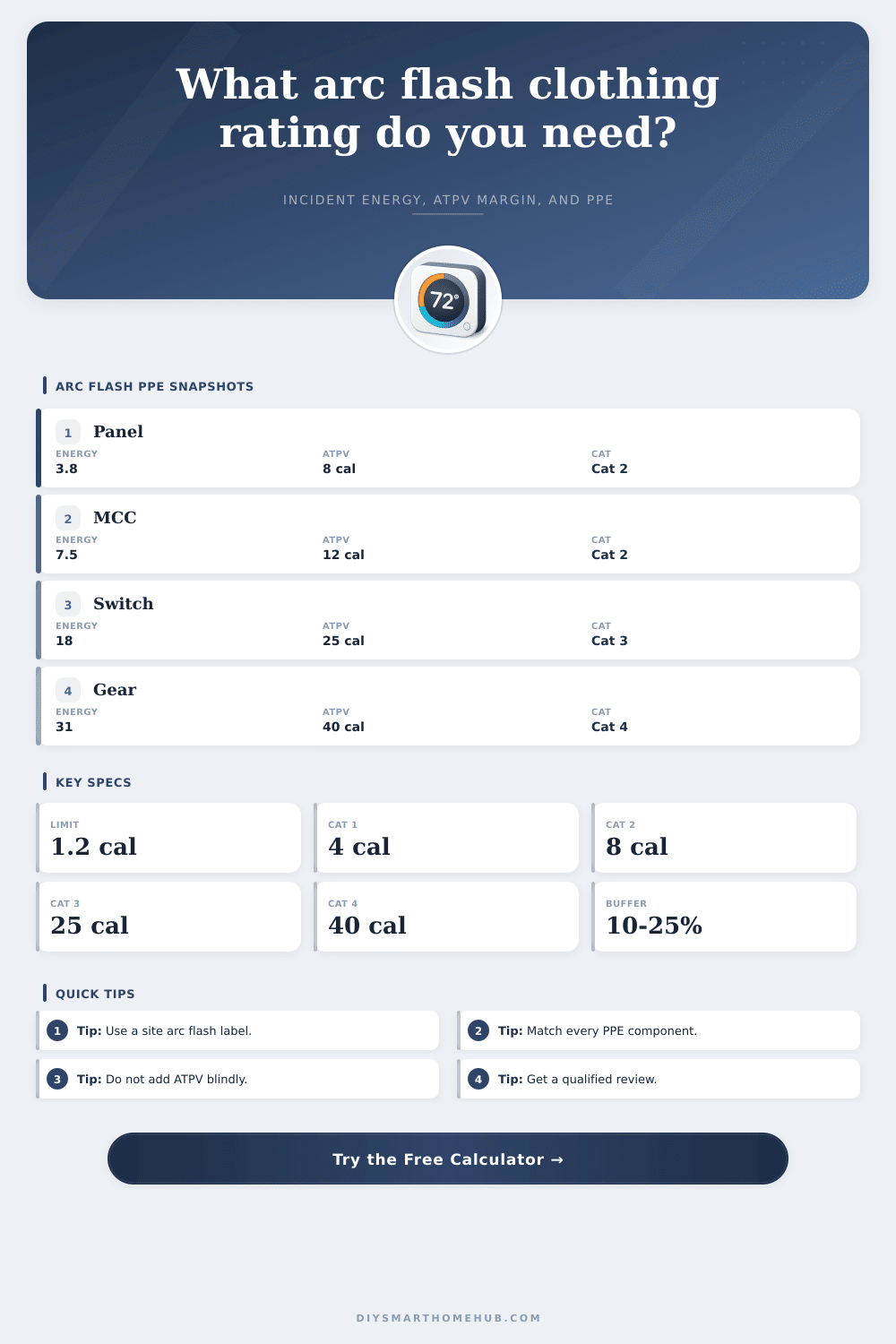
| Calculated incident energy | Minimum arc rating | Planning category | Typical clothing signal |
|---|---|---|---|
| Less than 1.2 cal/cm2 | Site policy minimum | Below arc PPE threshold | Arc-rated PPE may still be required by task policy |
| 1.2 to 4 cal/cm2 | 4 cal/cm2 ATPV | Category 1 | Arc-rated shirt and pants or coverall |
| More than 4 to 8 cal/cm2 | 8 cal/cm2 ATPV | Category 2 | Arc-rated daily wear plus face protection |
| More than 8 to 25 cal/cm2 | 25 cal/cm2 ATPV | Category 3 | Arc flash suit system and hood range |
| More than 25 to 40 cal/cm2 | 40 cal/cm2 ATPV | Category 4 | Higher-rated suit system with full component match |
| More than 40 cal/cm2 | Engineered review | Above Cat 4 table | Reduce hazard, remote operate, or re-study before work |
📐Incident Energy Model Factors
| Input | Calculator formula role | Higher value effect | Field data source |
|---|---|---|---|
| Arcing current | kA arc = bolted kA x arcing factor | Raises incident energy | Arc flash study or protective device analysis |
| Clearing time | Energy scales with seconds to interrupt | Raises incident energy quickly | Fuse curve, breaker trip unit, or relay settings |
| Working distance | Energy scales by (18 / distance)^1.6 | Closer distance raises exposure | Task posture and equipment label |
| Enclosure and gap | Multiplier for concentration and spacing | Enclosed gear can concentrate energy | Equipment type and bus spacing |
| Task duration | Exposure factor for work interaction | Longer task raises task risk note | Planned energized work step |
This worksheet is a planning estimator. Use a formal arc flash study and the equipment label for work authorization and final PPE selection.
🧰Layering And Component Table
| Layer situation | Calculator treatment | Reason | Planning note |
|---|---|---|---|
| Single arc-rated layer | Uses entered base ATPV | Simple label comparison | All worn components still need matching ratings |
| Manufacturer tested system | Base + 85% of outer layer | Allows partial stacking credit | Use actual system label if it differs |
| Non-tested mixed layers | Base + 60% of outer layer | Conservative derate for uncertainty | Do not simply add garment labels |
| Accessory rating lower than clothing | Flags lowest component margin | Weakest component can govern protection | Check hood, face shield, gloves, and balaclava |
📋Common Work Task Reference
| Preset | Electrical profile | Default PPE rating | Expected result band |
|---|---|---|---|
| Meter verification | 208 V, low fault current, 3 cycles | 4 cal/cm2 | Category 1 planning range |
| Panel diagnostics | 480 V enclosed panel, 6 cycles | 8 cal/cm2 | Category 2 planning range |
| MCC bucket work | 480 V MCC, moderate fault current | 12 cal/cm2 | Upper Category 2 planning range |
| Fused switch work | 600 V switch, longer clearing | 25 cal/cm2 | Category 3 planning range |
| Switchgear racking | 480 V gear, high current | 40 cal/cm2 | Category 4 or engineered review |
💡Practical Tips
Matching clothes ratings to amount of energy (burst) that you might be exposed to in the event of a fault is crucial to arc flash protection, not just grab the heaviest jacket possible. The calculator above removes guesswork out of coefficients by doing the math for you based off your fault information and voltage info.
Before you believe the numbers, you have to know what they mean and that starts with understanding concept of incident energy, the amount of heat per square centimeter of your skin during a fault. There are only two variable involved in this calculation, arcing current (not the same as the bolted fault current on your study report), and distance from equipment. Because there is a resistance in an arc, when it jumps across the gap, the current will decrease and the tool accounts for this with what they calls the arcing factor. If you apply full bolted current but do not account for that resistance, you are going to massively overestimate the risk. This is because it is simply wrong information. It’s not conservative planning.
How to Choose the Right Protection Clothes
The other is time; energy are equal to power times time. Most facility assume a worst-case clearing time to maintain safety under uncertainty. This is why most facility labels assumes a worst-case clearing time to keep everyone safe under uncertainty. But what if you knew your relays were set for a faster clearing time? You’ll be able to choose less strict PPE and note that the threshold for each category change with increasing levels of energy. That’s the whole point of the reference table: knowing your relays are fast means you can step down a category (from Category 3 to Category 2) based off this information alone.
Other factors such as working distance also influence level of risk posed by electricity, which acts more like heat or light than a static danger. The amount of energy depend on how close your torso and face are to the bus bars. If you move two feet away, intensity decreases. This is why you use the calculator. The closer you get to the MCC bucket with your hands reaching deep into it, versus standing outside the door of that switchgear, the more intense the energy become, and that is your body position changing your risk profile just as much as the piece of equipment.
So how does this work with clothing? Adding together the ATPVs of the items you’re wearing doesn’t really work because fabric isn’t linear like that: stacking affects its performance and heat transfer patterns becomes different. Therefore, manufacturers don’t rate mixed fabrics as systems. Instead, they apply a conservative decrease for non-tested items. This is why it’s important to look at the lowest-rated item in your outfit. If you have a rated shirt but pair it with an untested rain jacket, for example, that jacket may not block heat but actualy trap it next to your body. While a heavy-duty suit can help you out, it won’t save you if your gloves rip off or your face shield cracks. You should of used better gear.
The bottom line: This calculator isn’t a permit. It’s not even a permit request. Instead, it’s a way to see how far away from an identified hazard your protection margin is; it’s a planning aid that’ll help you see where there is enough of a gap. But when you get there, always look at the equipment label first. If it reads forty calories per square centimeter, you ain’t getting outta there unless you have engineered controls, no matter what layering tricks you try.)
The goal is always to leave with a little bit more skin than you came in with; use the tool to understand the physics of the blast first and then dress for it.